A plastic recycling business takes waste plastic and turns it into raw materials that manufacturers can use. Mechanical recycling shreds, washes, dries and extrudes sorted plastic into recycled flakes, granules and pellets. Chemical recycling breaks the polymer down into monomers as pure as new material — BHET or TPA from PET, Caprolactam from Nylon-6, and Styrene monomer from Polystyrene. Registered processors also earn digital EPR credits they can sell to producers, importers and brand owners.
In India a Tier 1 collection, sorting and baling unit costs about ₹30 Lakhs to ₹50 Lakhs, a Tier 2 mechanical washing, granulation and pelletizing plant ₹90 Lakhs to ₹1.5 Crores, and a Tier 3 chemical depolymerization facility ₹2 Crores to ₹3 Crores. Mechanical lines report EBITDA margins of 22% to 30% with payback in 2.5 to 3.5 years; chemical depolymerisation plants reach 35% to 48% but take 3.5 to 5 years to pay back.
You will need company incorporation, PAN, TAN and GST, Consent to Establish and Consent to Operate from your state pollution control board, factory building plan approval, a fire NOC, a groundwater NOC where you draw water, and registration as a Plastic Waste Processor (PWP) on the CPCB EPR portal. Mechanical recycling falls in the Orange category and chemical recycling in the Red category. Individual approvals run from 15 to 30 days for a fire NOC up to 60 to 90 days for a CGWA groundwater NOC.
1. What a Plastic Recycling Business Actually Does
A plastic recycling business takes waste plastic and turns it into raw materials that manufacturers can use. This is not just about collecting rubbish. A modern recycling plant is a processing unit that connects waste streams from households or factories to industries that need quality polymers.[1]
Routes of a Plastic Recycling Enterprise
- You can get plastic waste from city collection, factory scrap, or informal sources. The first step is to sort it by type.
- Mechanical recycling means shredding, washing, drying, and extruding the sorted plastics. This gives you recycled flakes, pellets, or granules.
- If you need to make virgin-grade polymers, you use chemical recycling. This process breaks down the plastic into its building blocks, called monomers. For example, PET becomes BHET or TPA, Nylon-6 becomes Caprolactam, and Polystyrene becomes Styrene monomer.
- When you process plastic waste, you earn EPR creditsEPR CreditsTradable certificates that represent compliance with producer responsibility obligations for end-of-life product management.. You can sell these to Producers, Importers, and Brand Owners (PIBOsPIBOsEntities responsible for managing end-of-life waste from their products under EPR regulations.) who need them to meet their Extended Producer Responsibility targets.
- You earn money in two ways: by selling your recycled products and by selling EPR credits.
Mechanical vs. Chemical Recycling Pathways
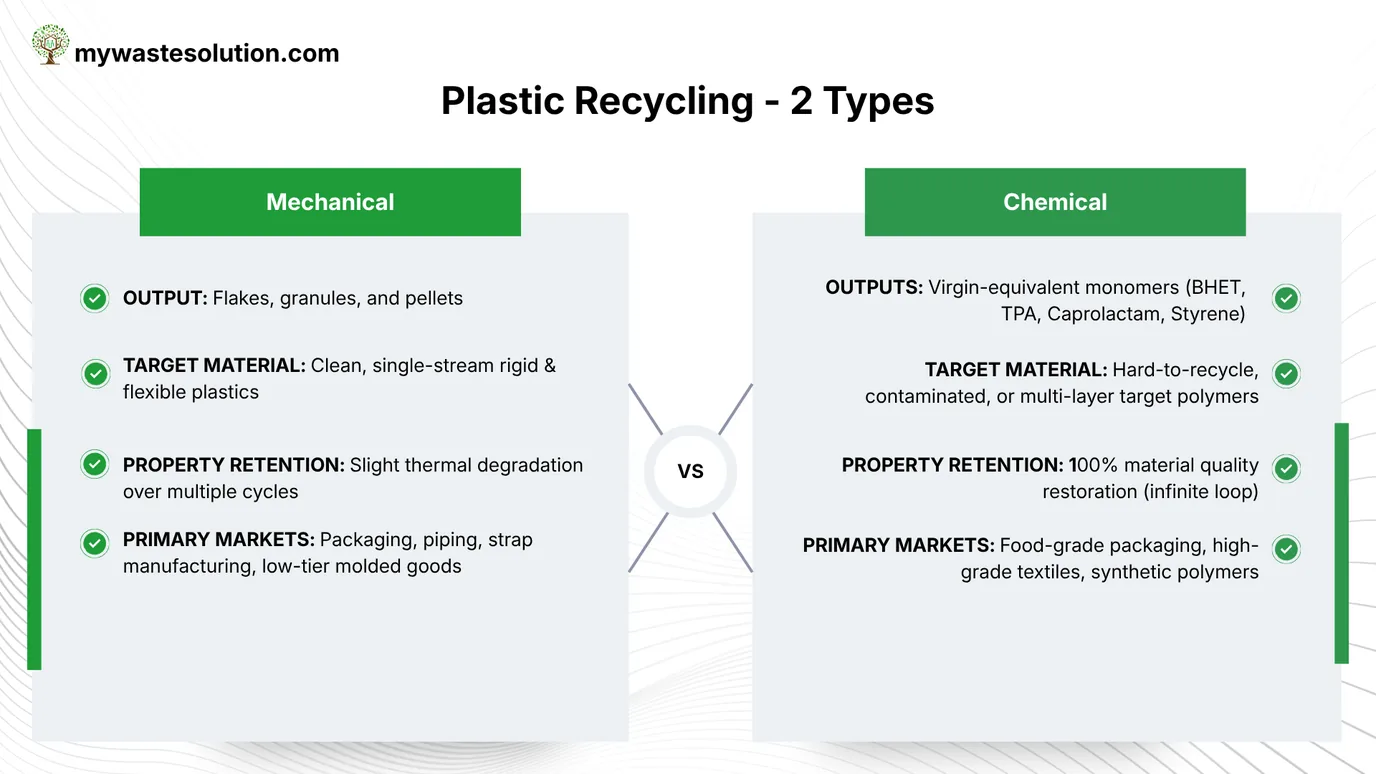
| Feature | Mechanical Recycling | Chemical Recycling (Depolymerization) |
|---|---|---|
| Output | Flakes, granules, and pellets | Virgin-equivalent monomers (BHET, TPA, Caprolactam, Styrene) |
| Target Material | Clean, single-stream rigid and flexible plastics | Hard-to-recycle, contaminated, or multi-layer target polymers |
| Property Retention | Slight thermal degradation over multiple cycles | 100% material quality restoration (infinite loop) |
| Primary Markets | Packaging, piping, strap manufacturing, low-tier molded goods | Food-grade packaging, high-grade textiles, synthetic polymers |
2. Plastic Recycling Plant Cost in India: Full Breakdown
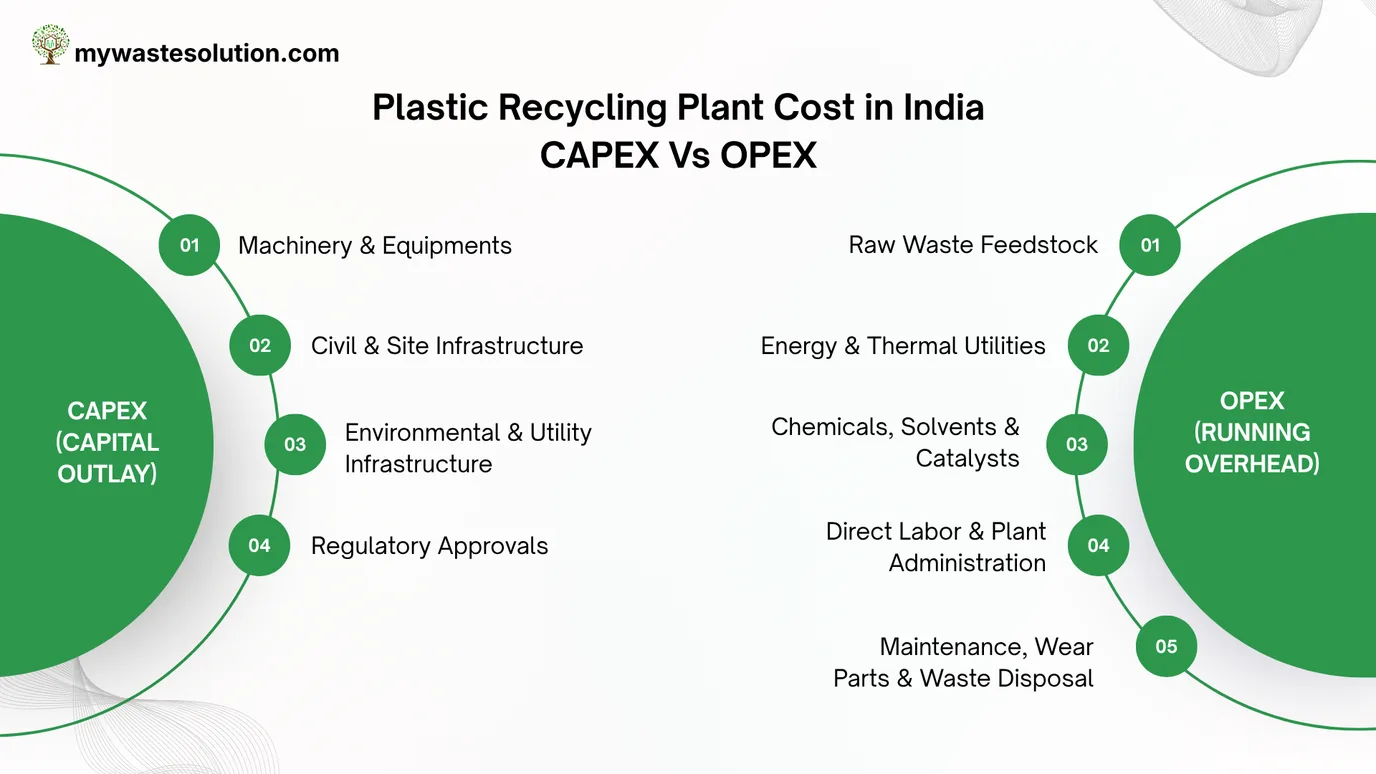
When you check if a plastic recycling plant can make money, start by separating the upfront capital cost from the ongoing operating cost. The balance between these two changes a lot depending on the type of plant you choose and what you plan to sell.
Factors driving your plastic recycling plant cost
Your CAPEX expenditure includes all fixed and non-recurring investments required to get your plant fully commissioned.[2]
- Machinery and Equipments (40% – 50% of CAPEX):
- Mechanical Line: Granulators, optical sortersOptical SorterEquipment that uses optical sensors and compressed air to separate materials by their visual and spectral characteristics., friction washing tanks, and degasified extruders.
- Chemical Line: C22/Hastelloy alloy reactors, fractional distillation columns, batch crystallizersBatch CrystallizerChemical reactor that produces crystals from solution in timed batches rather than continuous operation., and solvent recovery systems.
- Civil and Site Infrastructure (20% – 25% of CAPEX): Factory shed construction, heavy dynamic machinery concrete foundations, raw scrap storage yards, and fire safety zones.
- Environmental and Utility Infrastructure (15% – 20% of CAPEX): High-voltage transformer sub-stations (2.5 MW–3.5 MW), Zero Liquid Discharge (ZLD)Zero Liquid Discharge (ZLD)Wastewater treatment approach that recycles all water and concentrates waste into solids, with no liquid discharge. or Effluent Treatment Plants (ETP), and wet scrubber air filtration systems.
- Regulatory Approvals (5% – 10% of CAPEX): SPCB/CPCBCPCBCentral Pollution Control Board — India's apex statutory body for environmental regulation, constituted under the Water Act, 1974. CTE-CTO fees, CGWA groundwater approvals, factory plan approvals, detailed engineering studies, and initial commissioning trials.
OPEX represents the ongoing variable and fixed costs needed to keep the factory running daily.[3]
- Raw Waste Feedstock (45% – 55% of OPEX): The single largest operational cost. Price fluctuates based on bale purity, seasonal supply, post-consumer vs. post-industrial packaging, and transport distance (inbound logistics).
- Energy and Thermal Utilities (15% – 25% of OPEX): Heavy power for high-torque shredder drives, extruder barrel heaters, vacuum pumps, and distillationDistillationA clean-up step that separates the crude pyrolysis oil into narrower, higher-value fractions, giving a cleaner diesel-like fuel that sells for more. reboilers.
- Chemicals, Solvents and Catalysts (8% – 12% of OPEX): Solvents (Ethylene Glycol / Methanol), reaction catalysts (Zinc Acetate / Ionic Liquids), and washing additives (Caustic Soda / Surfactants). Solvent loss percentage during recovery directly impacts daily margins.
- Direct Labor and Plant Administration (8% – 10% of OPEX): Shift operators, sorting line managers, maintenance engineers, and NABL lab quality-control chemists.
- Maintenance, Wear Parts and Waste Disposal (5% – 8% of OPEX): High-wear consumable replacements (shredder bladesShredder BladeCritical cutting component in shredding machines for reducing waste material size in recycling operations., melt filter screens, mechanical seals), ETP chemical sludge disposal, and TSDF hazardous waste dispatch (Form 10).
Capital Expenditure (CAPEX) Budgeting
Below is a detailed CAPEX breakdown across the three recycling tiers. Estimates are benchmarked against standardized capacity scales in India:
Tier 1: Collection, Sorting and Baling Unit
- Estimated Investment Range: ₹30 Lakhs – ₹50 Lakhs
- Target Output: Sorted plastic bales, crushed regrind, and classified scrap.
| Head / Category | Cost Share (%) | Estimated Budget (₹ Lakhs) | Major Included Items |
|---|---|---|---|
| Land and Civil Infrastructure | 30% | ₹10L – ₹15L | Lease deposit, shed, concrete flooring, loading bays. |
| Machinery and Processing Lines | 45% | ₹15L – ₹25L | Hydraulic baling press, manual/semi-auto sorting conveyors, magnetic separator, basic scrap grinder. |
| Utilities and Electrification | 12% | ₹4L – ₹6L | Power connection, wiring panels, basic dust collection fans. |
| Environmental Control | 5% | ₹1L – ₹3L | Fire extinguishers, safety barrier netting. |
| Regulatory approvals | 8% | ₹2L – ₹4L | SPCB CTE/CTO fees, MSME registration, factory plan approvals, initial site layout fees. |
Tier 2: Mechanical Washing, Granulation and Pelletizing Plant
- Estimated Investment Range: ₹90 Lakhs – ₹1.5 Crores
- Target Output: High-purity washed PET flakesPET FlakeShredded PET plastic produced from post-consumer bottles; a key intermediate in PET recycling., HDPE/PP reprocessed pellets, and masterbatch compounds.
| Head / Category | Cost Share (%) | Estimated Budget (₹ Crores) | Major Included Items |
|---|---|---|---|
| Land and Civil Infrastructure | 20% | ₹30L – ₹60L | Land cost, Industrial shed, heavy anti-vibration foundations, drainage trenches. |
| Core Machinery and Process Lines | 50% | ₹50L – ₹70L | Heavy-duty shredder, hot-washing line, friction washers, NIR optical sorters, vacuum degasified twin-screw extruders. |
| Utilities and Electrification | 15% | ₹8L - 15L | Dedicated HT transformer sub-station, MCC panels, compressed air network. |
| Environmental Control (ETP/APCD) | 10% | ₹6L – ₹8L | Multi-stage closed-loop Effluent Treatment Plant (ETP), extruder fume extraction hoods, carbon filters. |
| Regulatory approvals | 5% | ₹4L – ₹6L | SPCB Orange Category CTE/CTO fees, NABL lab setup, commissioning engineer trials. |
Tier 3: Chemical Depolymerization Facility
- Estimated Investment Range: ₹2 Crores – ₹3 Crores
- Target Output: High-purity virgin-equivalent chemical monomers (BHET/PTA/MEG) and recycled polyols.
| Head / Category | Cost Share (%) | Estimated Budget (₹ Crores) | Major Included Items |
|---|---|---|---|
| Land and Civil Infrastructure | 18% | ₹70L – ₹90L | Industrial plot, chemical shed, explosion-proof zones, blast-resistant control room. |
| Core Reaction and Distillation Lines | 48% | ₹80L – ₹1Cr | Hastelloy/SS316 depolymerization reactors, fractional distillation columns, crystallizers, solvent recovery systems. |
| Utilities and Heavy Power Grid | 16% | ₹10L – ₹20L | 2.5 MW – 3.5 MW power connection, thermic fluid heaters, high-pressure steam boilers, cooling towers. |
| Zero Liquid Discharge and CEMS | 12% | ₹8 – ₹15L | Zero Liquid Discharge (ZLD) plant with MEE/RO, wet scrubbers, Continuous Emission Monitoring (CEMS) connected to CPCB. |
| Regulatory approvals | 6% | ₹5L – ₹10 L | HAZOP analysis, PESO solvent storage clearance, SPCB Red Category CTE/CTO, detailed FEED engineering studies. |
Operational Expenditure (OPEX) breakdown
Operational costs vary significantly depending on the level of processing, thermal energy inputs, and chemical recovery required at each stage.
| OPEX Cost Factor | Tier 1: Collection and Sorting | Tier 2: Mechanical Recycling | Tier 3: Chemical Depolymerization |
|---|---|---|---|
| Raw Feedstock Procurement | High (Relative to total cost) | High | Medium (Can process lower-grade/cheaper scrap) |
| Electricity and Power Load | Low | Medium | High |
| Thermal Energy and Steam Generation | Low | Medium | High |
| Solvents, Catalysts and Chemicals | Low / None | Low | High (Glycol, catalysts, acids) |
| Direct Labor and Sorters | High (Manual sorting dependent) | Medium | Low to Medium (Highly automated) |
| Skilled Engineering and Technical Staff | Low | Medium | High (Chemical engineers and lab tech) |
| Effluent and Hazardous Waste Treatment | Low | Medium | High (ZLD operations and TSDF disposal) |
| Maintenance and High-Wear Parts | Low | Medium (Blades and extruder screws) | High (Reactors, valves and distillation) |
Financial Planning and Engineering Disclaimer: Treat the CAPEX and OPEX numbers above as a starting point for early planning. Your real costs will depend on your site, technology, local utility rates, feedstock quality, automation, and state rules. For accurate budgets and compliance, work with a qualified technical consultant, chartered accountant, or EPC vendor.
No testimonials, no client logos. The knowledge base is free and live — judge the depth yourself.
3. Which Plastic Recycling Plant to Build: ₹30 Lakh to ₹3 Crore
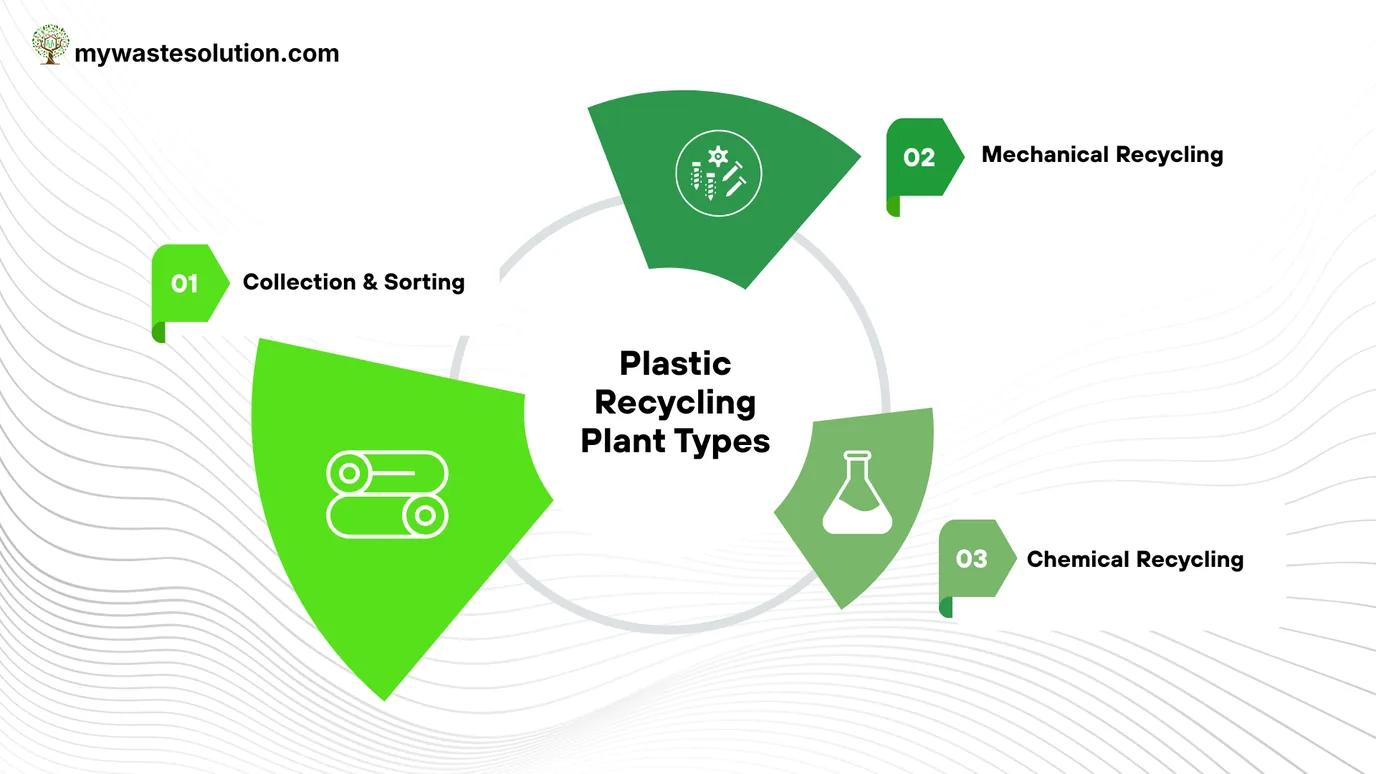
Plastic recycling runs at three main levels. These range from simple collection to breaking plastics down into their chemical building blocks.
Tier 1: Collection and Sorting
Tier 1 is the starting point for all recycling. Here, you collect and sort plastic waste by type. Sorting can be manual or use machines like optical sorters, which use near-infrared (NIR)Near-Infrared (NIR)Non-destructive spectroscopic method for rapid identification of polymer types in mixed plastic waste streams. or AI vision systems. The goal is to separate plastics by resin type, such as PET, HDPE, PP, PS, or Nylon, and by colour.
- Major Focus: You need to focus on feedstock purity, removing contamination, and collecting enough material in one place.
- Primary Output: Your main output is baled, single-type sorted plastic waste, ready for the next stage.
- Cost Profile: Capital costsCapital Cost (CAPEX)CAPEX — the money required to purchase or upgrade physical assets like equipment and facilities needed to start operations. are low to moderate. Whether this works depends on your local collection network, freight costs, and how efficiently you can sort in bulk.
Tier 2: Mechanical Recycling
Tier 2 is mechanical recycling. You change the shape of the plastic, not its chemistry. You shred the sorted plastic into flakesFlakesIntermediate plastic pieces produced by shredding sorted and washed waste, used as feedstock for recycling., then melt and extrude it to make pellets or granules.[4]
- Major Focus: The key steps are reducing the size, melting and extruding, and keeping the material's properties as close to the original as possible.
- Primary Output: You produce recycled flakes, granules, and pellets.
- Capital costs are moderate. You can get good profit margins if your feedstock is clean. The main limit is that quality drops each time you recycle, because heat damages the plastic.
Tier 3: Chemical Recycling
Tier 3 is chemical recycling. You use this for plastic waste that mechanical recycling cannot handle, or when you need to make monomers as pure as new. Chemical depolymerisationDepolymerisationChemical process that breaks plastic polymers back into monomers (e.g. TPA + EG from PET), enabling production of virgin-quality recycled resin — contrasted with pyrolysis, which produces mixed fuel oil. breaks plastics down into monomers and removes colour, additives, and impurities. The output is chemical building blocks that can be reused many times without losing quality.[5]
- Major Focus: You run chemical reactions, recover solvents, and extract and purify monomers using distillation or crystallisationCrystallisationProcess of forming ordered solid crystals from solutions, melts, or gases to recover and purify materials..
- Primary Output: You produce pure monomers such as BHET or TPA from PET, Caprolactam from Nylon-6, and Styrene monomer from Polystyrene.[6]
- Capital costs are high: This process is more technically complex, but the output can sell at a premium for food-contact and high-grade industrial uses.
Each chemical output pathway is a separate plant type. Each reaction needs its own chemical process, catalyst, and purification steps. For example, a plant built for PET glycolysisPET GlycolysisChemical depolymerization of PET waste into monomers for closed-loop plastic recycling. cannot process Nylon-6 or Polystyrene.
Deciding between the three tiers is where most projects go wrong; plastic recycling consultants size and price each one against real feedstock.
4. Plastic Recycling Licences in India: CTE, CTO and EPR
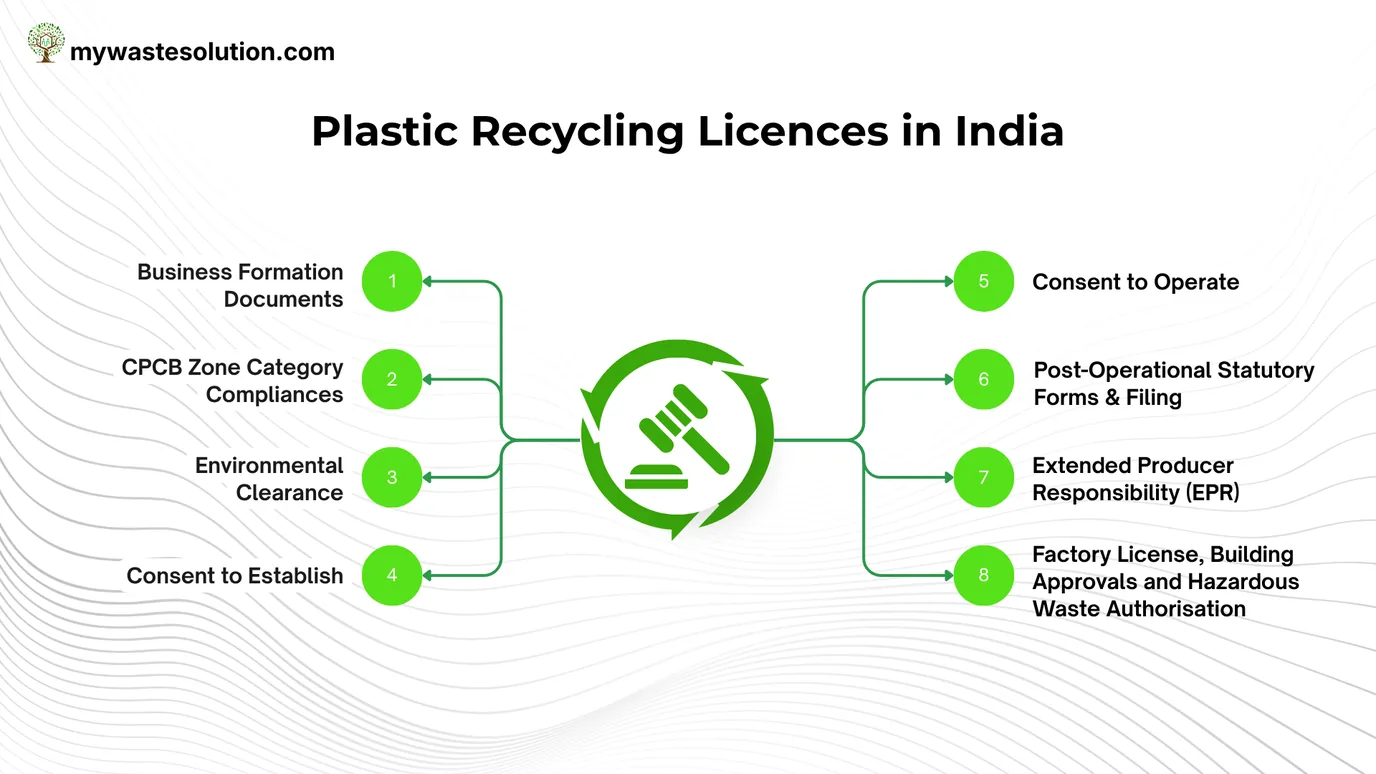
Business Licences you will need
Before you apply for factory or environmental permits, you need to set up your company and register with the tax authorities. This is the first step for any formal plastic recycling unit in India.
- Company IncorporationCompany IncorporationLegal registration of a business as a distinct corporate entity required for waste-to-value operations in India. (COI): Issued by the Ministry of Corporate Affairs (MCA) to establish the legal entity as a Private Limited, LLP, or Partnership Firm. It provides legal authorization to enter the market supply chain and secure institutional loans.
- PANPANSynthetic polymer whose industrial waste can be recycled into fibers and nonwoven materials through solvent-based processing. and TAN: You must have a Permanent Account Number (PAN) for all financial transactions. You also need a Tax Deduction Account NumberTax Deduction Account NumberUnique identifier required for tax deduction and collection at source compliance in India. (TAN) if your business will deduct tax at source (TDS) when buying raw plastic scrap or paying contractors.
- GST Registration: GST registration gives you a 15-digit GSTIN. You need this to sell processed plastic flakes, pellets, or monomers anywhere in India and to issue official tax invoices. GST invoices are required to generate EPR credits.
- Udyam / MSME RegistrationMSME RegistrationDigital self-declaratory registration process that grants enterprises formal recognition and access to government schemes and financial support. (Optional): This is a government registration under the Ministry of MSME. It classifies your plant as a Micro, Small, or Medium Enterprise. With this, you can access capital subsidies like the SPICE scheme and get priority sector loans from banks.
- DPIIT Startup India RecognitionDPIIT Startup India RecognitionGovernment recognition that provides tax exemptions and compliance support to eligible Indian startups. (Optional): This registration is for innovative recycling startups, especially those using advanced depolymerisation. It offers a 3-year tax holiday, faster patent clearances, and simpler public procurement compliance.
- Current Bank Account and Board Resolution: You need to open a dedicated corporate bank account. Use your COI, PAN, and address proof. This account is required to manage capital expenses, day-to-day finances, and any grant payments.
- IEC (Import Export CodeImport Export CodeA mandatory 10-digit registration code required by Indian customs for all import and export activities.): The Directorate General of Foreign Trade (DGFT) issues a 10-digit Import Export Code (IEC). You must have this code if you plan to import or export any goods.
Environmental Compliances
The Central Pollution Control Board (CPCB) uses a Pollution Index (PI) to classify industrial units. The PI is a score from 0 to 100, based on your air emissions, wastewater, and hazardous waste.
Red Category: PI ≥ 80
Orange Category: 55 ≤ PI < 80
Mechanical Recycling — ORANGE category
- S.No. 152.1 Manufacturing of flakes/staple fibre/strip from recycling of PET bottles (PI 64)
- S.No. 152.2: Plastic waste reprocessing/recycling (manufacturing of flakes/granules — mechanical) (PI 55).
Chemical Recycling — RED category
- S.No. 111.1: Organic chemicals including halogenated hydrocarbons (using solid/liquid fuel) (PI 93.6)
- S.No. 111.2: Organic chemicals including halogenated hydrocarbons (using cleaner fuel) (PI 92.1)
Your category decides how often the state inspects your plant, where you can build, and how long your consent is valid. You must get Consent to Establish (CTE) from the State Pollution Control Board (SPCB) before you start any construction or install machinery.
To apply for CTE, you need the following:
- Land Allotment Letter / Registered Lease Agreement and Site Layout Plan showing civil layout.
- Detailed Project Report (DPR) covering raw material balance, utility loads, and manufacturing flowcharts.
- Chartered Accountant (CA) Certificate certifying projected capital investment in plant and machinery.
- Proposed Effluent Treatment Plant (ETP) and Air Pollution Control Device (APCD) engineering designs.
- Company Incorporation proofs (COI, PAN, GST, Board Resolution).
CTE is valid for 10 years for orange category plants and 5 years for red category plants. If you do not finish construction within this period, you must reapply for CTE and complete the work within the new validity.
Pre-Operational Factory Approvals
- Factory Building Plan ApprovalFactory Building Plan ApprovalRegulatory approval of building plans before industrial construction can legally commence.: The State Inspectorate of Factories issues this approval when your plant design meets the structural stability and safety standards in the Factories Act.
- Provisional Fire NOCFire NOCMandatory fire safety approval required before a waste-to-value facility can legally operate.: The State Fire and Rescue Department gives this provisional NOC if your proposed fire suppression systems meet their requirements.
- High-Tension (HT) Industrial Power Sanction: The State Electricity Board approves and allocates dedicated grid power for your plant. Most recycling plants need less than 11 kV to meet manufacturing demand.
- Groundwater Extraction NOCGroundwater Extraction NOCRegulatory permit required to legally extract groundwater for industrial operations in India.: The Central Ground Water Authority issues this NOC. It allows you to extract a set volume of groundwater for your plant's processing and utility needs.
- Municipal Industrial Trade License: You need this license from your local municipal or village authority to run a manufacturing business at your site's jurisdiction.
- Solvent Storage ApprovalSolvent Storage ApprovalRegulatory permission required for solvent storage facilities, mandating compliance with safety and environmental standards. (PESO): This approval covers the layout, storage limits, and handling rules for bulk volatile organic solvents at your plant.
After you finish civil work and commission your machinery, you must apply for Consent to Operate (CTO). The State Pollution Control Board (SPCB) will inspect your plant to check that your Effluent Treatment Plant (ETP) and Air Pollution Control Device (APCD) are working as planned. You need the following documents for your application:
- Copy of the granted Consent to Establish (CTE).
- ETP / STP treated water test analysis report and air emission stack monitoring report.
- Proof of installation of water/electricity meters and monitoring sensors.
- Final CA Certificate certifying actual expenditure incurred on plant and machinery.
- Final Fire Safety Certificate / Final Fire NOC.
CTO is valid for 10 years for orange category plants and 5 years for red category plants. This is your operational licence period. The State Pollution Control Board charges a consent fee each year, based on your Gross Capital Investment.
You can pay this fee in two ways:
- Advance One-Time Payment (Most Common): You can pay the full fee upfront for the entire validity period (e.g., 5 years of fees at once for Red, or 10 years at once for Orange) at the time of CTO issuance/renewal.
- Annual Installments: Yearly fee to be paid before the specified annual due date while keeping the same continuous 5-year or 10-year CTO license active.
Submit CTO renewal applications at least 60 to 90 days before the CTO expiry date.
After CTO approval and once your plant starts running commercially you need to start filing Statutory Forms without fail, such as,
- Form 3: Daily Onsite Hazardous Waste Register
- Form 10: 7-Copy Hazardous Waste Transport Manifest
- Form IVForm IVQuarterly waste management compliance report submitted to Central Pollution Control Board or State boards. (PWM): Plastic Recycler Annual Return (submitted by April 30)
- Form 4: Hazardous Waste Annual Return (submitted by June 30)
- Form VForm VAnnual waste management declaration filed with pollution control boards to demonstrate Extended Producer Responsibility compliance.: Annual Environmental Statement Audit Return (submitted by September 30)
Extended Producer Responsibility (EPR) Registration
Once you have the Consent to Operate (CTO), register as a Plastic Waste Processor (PWPPWPPlastic Waste Processor — a CPCB-registered category under India's Plastic Waste Management Rules that allows plastic recyclers to issue EPR certificates and participate in the EPR credit market.) on the CPCB EPR digital portal. You need to upload specific documents to generate EPR credits.
- These include your active CTO, plant capacity details, process videos or flowcharts, and clear photos of your plant.
- You also need to provide raw material purchase invoices, electricity and water bills, and sales receipts for your end products.
CPCB reviews your documents and issues EPR credits based on the quantity of waste you process. You can sell these credits directly to producers and brand owners (PIBOs) as a revenue source. If you do not upload all required GST invoices and supporting documents, CPCB can cancel your EPR license, and you may face penalties.
EPR authorisation consultants file the PWP registration and the annual returns for operators who would rather not.
Approval Timelines
| Statutory Body | Mandatory Approval | Processing Time |
|---|---|---|
| State Pollution Control Board (SPCB) | Consent to Establish (CTE) | 30 to 40 Days |
| State Pollution Control Board (SPCB) | Consent to Operate (CTO) | 30 to 60 Days |
| Central / State PCB (CPCB / SPCB) | CPCB EPR Processors Registration | 15 to 30 Days |
| State Factory Inspectorate | Factory Building Plan and License | 30 to 45 Days |
| State Fire and Rescue Department | Fire Safety Certificate (Fire NOC) | 15 to 30 Days |
| Central Ground Water Authority (CGWA) | Groundwater NOC | 60 to 90 Days |
| Petroleum and Explosives Safety Org. (PESO) | Solvent and Gas Storage License | 45 to 60 Days |
5. How to Start a Plastic Recycling Business: Step-by-Step Blueprint
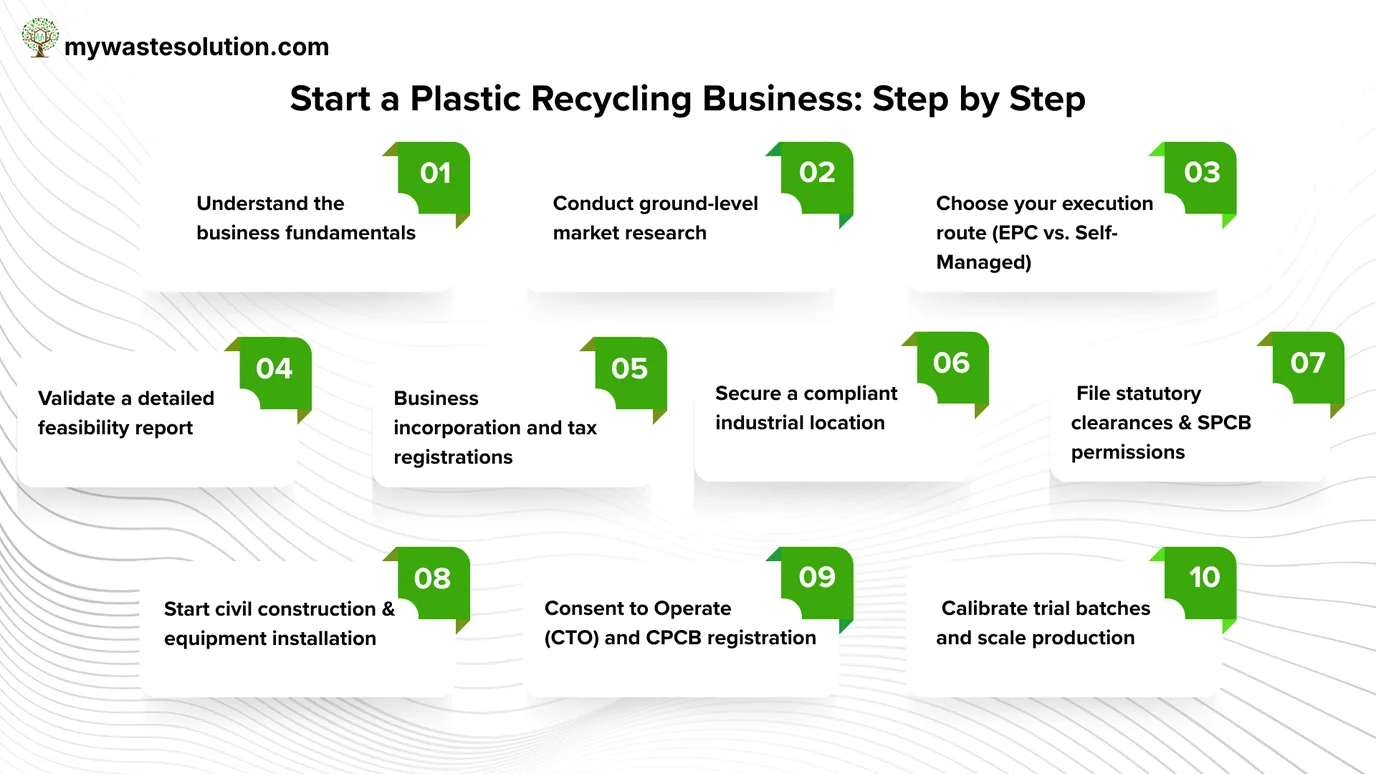
- Understand the real business: Plastic recycling involves a lot more than you think as it varies with feedstock types, plant capacity and processing variations. Make use of available resources to get the basic understanding of what the business is all about, what we process and what we get in the end.
- Do ground work: Contact at least three local scrap dealers and visit Material Recovery Facilities (MRFs) and municipal collectors. Find out what feedstock is actually available and at what price. Ask machinery vendors for real quotations, not estimates, so you understand both the costs and the technology on offer.
- Get a consultation: After you finish your ground work, get a technical consultation from someone with real experience. Use this to check your understanding of government rules, capital costs, and how the operations work in practice.
- Prepare a Detailed Project Report: Prepare a Detailed Project Report (DPR) with an industrial process engineer and a Chartered Accountant. Make sure your process and financial models match what you found in your ground work.
- Register your business: Register your business as a Private Limited companyPrivate Limited CompanyA business entity with limited shareholder liability, restricted share transfer, and a maximum of 200 shareholders, commonly used in India's waste management and recycling sectors. or LLP. Get your GST number, PAN, TAN, and MSME registration. If you plan to trade internationally, apply for an Import-Export Code (IEC).
- Plant site selection: Choose a plot in an industrial estate like GIDC, MIDC, or SIPCOTSIPCOTTamil Nadu state agency that develops and manages industrial estates and SEZs for various industries including waste-to-value sectors.. This usually avoids the need for land conversion approvals. Make sure the site fits the CPCB red or orange category and meets all siting rules.
- Regulatory approvals: Apply to your State Pollution Control Board (SPCB) for Consent to Establish (CTE). This is the permit you need to build your plant and install machinery. At the same time, get your Factory Building Plan Approval and a Provisional Fire NOC.
- Civil and Machinery Installment: Begin construction only after you have your CTE. Install your machines, but do not make the final payment until you complete both a Factory Acceptance Test (FAT)Factory Acceptance Test (FAT)Formal quality verification of equipment at the manufacturer's site before delivery. and a Site Acceptance Test (SAT) with the vendor.
- Consent to Operate: SPCB officers will inspect your site before they issue a Consent to Operate (CTO). Make sure your Effluent Treatment Plant (ETP), Zero Liquid Discharge (ZLD) system, and air scrubbersScrubbersEquipment used to remove air pollutants from industrial exhaust before atmospheric release. are fully installed and working at the time of inspection. Missing equipment usually means delays and extra paperwork.
- EPR registrationEPR RegistrationMandatory registration process for producers and importers to manage post-consumer waste and meet Extended Producer Responsibility obligations.: After you get your CTO, register as a Plastic Waste Processor (PWP) on the central CPCB portal. You need an active CTO for this step. Without PWP registration, you cannot legally issue or trade digital Extended Producer Responsibility (EPR) certificates to Brand Owners (PIBOs).
- Start Trial Batches: Run cold and hot trial batches to set your operating parameters. Once your emission and discharge tests meet the legal limits, start full-scale feedstock procurement and production. You can then begin selling EPR credits on the CPCB exchange.
- Statutory filings: File your annual returns on time and keep complete records of all incoming and outgoing materials. Missing filings or poor record-keeping can lead to penalties or loss of your EPR licence.
6. Plastic Recycling Machinery and Equipment List
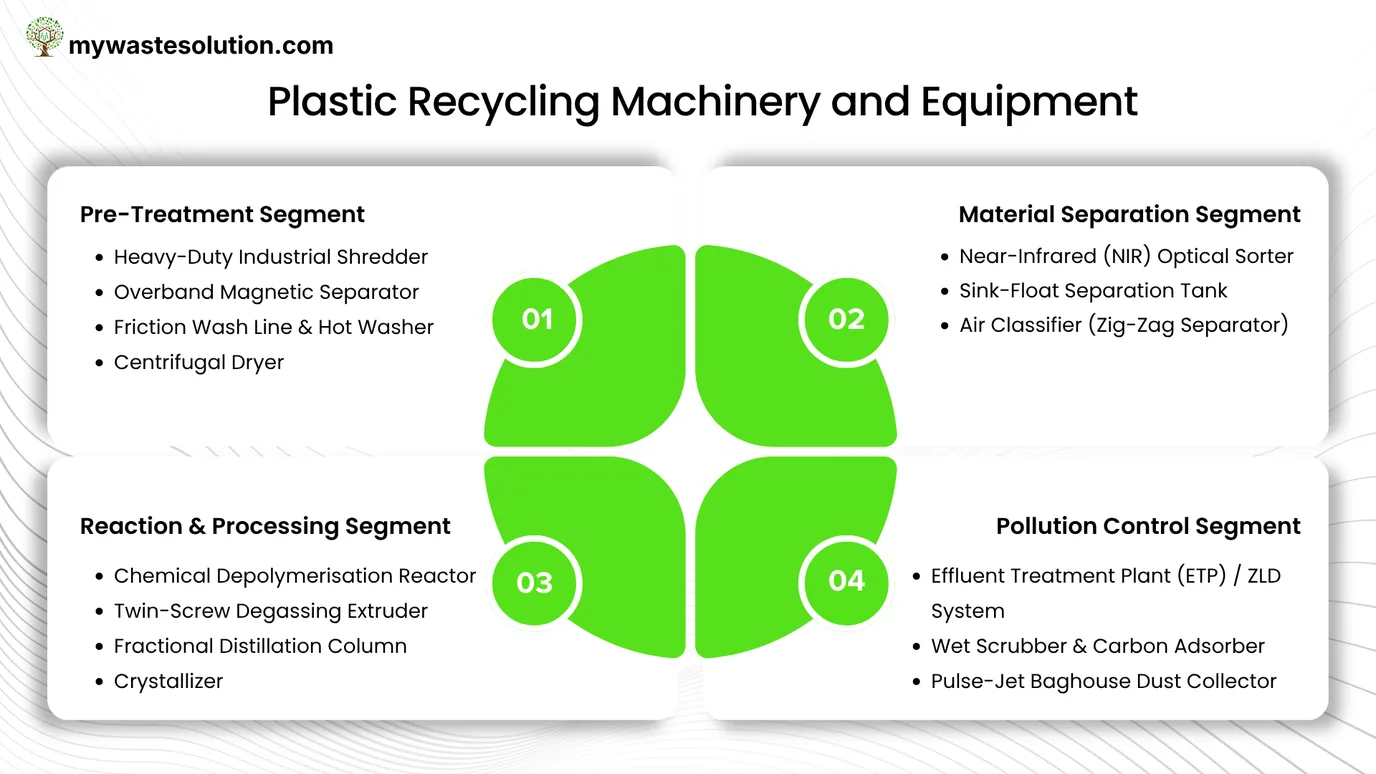
A plastic recycling plant runs on a series of machines, each with a specific job. You can group the equipment by what it does: pre-processing, separating materials, refining, and controlling pollution.
1. Pre-Treatment Segment
- Heavy-Duty Industrial Shredder: This machine cuts large plastic pieces or bales into flakes about 20 to 50 mm in size. Uniform flakes help the rest of the line run smoothly.
- Overband Magnetic Separator: It removes stray metal pieces before they can damage shredder or extruder blades.
- Friction Wash Line and Hot Washer: A high-speed washer uses hot water at 80 to 90°C and mild caustic soda to clean grease, food, and glue from the plastic flakes.
- Centrifugal DryerCentrifugal DryerMechanical equipment using centrifugal force to remove liquid from solids in recycling operations.: A fast mechanical dryer brings flake moisture down to below 1 to 2 percent before melting or chemical processing.
2. Material Separation Segment
- Near-Infrared (NIR) Optical Sorter: A sensor sorts different plastic types like PET, HDPE, PP, and PS by scanning them with light. It uses air jetsAir JetsCompressed air streams used to separate and sort materials in waste processing based on physical properties. to remove the wrong types.
- Sink-Float Separation Tank: A water tank separates plastics by density. Heavier types like PET and PVCPVCPolyvinyl Chloride — a chlorinated plastic widely used in cable insulation and casings. Releases corrosive hydrochloric acid and dioxins when incinerated. sink, while lighter ones like HDPE, LDPE, and PP float.
- Air Classifier (Zig-Zag Separator): An air stream lifts out light waste like film, paper, and dust, leaving the heavier plastic flakes behind.
3. Reaction and Processing Segment
- Chemical Depolymerisation ReactorChemical Depolymerisation ReactorEquipment that converts waste plastics into chemical building blocks through depolymerisation reactions.: A reactor breaks down plastic chains into base chemicals, usually at 180-240°C. It uses glycol, alcohol, or catalysts. For example, it turns PET back into BHET or TPA.
- Twin-Screw Degassing Extruder: A twin-screw extruderTwin-Screw ExtruderIndustrial machine with two rotating screws used to melt, mix, and extrude recycled plastics and rubber into pellets or continuous strands. melts and mixes the plastic. It uses vacuum ports to remove gases before making pellets.
- Fractional Distillation Column: A distillation column separates the recovered liquids by boiling point. This step sorts out monomers, solvents, and fuel fractions after depolymerisation.
- Crystallizer: A crystalliser cools the liquid and forms pure monomer crystals like BHET.
4. Pollution Control Segment
- Effluent Treatment Plant (ETP) / ZLD System: An effluent treatment plant cleans the wash water using several steps, including coagulation, air flotationAir FlotationPhysical separation process using air bubbles to float suspended solids and contaminants to the surface for removal., and reverse osmosis. This allows you to reuse all the water in the washing line.
- Wet Scrubber and Carbon Adsorber: A wet scrubber and carbon filter clean the air from the extruder and reactor. They remove volatile organic compoundsVolatile Organic CompoundsVolatile Organic Compounds — gases released from organic materials that can cause odor, air pollution, and equipment damage. and acid gases.
- Pulse-Jet Baghouse Dust CollectorPulse-Jet Baghouse Dust CollectorIndustrial dust collector that uses compressed air pulses to clean fabric filter bags and remove particulate matter from recycling processes.: A dust collector pulls in microplastic dust from shredders and conveyors to keep factory air safe.
Best Practices for Machine selection
When you choose machines for a recycling plant, don't focus only on price. Technical fit, reliability, and running costs matter more. The machines you choose affect your uptime, maintenance bills, and output quality.
Technical Fit and Machine Quality Assessment: Check that each machine fits your plant layout, or you will get bottlenecks. Look at the build quality and the grade of wear parts like screws and blades. Hardened tool steel, such as D2 or SKD-11, lasts longer than standard carbon steel. Ask for motor load curve data for your polymer. The drive system should run at 60 to 75 per cent of its rated load during normal use, so it can handle surges without tripping.
Vendor Qualification and Acceptance Testing: Get quotes from several vendors. Compare features and build quality before you look at price. Choose vendors with ISOISOInternational Organization for Standardization - sets global quality, safety, and efficiency standards for industrial equipment certification who offer both Factory Acceptance Test (FAT) and Site Acceptance Test (SAT). FAT means running the machine at the vendor's site for one to two hours at full load to check energy use, stability, and output. SAT is done at your site to check installation, safety systems, utilities, and performance before you make the final payment.
Warranty, Maintenance and Lifecycle Operations: Check the warranty on every machine. Try to get more than the standard 12 months, especially for key parts like gearboxes, motors, shafts, and reactor vesselsReactor VesselAn enclosed container where controlled chemical reactions occur, central to pyrolysis and chemical recycling processes.. Make sure the vendor can supply spare parts and provide local support. Arrange for operator training at your site before you start commercial production.
Quotes are worth comparing side by side — recycling machinery and equipment suppliers list what they build and at what scale.
7. Plastic Recycling Plant Location and Infrastructure
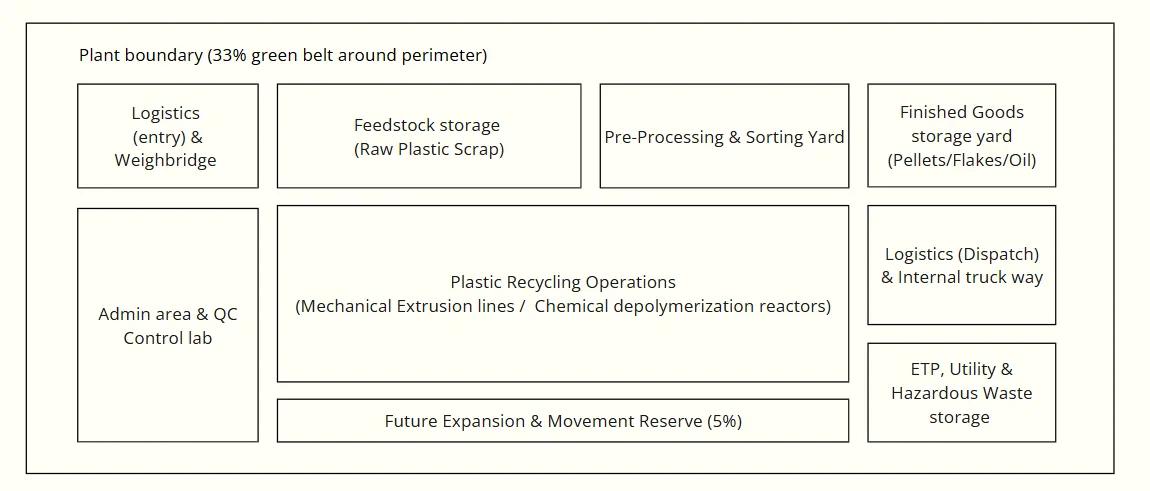
You need to pick a plant site that meets the legal distance rules and still lets you get enough raw material and move your products out at a workable cost.[7]
Critical site selection factors
Industrial siting rules set minimum distances from protected or sensitive areas. You need to check these before you choose a site.
- Residential Limits: You must keep at least 250 to 500 metres away from residential areas in Orange ZonesOrange ZoneModerate pollution industrial classification requiring environmental permits and compliance monitoring., and at least 1 to 2 kilometres in Red Zones.[8]
- Surface Water Bodies and Rivers: Keep the plant at least 500 metres to 1 kilometre away from rivers, lakes, or drinking water sources. This prevents runoff from reaching them.
- National and State Highways: Keep the plant at least 100 to 200 metres from the highway boundary. This keeps access easy while avoiding added traffic.
- Ecologically Sensitive Zones (ESZ): You must keep at least 10 to 25 kilometres away from national parks, wildlife sanctuaries, or Ramsar wetlands.
- Industrial Zone Preference: If you set up inside an approved industrial estate like GIDC, MIDC, SIPCOT, or KIADB, you do not need separate land-use change approval. This also speeds up the Consent to Establish process with the Pollution Control Board.
- Feedstock Radius: If you need to bring in plastic waste from more than 150 to 200 kilometres away, your transport costs will go up and margins will shrink. Pick a site close to major urban material recovery facilities or manufacturing clusters.
Internal Utility Requirements
- You will need strong concrete floors, covered sheds, and storage areas with clear road access for trucks.
- Industrial Electrical Grid to deliver uninterrupted electrical load connection
- Use a closed-loop Effluent Treatment Plant (ETP) to recycle wash water in mechanical units. For chemical plants, install a Zero Liquid Discharge (ZLD) system.
- Fume extraction hoods and scrubbers to control air pollution and to capture volatile emissions.
- Set up fire safety systems, including foam sprinklers in scrap yards. Use central screw compressors for air sorting lines.
Facility Zoning and Infrastructure mapping
- Green Belt Buffer: You must keep 33% of the site as a green belt buffer to meet the rules.
- Main Processing Area: Set aside 30% of the area for sorting lines, shredders, washing and drying, extruders, pelletisers, or chemical reactors.
- Raw Feedstock Storage: Use 12% of the site for storing baled or loose plastic scrap. This can be in open or covered yards.
- Finished Product Storage: Reserve 8% of the area for finished products such as bagged pellets, flakes, or liquid monomers.
- Logistics, Movement and Parking: Set aside 5% of the site for truck movement, the weighbridge, internal roads, and loading bays for 30- to 40-tonne trailers.
- Admin, Lab and Amenities: Use 5% of the area for offices, quality control labs, canteen, security, and control rooms.
- ETP, Utility and Hazardous Waste: Keep 4% of the site for the ETP or ZLD system, boiler room, transformer yard, and a locked hazardous waste room.
- Future Expansion Reserve: Leave 3% of the site open for future expansion or adding new processing lines.
The people who usually explain this business to you — vendors, brokers, commission agents — earn money when you say yes. We do not. We sell the understanding, not the project.
8. Where to Source Plastic Feedstock
You will receive plastic waste in many forms and grades. Sorting your feedstock correctly is essential. It lets you choose the right machinery and keeps your output clean enough to sell.
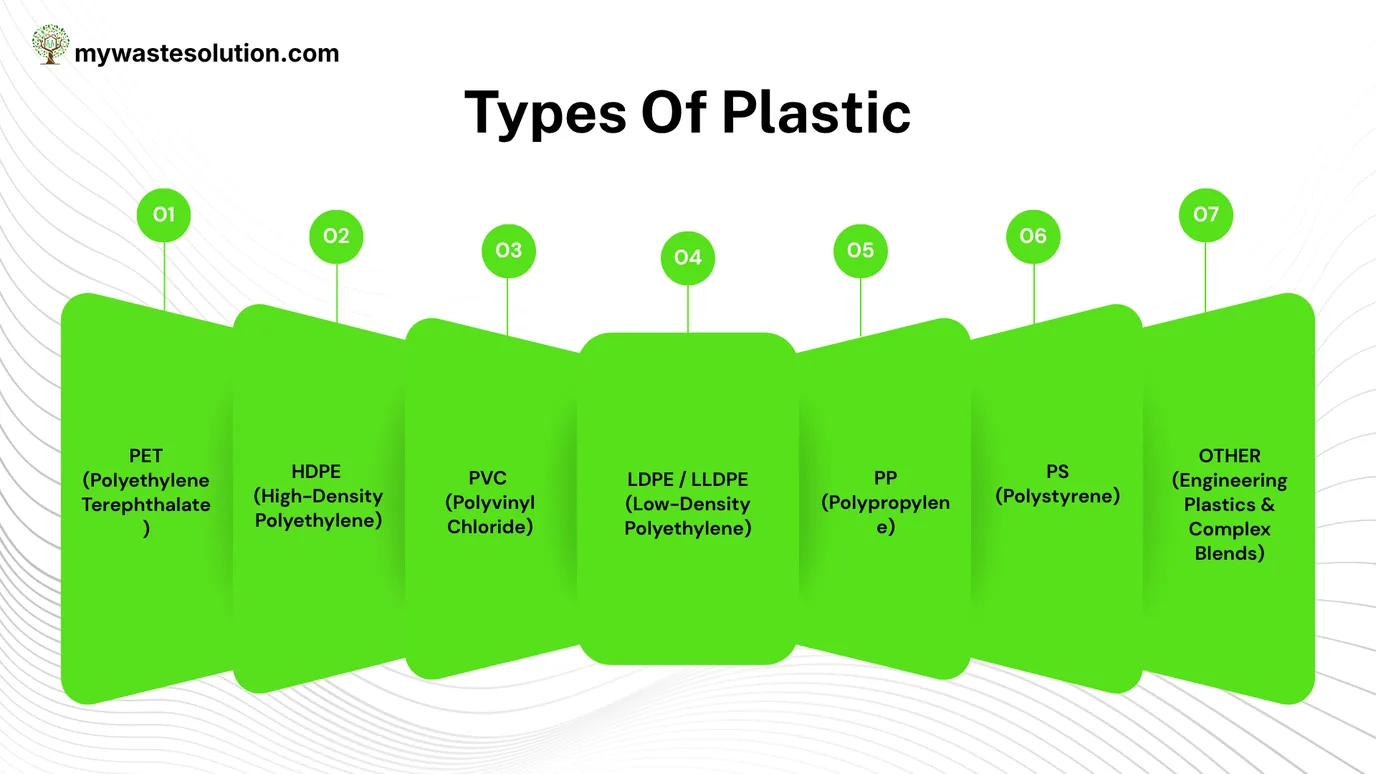
1. Classification by Polymer Resin Identification Codes (RIC #1 to #7)
The ASTM D7611ASTM D7611Standard methodology for verifying and quantifying recycled content in plastic products. standard groups most thermoplastics into seven main resin codes. These are called RICRICResin Identification Code — the 1–7 number inside the triangle symbol on plastic products (1=PET, 2=HDPE, 3=PVC, 4=LDPE, 5=PP, 6=PS, 7=Other). Identifies plastic type for sorting; does NOT certify recyclability. #1 to #7.[9]
- RIC #1 – PET (Polyethylene Terephthalate): Clear/colored beverage bottles, thermoform traysThermoform TraysPlastic containers made by heating and molding sheets into custom shapes for packaging., and polyester textile waste.
- RIC #2 – HDPE (High-Density Polyethylene): Milk jugs, shampoo bottles, chemical drums, and rigid crates.
- RIC #3 – PVC (Polyvinyl Chloride): Pipes, window profiles, cable sheathingCable SheathingProtective polymer layer covering electrical cable conductors and insulation., and blister packaging.
- RIC #4 – LDPE / LLDPE (Low-Density Polyethylene): Carry bags, stretch films, agricultural sheets, and squeeze bottles.
- RIC #5 – PP (Polypropylene): Bottle caps, woven sacks, food containers, auto bumpers, and furniture.
- RIC #6 – PS (Polystyrene): Expanded PS (Thermocol insulation, packaging blocks) and rigid PS (cutlery, electronic housings).
- RIC #7 – OTHER (Engineering Plastics and Complex Blends): PolyamidesPolyamidesSynthetic polymers (nylons) used across multiple sectors; can be recycled mechanically or chemically through depolymerization. (Nylon-6/66), Polycarbonate (PC), ABS, Polyurethane (PU), and multi-layer packaging films.
2. Statutory CPCB EPR Packaging Categories
Under India's Plastic Waste Management (PWM) Rules, feedstock is legally grouped into four structural categories:
| CPCB Category | Material Structure | Common Examples | Primary Processing Route |
|---|---|---|---|
| Category I | Rigid Plastics | PET bottles, HDPE drums, PP containers, rigid PS boxes | Mechanical sorting, flaking, granulating, or depolymerization |
| Category II | Flexible Plastics | LDPE films, PP bags, snack pouches, shrink wraps | Washing, agglomeration, and extrusion into film-grade pellets |
| Category III | Multi-Layered Packaging (Plastic + Non-Plastic) | Tetra Pak, aluminum-foil laminated pouches, metalized film | Chemical recycling, thermal heating and pyrolysis |
| Category IV | Compostable and Biodegradable Plastics | PLA trays, starch-based bio-bags, compostable films | Industrial composting facilities (kept completely separate from plastic recyclers) |
3. Supply Chain Origin
Post-Industrial Waste (PIW): Factory off-cuts, defective moldings, and runner scrap. Offers clean, single-resin material with high purity (>98%) requiring minimal pre-washing before processing.
Post-Consumer Waste (PCW): Household trash, used packaging, and commercial waste are all post-consumer sources. You will need several steps to clean this feedstock. Plan for sorting, friction washing, and thermal drying to remove food, glue, and plastics you do not want.[10]
4. Feedstock Sourcing Channels
Getting enough clean plastic waste is the main challenge for any recycling plant. In India, you can source feedstock from both informal and formal channels. The informal sector handles up to 80% of post-consumer plastic waste. Waste pickers, door-to-door collectors, kabadiwalas, and scrap dealers collect directly from homes, bins, and dumpsites.
Formal B2B channels include direct supply from factories as post-industrial scrap, municipal solid waste (MSW) and material recovery facilities (MRFs), retail hubs, e-commerce warehouses, and logistics centres. These sources usually offer cleaner and more reliable feedstock than informal channels.
To lock in steady supply, you can sign offset agreements with producers, importers, and brand owners. These contracts cover their post-consumer packaging waste and generate verified CPCB EPR credits.[11] Many plants now use digital procurement platforms like ReCircle or Recykal. These platforms supply traceable waste from industry and municipal MRFs, with digital tracking for each batch.
Plastic waste service providers and aggregators are the formal end of that supply.
9. Plastic Recycling Revenue Streams
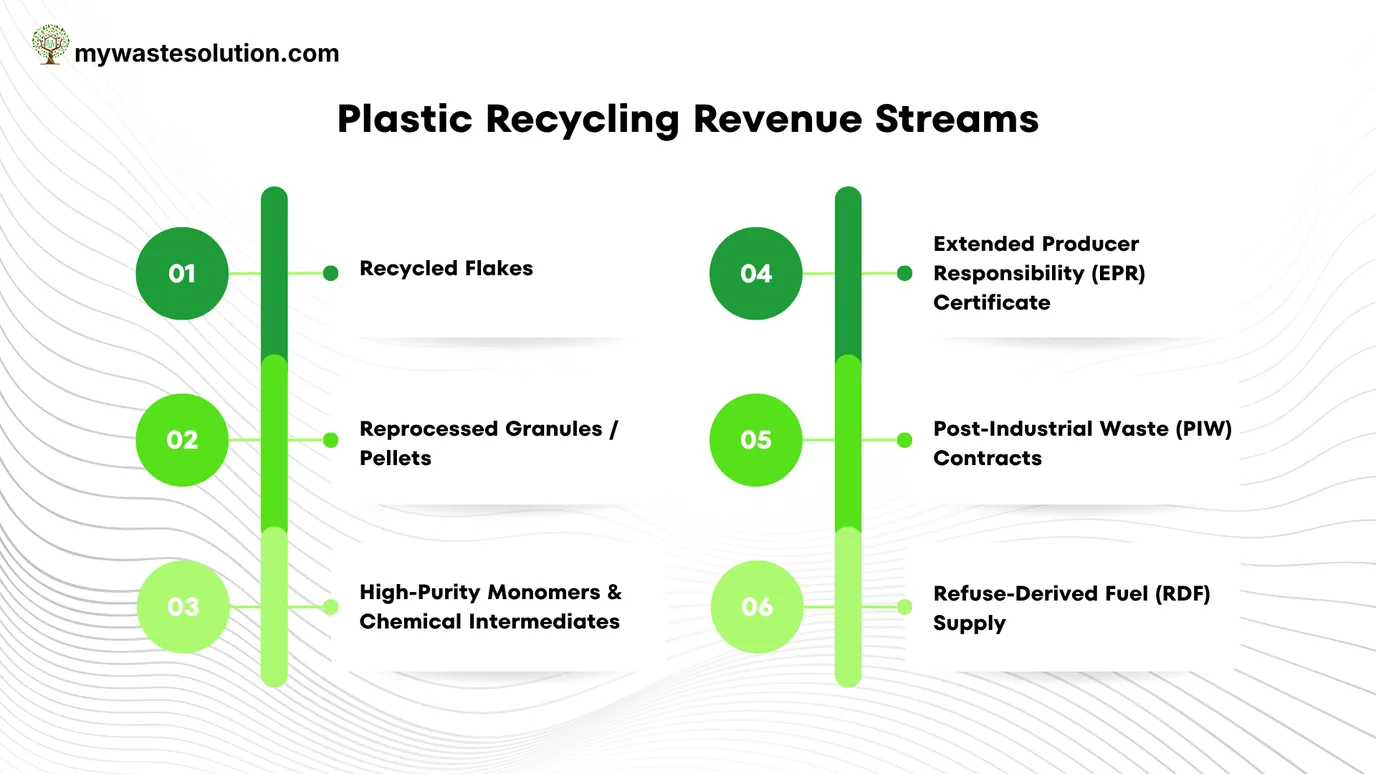
Your revenue in plastic recycling depends on three things: how pure your material is, what grade of output you produce, and how well you use statutory credits. Most modern plants have four main ways to earn money.
- Recycled Flakes: These are the basic washed and shredded flakes you get from PET, HDPE, or PP. You sell them to pelletizers, fibre makers for polyester staple fibre, or sheet extruders.[12]
- Reprocessed Granules / Pellets: These are plastic pellets that have been melt-filtered, degassed, and compounded. They usually fetch a higher price when you sell them to packaging converters, masterbatch makers, or automotive moulders.
- High-Purity Monomers and Chemical Intermediates: You can also recover chemicals by breaking down plastic. Examples include BHET, PTA, MEG, or styrene monomersStyrene MonomerThe chemical monomer recovered from polystyrene waste through depolymerization in chemical recycling processes.. These sell as virgin-grade feedstocks to refineries, resin makers, or synthetic fibre mills.[13]
- Extended Producer Responsibility (EPR) Certificate Monetisation: If you are a registered Plastic Waste Processor (PWP), you earn digital EPR credits on the CPCB portal for every metric ton of plastic you process.[11]
- Post-Industrial Waste (PIW) Contracts: You can also offer contract recycling to industrial plants. They send you contaminated or off-spec plastic scrap. You process it into washed flakes or pellets and send it back for a fixed fee per kilogram.
- Refuse-Derived FuelRefuse-Derived FuelA fuel produced from sorted and processed waste materials used in cement kilns and power plants. (RDF) Supply: You can bale non-recyclable, high-calorific waste and sell it as Refuse-Derived Fuel (RDF) to cement kilns or waste-to-energy plants.
Offtake is the other half of the question: companies buying recycled plastic and scrap are where flake and pellet volumes actually clear.
Financial Indicators
To understand the finances of a plastic recycling plant, look at gross margins, operating leverage, and operating periods. The numbers vary widely depending on your plant's capacity and how much you process.
| Financial Indicator | Simple Explanation |
|---|---|
| Revenue Projections | The total annual gross income earned by the plant across all sales streams. Includes selling (flakes, granules and monomers) and trading digital CPCB EPR credits. |
| Profit and Loss (P&L) Statement | The final accounting statement showing how much net income remains after deducting all expenses. Subtracts raw scrap costs, power, fuel, chemicals, labor, and taxes from total revenue. |
| Return on Investment (ROI) | How much overall profit the plant generates each year compared to the initial project cost. It measures how hard your invested capital is working. Collecting units — 28% – 35%; Mechanical unit — 22% – 28%; Chemical unit — 18% – 24%. |
| Payback Period | The exact time required to recover 100% of your starting investment. Shows how quickly your project reaches zero risk and starts generating net profit. Collecting units — 18 – 24 Months; Mechanical unit — 2.5 – 3.5 Years; Chemical unit — 3.5 – 5.0 Years. |
| Breakeven Capacity | The minimum plant utilization needed to cover fixed overheads. The point where total operational revenue equals running costs and the business stops bleeding cash. |
| EBITDA Margin | The pure operating profit percentage of the business. Shows core machinery and operational efficiency before accounting for taxes, interest, and bank loan payments. Collecting units — 12% – 18%; Mechanical unit — 22% – 30%; Chemical unit — 35% – 48%. |
10. Risks and Challenges in a Plastic Recycling Business
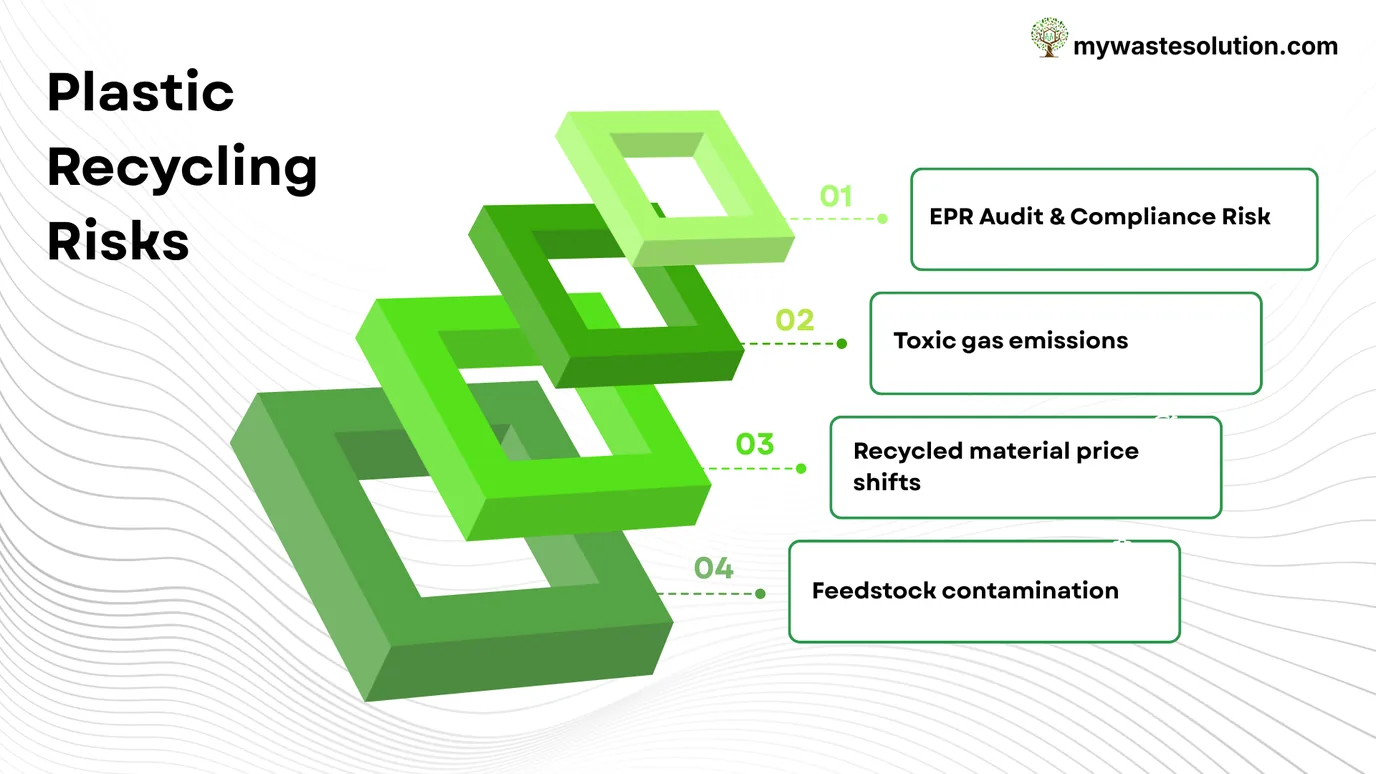
The main operational risks in plastic recycling are feedstock contamination, unstable polymer prices, high energy use, and strict regulatory audits.
1. Feedstock contamination
Mixed post-consumer waste, high moisture, and polymers like PVC are major challenges. These can degrade your process, release acidic gases, and raise your costs. You can reduce these risks by using multi-stage automated pre-sorting systems, such as optical NIR sorters and sink-float tanksSink-Float TanksDensity-based separation equipment used to purify waste streams in recycling processes..
2. Recycled material price shifts
Recycled plastic prices move with crude oil and virgin polymer prices. When virgin prices drop, manufacturers often switch back to using new plastic. To avoid losing your buyers, secure long-term off-take contracts for one to three years with brand owners and FMCG packaging companies. The CPCB requires a set amount of recycled plastic in new production, so you need to register as an authorised recycler.
3. Toxic gas emissions
Heating contaminated plastics can release fine microplastic dust and acidic gases. These emissions can cause health problems for your workers. If your plant is in the orange or red category, you need to install wet scrubbers, activated carbon adsorbers, and pulse-jet baghouseBaghouseA dust collector that filters air through dozens of fabric bags or cartridges hanging in a sealed chamber. The standard dust-control device for shredder and granulator lines. dust collection systems over the melting hoods.
4. EPR Audit and Compliance Risk
You face EPR audit and compliance risk if you do not upload all filings on time. If your reported power use, throughput, and EPR credits do not match, you can be blacklisted on the portal, lose your CTO, or face heavy penalties. Use real-time IoT-enabled monitoring systems like CEMS or OCEMS to track your plant operationsPlant OperationsThe day-to-day activities that keep a processing facility running — feedstock handling, the core process, utilities, maintenance and compliance monitoring.. Keep your Form 3 hazardous waste logbooks and Form 10 transport manifests up to date every day.
Costs, regulations, location analysis and vendor comparison for plastic recycling — researched from source, not estimated. Free to browse.
11. Is a Plastic Recycling Business Worth Starting?
India's plastic recycling industry is moving from informal scrap trading to a regulated manufacturing sector. This shift is mainly due to new rules that require FMCG brands to use more post-consumer recycled (PCR) plastic in their packaging. These brands must also buy digital EPR credits from recyclers, which creates steady demand. India generates over 3.5 million tonnes of plastic waste each year, so there is plenty of raw material. If you set up a processing facility, you can access both this feedstock and a stable group of buyers.
To succeed in this sector, you need to secure a reliable supply of plastic scrap, invest in machinery that can produce high-purity recycled material, and follow all regulatory requirements closely. Long-term supply contracts help protect you from price swings. Advanced washing or chemical depolymerisation lines can improve product quality. You also need to keep clear daily records of your inputs and outputs, since these are required for EPR certificate claims. These steps make your business more stable and help you meet both market and legal demands.
12. Plastic Waste Market Size and Industry Outlook in India (2026)
India's plastic recycling industry has evolved from an unorganized scrap management sector into a formal, high-growth manufacturing ecosystem. Driven by mandatory Extended Producer Responsibility (EPR) and corporate circularity commitments, recycling capacity is scaling rapidly nationwide.[14]
The Indian plastic recycling market was valued at $2.18 billion in 2024 and is projected to reach $4.3 billion by 2030, growing at a CAGRCAGRCompound Annual Growth Rate — measures the average annual growth rate of an investment or market over a specified period. of 10.76%.[14] Over 60% of PET bottle waste in India is currently recycled, representing one of the highest recovery rates globally, though other complex polymers lag significantly behind.
- Annual Plastic Waste Generation: ~11.secure tons per year.
- Formally collected / Recycled: Approximately ~7.1 Million Tons (around 60% overall recovery across mechanical, co-processing, and industrial channels).
- Untreated / Landfill Deficit: Nearly ~4.8 Million Tons per year either end up in landfills, low-tier open dumps, or escape into environmental streams. This gap forms the target feedstock reserve for new recycling facilities.
Driving Factors
Rigid EPR Targets: The Central Pollution Control Board (CPCB) enforces strict minimum recycled-content targets for FMCG and packaging brands, creating guaranteed domestic demand for recycled flakes and pellets.[11]
Shift to Building Block Recovery: Traditional mechanical recycling faces thermal degradationThermal DegradationHeat-driven breakdown of polymer chains used in chemical recycling to recover valuable products. limits over multiple reuse cycles. Monomer recoveryMonomer RecoveryChemical recycling process that breaks polymers back into monomers for repolymerization into new plastics. (depolymerization) offers an infinite loop solution, creating high value for virgin-equivalent monomers like BHET, TPA, Caprolactam, and Styrene.
The same EPR machinery drives the other recovered streams — see the battery recycling and e-waste recycling guides for how credits work there.
Recycling Network
To streamline circularity, CPCB mandates registration for both waste generators and processors. The formal network comprises:
- Registered PIBOs (Producers, Importers, Brand Owners): 40,000+ entities actively generating post-consumer and post-industrial packaging waste that requires mandatory compliance offset.
- Registered PWPs (Plastic Waste Processors / Recyclers): 6,000+ registered facilities operating across mechanical recycling, end-of-life disposal, and chemical processing.
- Regional Concentration: Nearly 45% of formal processing units are concentrated across Western industrial hubs (Gujarat and Maharashtra) and Northern manufacturing belts (NCR and Punjab).
Market demand and gap
Despite a large informal collection network, India faces a critical structural gap between raw waste generation, formal mechanical capacity, and high-value chemical recycling. CPCB rules require 30–60% recycled plastic content in new packaging for producers and Brand Owners.
Traditional mechanical recycling degrades polymer chains, preventing food-grade or high-tensile re-entry. This creates opportunities for monomer recovery, as over 1.0 Million Tons/year of contaminated, multi-layered, or complex polymers remain untreated by basic mechanical recycling. This targets the exact unaddressed gap: supplying virgin-grade monomers back to petrochemical majors.
13. Plastic Waste Frameworks and Policies
The Central Pollution Control Board (CPCB) and State Pollution Control BoardsState Pollution Control BoardState Pollution Control Board — the state-level statutory authority that issues, monitors, and enforces environmental consents for industrial plants. (SPCBs) set the rules for plastic recycling in India. The requirements are specific and tightly enforced.
- Plastic Waste Management (PWM) Amendment Rules:[11] You must register for Extended Producer Responsibility (EPR) with the CPCB if you handle any of four main types of plastic: rigid plastics, flexible packaging, multi-layered packaging, or compostable plastics. This registration is mandatory and managed centrally.
- EPR Certificate Trading: As a recycler, you can sell verified EPR certificates directly to producers, importers, and brand owners (PIBOs). This gives you a second source of income besides selling recycled material.
- Packaging TraceabilityPackaging TraceabilitySystem for tracking packaging from raw materials through recycling using identification technologies and databases. Mandate: Every batch of plastic packaging and recycled material must have a unique identifier, like a QR code or barcode. You also need to label it as compliant with IS 14534:2023IS 14534:2023Indian Standard 14534:2023 sets quality benchmarks for recycled plastic materials. and link it to the CPCB portal. This is to stop fraud in the credit system.
- Raw Material Supplier Accountability: If you supply raw material, produce resin, or distribute pellets, you now report directly to the CPCB. This lets the regulator track material flow through the whole supply chain.
Mandatory Recycled Content Targets
Producers, importers, and brand owners (PIBOs) must now meet minimum targets for recycled plastic content. This creates steady demand for high-quality recycled plastic.
| Category | Packaging Description | FY Target | Target Polymers |
|---|---|---|---|
| Category I | Rigid Plastic Packaging | 40% Minimum Recycled Content | PET, HDPE, Rigid Polystyrene |
| Category II | Flexible Plastic Packaging | 10% Minimum Recycled Content | LDPE, LLDPE, PP films |
| Category III | Multi-Layered Packaging (MLP) | 5% Minimum Recycled Content | Nylon laminates, complex film blends |
| Category IV | Compostable Plastics | 100% Industrial Composting Compliance | PLA, Starch blends |
Note: If you make packaging that touches food, you must also meet FSSAIFSSAIFood Safety and Standards Authority of India — the statutory body that sets standards for food and food-contact packaging, including migration limits for recycled plastics used in food packaging. rules. High-purity monomer recovery by depolymerisation, such as turning PET into BHET or TPA, can give you raw material that counts as food-grade.
Single-Use Plastic (SUP) Restrictions
Banned Items: India still bans single-use plasticSingle-Use PlasticPlastic items designed for single use before disposal, commonly used in packaging and consumer products. items that cause litter. This includes plastic cutlery, straws, plates, thermocol decorations, and carry bags thinner than 120 micronsMicronOne-thousandth of a millimetre (1 μm). The size scale used to specify dust particles, filter ratings, and fine separation cut-points; modern HEPA filters trap 0.3 μm at 99.97%..
Impact on Feedstock: Because of the single-use plastic ban, most available feedstock now comes from industrial scrap, rigid packaging, and multi-layer flexible films. These are better suited for advanced chemical or mechanical recycling.
Government Subsidies and Financial Incentives
- MSME SPICE Scheme (SIDBI): The scheme gives micro, small, and medium enterprises (MSMEs) capital support and low-interest loans if you invest in green technology, modern washing lines, or circular economy equipment.[15]
- Plastic Park Scheme Grant: The Department of Chemicals and Petrochemicals (DCPC) runs a grant scheme that covers up to 50% of infrastructure costs in dedicated plastic parks, up to a maximum of ₹40 crore per park.[16]
- State Industrial Policy Incentives: Key states (e.g., Gujarat, Maharashtra, Tamil Nadu, Uttar Pradesh) provide:
- Capital Subsidies: You can get back 10% to 25% of what you spend on plant and machinery as a subsidy.
- Interest Subvention: You may qualify for a 5% to 7% interest subsidy on bank loans, usually for five to seven years.
- Fiscal Exemptions: Some states also offer partial SGST refunds, waive electricity duty, and reduce stamp duty on land registration.
- Priority Sector LendingPriority Sector LendingRBI mandate requiring banks to lend a minimum portion of credit to priority sectors including MSMEs and agriculture. (PSL): Priority sector lending means you can get faster bank loan approvals and better rates if you set up a waste processing or monomer recovery unit.
Environmental Penalties and Compensation Structure
If you miss your EPR target or run a plant without the right SPCB consent, the CPCB and SPCB can fine you. The penalty is usually ₹5,000 to ₹20,000 per ton of unmanaged plastic waste, depending on how complex the packaging is and how serious the non-compliance is.
FAQs: Plastic Recycling Business in India: Cost, Licences, Profit and How to Start (2026)
Is an Effluent Treatment Plant (ETP) mandatory?
You cannot get a Consent to Operate (CTO) from the pollution control board unless you have a working Effluent Treatment Plant (ETP) or a Zero Liquid Discharge (ZLD) system to treat and recycle your wash water. This is a basic legal requirement.
How do I make money from CPCB digital EPR credits?
Once you have your CTO, register as a Plastic Waste Processor on the CPCB portal. You will need to upload your monthly mass-balance data. The portal then issues digital EPR credits, which you can sell to FMCG brands and packaging importers. This is a regulated process, so keep your records accurate.
What is the expected payback period and profit margin?
Mechanical recycling lines usually deliver EBITDA margins between 22% and 30%, with payback periods of 2.5 to 3.5 years. Chemical depolymerisation plants can reach 35% to 48% EBITDA margins, but the payback is longer, typically 3.5 to 5 years. These are industry averages; your actual results will depend on your feedstock cost, plant efficiency, and product prices.
How do I ensure a continuous supply of raw plastic scrap?
Secure your raw plastic supply by signing annual contracts with regional scrap aggregators, municipal Material Recovery Facilities (MRFs), and industrial packaging units within 100 to 150 kilometres. Relying on spot buying is risky and often leads to shortages or higher prices.
What are the key statutory approvals required before launch?
You will need to complete several registrations before you start. These include Company Registration (Pvt Ltd or LLP), GST, MSME, State Pollution Control Board (SPCB) Consent to Establish (CTE), Consent to Operate (CTO), Provisional Fire NOC, and CPCB Plastic Waste Processor registration. Each approval has its own process and timeline.
Should I start with Mechanical or Chemical Recycling?
Start with Mechanical if you have lower initial capital and want faster commissioning with simpler operations. Choose Chemical if you have higher capital, technical expertise, and want higher profit margins (35%–48%) selling virgin-equivalent feedstocks.
Sahil Sanwal founded MyWasteSolution, the marketplace where India’s recyclers, waste companies and plant-setup consultants find each other. He writes about what it actually takes to build and run a recycling business here — the costs, the approvals and the economics operators deal with rather than the version in a brochure.
References
- Ragaert, K., Delva, L. and Van Geem, K. Mechanical and chemical recycling of solid plastic waste. Waste Management https://doi.org/10.1016/j.wasman.2017.07.044
- IMARC Group. Waste Plastic Recycling Plant Setup, CAPEX and OPEX Analysis https://www.imarcgroup.com/waste-plastic-recycling-plant-project-report
- PolyNext. The Economics of Plastic Recycling: Making the Business Case for Sustainability https://polynextconf.com/the-economics-of-plastic-recycling-making-the-business-case-for-sustainability/
- Lamtai, A. et al. Mechanical Recycling of Thermoplastics: A Review of Key Issues. Waste (MDPI) https://doi.org/10.3390/waste1040050
- Silva, C. et al. Plastic waste recycling: an overview of the mechanical, chemical, and thermal technologies. Journal of Engineering and Applied Science https://doi.org/10.1186/s44147-025-00799-2
- Balema, V. P. et al. Depolymerization of polystyrene under ambient conditions. Green Chemistry https://www.researchgate.net/publication/348472571_Depolymerization_of_polystyrene_under_ambient_conditions
- Site selection for plastic recycling plant in a circular economy context using fuzzy decision-making system. Environmental Science and Policy https://doi.org/10.1016/j.envsci.2026.104365
- Central Pollution Control Board. Sectors Classified by CPCB https://cpcb.gov.in/uploads/Sectors_Classified_by_CPCB_12012026.pdf
- ANSI. Resin Identification Codes (RICs) and ASTM D7611 https://blog.ansi.org/ansi/resin-identification-codes-rics-astm-d7611/
- Compositional Analysis and Mechanical Recycling of Polymer Fractions Recovered via the Industrial Sorting of Post-Consumer Plastic Waste. Polymers (MDPI) https://www.mdpi.com/2073-4360/16/20/2898
- Central Pollution Control Board. Plastic Waste Management (Second Amendment) Rules, 2022 https://cpcb.gov.in/uploads/plasticwaste/2-amendment-pwmrules-2022.pdf
- Polaris Market Research. Recycled Plastics Market: Dynamics, Streams and End-Use Applications https://www.polarismarketresearch.com/industry-analysis/recycled-plastics-market
- Data Bridge Market Research. Chemical Recycling Methods to Convert Plastic Waste into Valuable Feedstock https://www.databridgemarketresearch.com/articles/chemical-recycling-methods-to-convert-plastic-waste-into-valuable-feedstock
- Research and Markets. India Plastic Recycling Market, By Region, Competition, Forecast and Opportunities, 2020-2030F https://www.researchandmarkets.com/reports/5986499/india-plastic-recycling-market-region
- SIDBI. SPICE Scheme, Green MSME https://green.msme.gov.in/homeSpices
- Department of Chemicals and Petrochemicals. Plastic Park Scheme https://chemicals.gov.in/plastic-park-scheme