A battery recycling business collects spent batteries and recovers the materials inside them. Lead-acid batteries yield 99.97% pure lead ingots, polypropylene chips and sodium sulfate; lithium-ion packs — including electric-vehicle packs — yield black mass carrying nickel, cobalt, lithium and manganese, plus copper and aluminium foils that go back to cell makers.
In India a 2 TPD collection and dismantling hub costs about ₹1.05 crore to ₹1.70 crore, a 5 TPD mechanical shredding plant ₹9.40 crore to ₹13 crore, and a 10 TPD integrated refinery ₹25.5 crore and up. Established lead-acid plants report EBITDA margins of 18% to 24% and annual returns on investment of 25% to 45%.
You will need Consent to Establish and Consent to Operate from your state pollution control board, Hazardous Waste Authorisation, a factory licence, a fire NOC, and recycler registration on the CPCB EPR portal under the Battery Waste Management Rules, 2022. Plan for 12 to 18 months from start to production — the Consent to Operate at about 90 days and the Hazardous Waste Authorisation at about 120 days are the long poles.
1. What a Battery Recycling Business Actually Does
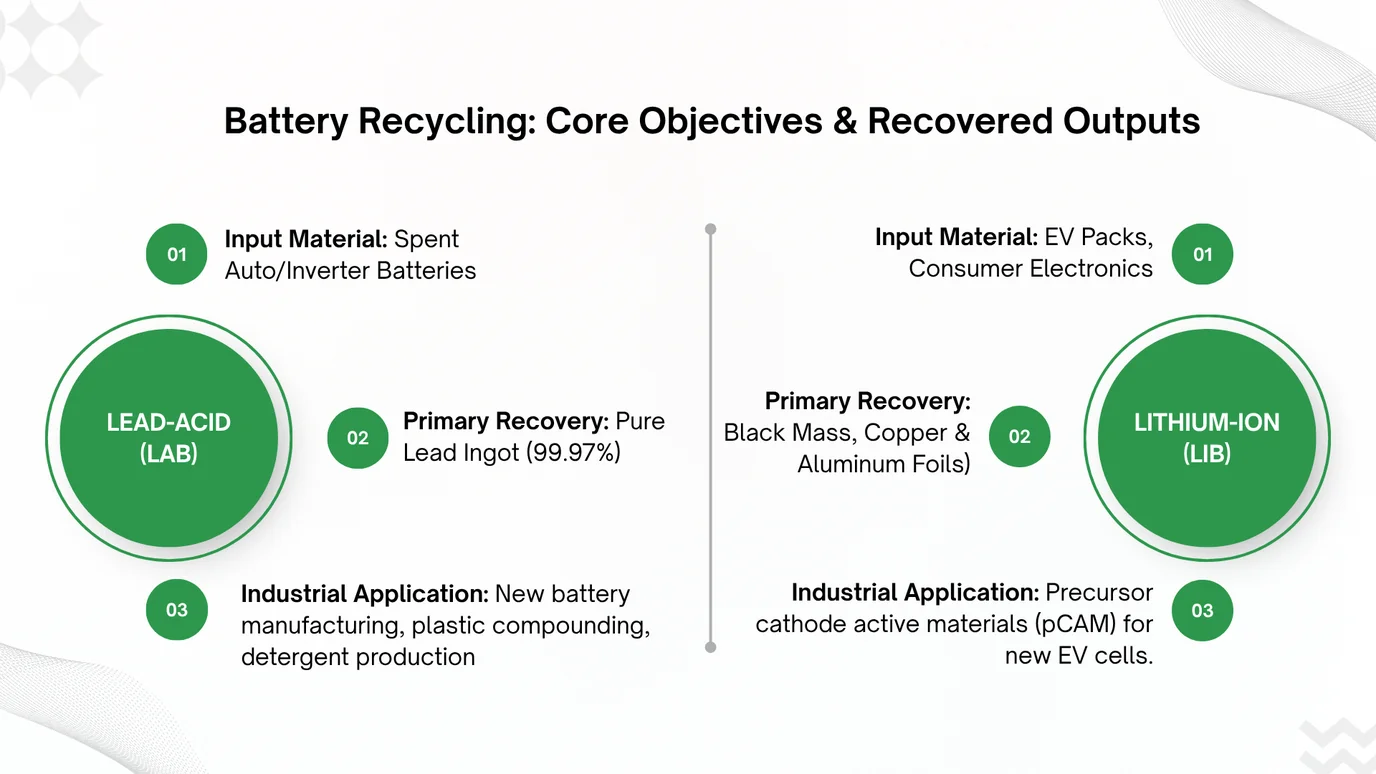
A battery recycling business acts as an important resource-recovery point in the circular economy, collecting used energy-storage units and extracting high-value industrial raw materialsHigh-Value Industrial Raw MaterialsWaste-derived materials meeting virgin-equivalent specifications for reintegration into production.. Rather than letting hazardous battery wasteHazardous Battery WasteSpent batteries and hazardous materials from battery recycling requiring controlled management and processing. end up in landfills, recycling plants safely balance residual charges, break down physical casings, and extract purified metals back into manufacturing supply chains.
In India, most battery recycling focuses on two main types:
-
Lead-acid batteries (LAB)Lead-Acid Batteries (LAB)Rechargeable batteries containing lead and sulfuric acid, primarily recycled for secondary lead recovery.: These are the older, heavy batteries used in cars, inverters, and backup power for industry.[1]
-
Lithium-ion batteries (LIB)Lithium-Ion Batteries (LIB)Rechargeable batteries used in portable electronics, electric vehicles, and energy storage systems.: These are the newer, high-energy batteries found in electric vehicles, phones, laptops, and large solar storage systems.
Core Objectives & Recovered Outputs
| Chemistry Stream | Input Material | Primary Recovered Output | Industrial Applications |
|---|---|---|---|
| Lead-Acid (LAB) | Spent Auto/Inverter Batteries | Pure Lead Ingot (99.97%), Lead Alloys, Polypropylene (PP) Chips, Sodium Sulfate | New battery manufacturing, plastic compounding, detergent production. |
| Lithium-Ion (LIB) | EV Packs, Consumer Electronics | Black Mass (Nickel, Cobalt, Lithium, Manganese), Copper and Aluminum Foils, Plastic scrap[2] | Precursor cathode active materials (pCAM) for new EV cells. |
How Battery Recycling Works
The main operations use separate physical, mechanical, or chemical steps, depending on the type of feedstock you receive.
Collection & Discharging ➔ Mechanical Crushing & Sorting ➔ Chemical Extraction / Refining ➔ High-Purity Metal Output
- Safety Deactivation & Electrolyte Management:
You need to discharge spent batteries before processing to prevent thermal runaway, which can cause fires. For lead-acid batteries, this means handling sulfuric acid safely. For lithium-ion batteries, you deal with organic salts. In both cases, you either neutralise or recover the electrolyte to avoid contamination.
- Crushing & Physical Separation:
You use shredders and hammers to break open the battery casings. After that, high-density separation lets you separate the metals from the plastics, such as polypropylene or metal cell casings. This step is necessary to recover the valuable materials cleanly.
- Refining & Metal Recovery:
- For LAB: You use pyrometallurgical smelting to turn the lead paste into high-purity lead ingotsLead IngotsStandardized blocks of refined lead metal, the primary output of lead-acid battery recycling.. This is the main way to recover lead from spent lead-acid batteries.
- For LIB: Mechanical shredding gives you what is called 'Black Mass', which contains the valuable metals. You then use hydrometallurgical acid leachingHydrometallurgical Acid LeachingChemical dissolution of metals from waste using acid solutions for metal recovery. to separate out pure cobalt, lithium, and nickel salts. This is the main recovery step for lithium-ion batteries.[3]
Links you might be interested in
2. Battery Recycling Plant Cost in India: Full Breakdown
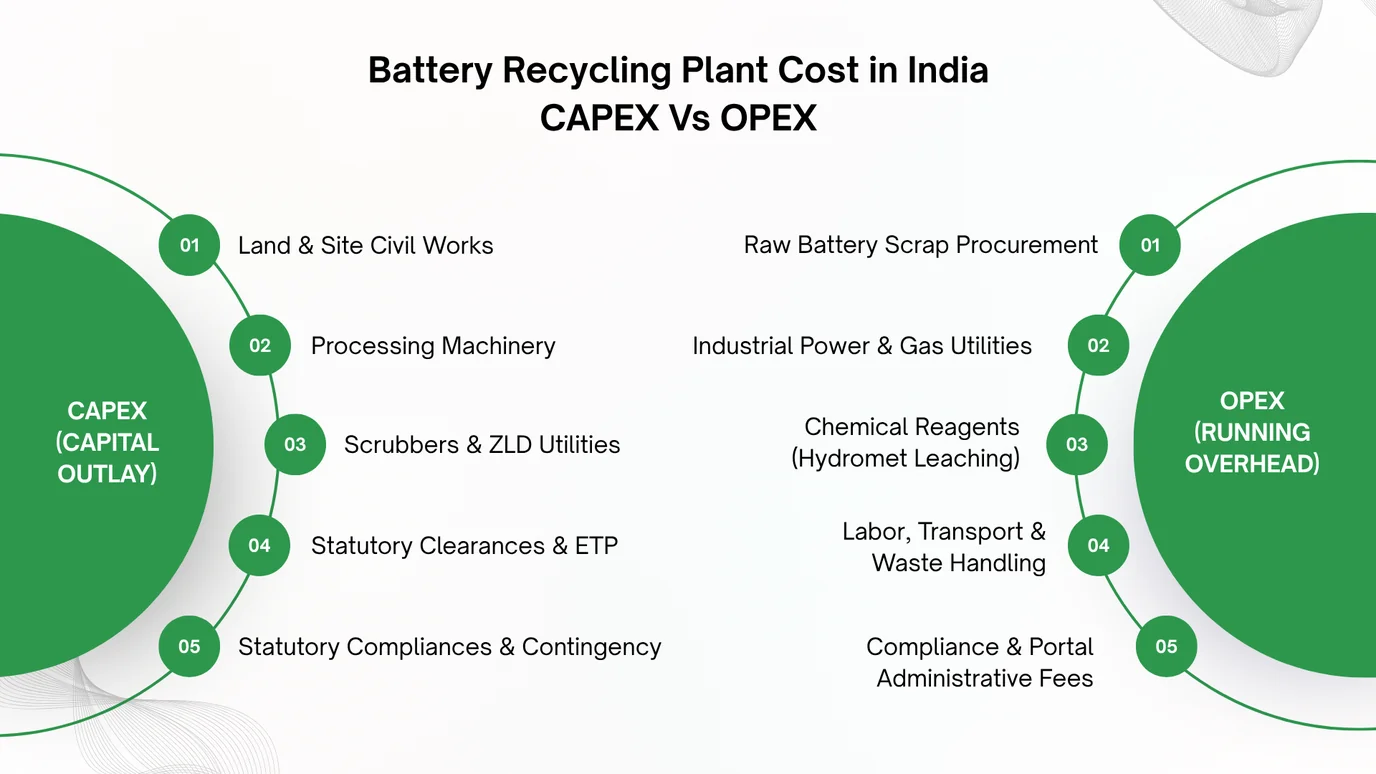
To understand the economics of a battery recycling plant, start by breaking down your costs into capital expenditure (CAPEX) and operational expenditure (OPEX). Your profit depends mainly on how much you pay for raw materials, how much you can recover from them, and your utility costs.[18]
TOTAL PROJECT COST STRUCTURE
- CAPEX (Capital Outlay):
- Land & Site Civil Works
- Processing Machinery
- ScrubbersScrubbersEquipment used to remove air pollutants from industrial exhaust before atmospheric release. & ZLD Utilities
- Statutory Clearances & ETP
- OPEX (Running Overhead)
- Raw Battery Scrap Procurement (60-70%)
- Industrial Power & Gas Utilities
- Chemical Reagents (Hydromet LeachingLeachingA hydrometallurgical process that dissolves target metals out of crushed battery material — black mass or lead paste — into an aqueous acid solution for later recovery.)
- Labor, Transport & Waste Handling
Primary Capital Expenditure (CAPEX) Drivers
You will need to invest in the full plant before you can start operations. This upfront cost is called CAPEX.
-
Processing Machinery & Technology: Processing machinery is usually the biggest part of your upfront cost. It often makes up 45% to 55% of your total CAPEX. Hydrometallurgical refineries and nitrogen-blanketed shredding linesShredding LineMechanical system for size reduction of waste materials before material separation and recovery. cost much more than basic lead-smelting rotary furnaces.
-
Environmental & Pollution Control Systems (APCS/ZLD): You will need to meet CPCB rules for pollution control. This means installing closed-loop Zero Liquid Discharge (ZLD)Zero Liquid Discharge (ZLD)Wastewater treatment approach that recycles all water and concentrates waste into solids, with no liquid discharge. systems, multi-stage venturi scrubbersVenturi ScrubberWet scrubber using high-velocity gas-liquid mixing to capture particulate matter and acidic gases from industrial exhaust., and pulse-jet baghouses. These systems usually make up 15% to 25% of your total CAPEX.
-
Civil Infrastructure & Specialized Flooring: You will also need to build civil infrastructure. This includes acid-resistant epoxy flooringAcid-Resistant Epoxy FlooringIndustrial epoxy coating that resists acid corrosion in chemical processing and battery recycling facilities., bunded containment walls, hazardous waste storage sheds, and fire suppression systems. These usually add up to 15% to 20% of your CAPEX.
Primary Operational Expenditure (OPEX) Drivers
Your operating expenses (OPEX) determine how much cash you need to keep the plant running once you start processing.
-
Raw Scrap Procurement (Feedstock Cost): Raw scrap makes up 60% to 70% of your ongoing operating costs. The price you pay usually follows global metal indexes, like the London Metal Exchange (LME)London Metal Exchange (LME)Global exchange where benchmark prices for industrial metals are set and traded. lead rates or current Black Mass prices.[19]
-
Chemical Reagents & Consumables: If you use hydrometallurgical processing, you will need inorganic acids like sulphuric acid (H2SO4) and nitric acid (HNO3), neutralising agents such as sodium carbonate or sodium hydroxide, and organic solvents for extraction. These chemicals together make up 10% to 15% of your operating costs.
-
Energy & Industrial Utilities: You will spend 8% to 12% of your operating costs on energy. Pyrometallurgical smelting needs high thermal energy, usually from LPG or furnace oil. Mechanical crushers and pumps use a lot of electricity.
-
Labor, Hazardous Waste Handling & Compliance Fees: Labor, waste handling, and compliance together make up 5% to 10% of your costs. This includes salaries for skilled metallurgical engineers and safety technicians, charges for disposing of hazardous drossDrossMetallic byproduct layer formed during smelting and metal recycling containing oxides, impurities, and entrapped metal. or slag, and fees for maintaining your State Pollution Control Board (SPCB) portal.
Capital Expenditure (CAPEX) Breakup
To estimate your capital costs, start with benchmark data from similar projects. The main factors are how much processing you plan to do, what environmental systems you need, and the cost of land and construction. For example, Zero Liquid Discharge and air pollution control scrubbers add significant cost. Each of these changes the total budget.
Tier 1: Pre-Processing, Collection & Dismantling Hub
Scope: The main steps are draining and neutralising acid from lead-acid batteries (LAB), discharging lithium-ion batteries (LIB) in a salt bath, taking apart battery packs by hand, sorting the cells, and separating the plastic casings.
Minimum Viable Plant Capacity: 2-3 Tons per day.
| CAPEX Component | Benchmark Specifications and Scale (2 TPD) | Estimated Cost Range |
|---|---|---|
| 1. Land and Civil Infrastructure | 500–800 sq. m plot (~5,000–8,000 sq. ft.); basic industrial shed, SPCB-mandated acid/alkali resistant epoxy flooring, containment bund walls, and spill sumps. | ₹35 lakhs – ₹55 lakhs |
| 2. Core Machinery and Tools | 2–3 salt discharge tanks, digital resistor discharge banks (400V/800V rated), 2 pack teardown stations, insulated HV manual toolkits, 1–2 ton overhead hoist crane, and manual scrap sorting tables. | ₹30 lakhs – ₹50 lakhs |
| 3. Utilities and Electrical Setup | 30–50 kW grid connection, commercial electrical panels/cabling, backup 30 kVA DG set, and a 10 HP industrial air compressor network. | ₹15 lakhs – ₹25 lakhs |
| 4. Environmental and Fire Safety | Local fume extraction hoods with wet air scrubber system over discharge/teardown tables, baseline ETP neutralization sump, CPCB air monitoring sensors, and Class D / Novec fire protection setup. | ₹15 lakhs – ₹25 lakhs |
| 5. Statutory Compliances and Contingency | SPCB CTE/CTO fees, CPCB EPR Recycler registration, Fire NOC, structural consultant charges, and a 5% contingency fund. | ₹10 lakhs – ₹15 lakhs |
| TOTAL ESTIMATED CAPEX | 2 TPD Phased-1 Entry Facility | ₹1.05 Cr – ₹1.70 Cr |
Tier 2: Mechanical Shredding & Physical Separation Plant
Scope: The process uses automated double-shaft shredders and hammer mills to break down the material. For lithium-ion batteries (LIB), you will need inert-gas shreddingInert-Gas ShreddingMechanical shredding of lithium-ion batteries in an inert-gas atmosphere to safely produce black mass. with vibrating sievesVibrating SievesVibrating machines that separate materials by size for waste sorting and material recovery. and air classifiers to produce Black Mass. For laboratory-scale plastic separation, hydrodynamic sink-float methodsHydrodynamic Sink-Float MethodPhysical separation of waste materials by density using liquid immersion. are used.
Minimum viable plant capacity: 5 tonnes per day.
| CAPEX Component | Benchmark Specifications and Scale (5 TPD Baseline) | Estimated Cost Range |
|---|---|---|
| 1. Land and Civil Infrastructure | 1,800–2,500 sq. m industrial land; 10,000–15,000 sq. ft high-clearance PEB shed, reinforced concrete foundations for heavy shredders, chemical-proof flooring, HAZMAT quarantine bays, and containment sumps. | ₹2.50 Cr – ₹3.50 Cr |
| 2. Major Shredding and Separation Machinery | 5 TPD automated line: Nitrogen-blanketed dual-shaft shredder (explosion-proof), hammer mill, zigzag air classifier, magnetic iron separator, and vibrating multi-deck sieve screens for black mass recovery. | ₹4.50 Cr – ₹6.20 Cr |
| 3. Utilities and Electrical Load | 250 kW HT grid power connection, dedicated transformer setup, LT main distribution panels, industrial cabling, and a 200–250 kVA backup DG set. | ₹80 lakhs – ₹1.10 Cr |
| 4. Environmental Control Systems (APCS/ETP) | Localized suction hoods, high-efficiency pulse-jet baghouse dust collectors (black mass collection), wet alkaline venturi scrubber (hydrofluoric acid gas treatment), and primary ZLD effluent filtration unit. | ₹1.20 Cr – ₹1.60 Cr |
| 5. Statutory Compliances and Contingency | SPCB CTE/CTO registration fees, CPCB EPR Recycler portal listing, HAZMAT storage authorization, EIA/DPR engineering fees, and a 5% contingency reserve. | ₹40 lakhs – ₹60 lakhs |
| TOTAL ESTIMATED CAPEX | 5 TPD Commercial Mechanical Processing Plant | ₹9.40 Cr – ₹13.00 Cr |
Tier 3: Integrated Mechanical + Pyrometallurgical / Hydrometallurgical Refinery
Scope: This setup covers the full refining process. You start by breaking or shredding the batteries. After that, you can use either high-temperature rotary smelting furnacesRotary Smelting FurnaceRotating furnace used for melting and refining metals, particularly in battery recycling operations. to produce lead ingots at 99.97% purity, or hydrometallurgical acid leaching and solvent extraction units to recover battery-grade lithium, cobalt, and nickel salts.
Minimum Viable Plant Capacity: The standard plant handles 10 to 24 tonnes of input per day, or about 3,000 to 7,000 tonnes per year.
| CAPEX Component | Benchmark Specifications and Scale (10 TPD Baseline) | Estimated Cost Range |
|---|---|---|
| 1. Land and Civil Infrastructure | 5,000–6,500 sq. m industrial land (e.g., KINFRA/MIDC/GIDC parks); specialized chemical-proof refinery shed, acid-resistant bunded tank farms, furnace pits, and hazmat storage bays. | ₹6.00 Cr – ₹8.50 Cr |
| 2. Primary Refining Machinery | 10 TPD integrated line: Nitrogen shredding train PLUS 10 TPD glass-lined/titanium leaching reactors, Solvent Extraction (SX) skids, crystallizers, and rotary smelting furnace (for LAB). | ₹12.00 Cr – ₹16.50 Cr |
| 3. Utilities and Power Infrastructure | 750 kW to 1 MW HT power connection, dedicated substation transformer, process boilers, thermic fluid heaters, and 350 kVA backup DG setup. | ₹2.50 Cr – ₹3.50 Cr |
| 4. Advanced Environmental Systems (ZLD and APCS) | Full-scale Zero Liquid Discharge (ZLD) plant with Multi-Effect Evaporators (MEE), Reverse Osmosis (RO) units, SO2 wet scrubbers, and stack continuous emission monitoring systems. | ₹4.00 Cr – ₹5.50 Cr |
| 5. Statutory Compliances and Contingency | Full Environmental Clearance (EC) documentation, SPCB CTE/CTO licensing, CPCB EPR Recycler registration, detailed engineering design, and 5% contingency reserve. | ₹1.00 Cr – ₹1.50 Cr |
| TOTAL ESTIMATED CAPEX | 10 TPD Commercial Tier 3 Integrated Refinery | ₹25.50 Cr – ₹35.50 Cr |
Operational Expenditure (OPEX) Breakdown
Operational Expenditure across battery recycling tiers is shaped by the depth of technological processing, chemical intensity, utility consumption, and environmental compliance requirements.
| OPEX Factor | Tier 1: Collection and Pre-Processing | Tier 2: Mechanical Shredding | Tier 3: Integrated Pyro / Hydro Refinery |
|---|---|---|---|
| Raw Material Procurement (Feedstock) | High (60% – 70% of OPEX; purchasing whole spent batteries from aggregators/OEMs) | Very High (65% – 75% of OPEX; continuous bulk scrap acquisition tied to metal indexes) | High (50% – 60% of OPEX; procuring scrap or concentrated Black Mass/lead paste) |
| Power and Industrial Utilities | Low (Basic 3-phase grid power for discharge tanks and sorting lines) | Medium (High electrical loads for heavy shredders, air classifiers, and pumps) | Very High (High gas/thermal energy for smelting furnaces or continuous electricity for hydro pumps/evaporators) |
| Chemical Reagents and Consumables | Low (Basic salt for discharge baths and neutralizing agents for acid spills) | Low to Medium (Inert gases like Nitrogen/Argon, water circulation, and sieve meshes) | Very High (Inorganic acids (H2SO4, HNO3), extraction solvents, soda ash, and fluxing agents) |
| Labor and Technical Staffing | Medium (Labor-intensive pack disassembly, manual sorting, and loading staff) | Medium (Machine operators, maintenance technicians, and safety supervisors) | High (Metallurgical engineers, chemical process operators, lab analysts, and EHS managers) |
| Effluent and Hazardous Waste Handling | Low (Occasional neutral acid sludge disposal via SPCB TSDF facilities) | Medium (Filtered baghouse dust, wash water sludge, and plastic residue handling) | High (ZLD maintenance, hazardous slag/dross stabilization, and effluent sludge disposal) |
| Compliance and Portal Administrative Fees | Low (Standard SPCB CTO renewals and local factory municipal fees) | Medium (SPCB hazardous waste authorization and CPCB EPR credit portal transaction fees) | Medium to High (Continuous stack emission monitoring, annual EIA/audits, and mandatory CPCB compliance reporting) |
Key Patterns
- Raw Scrap Dominates OPEX:
Feedstock is your main running cost in all three tiers. It usually makes up 50% to 75% of total operating expenses. Your margins depend on securing long-term supply contracts with EV manufacturers or large institutional suppliers.[20]
- Chemical Intensity Drives Tier 3 Costs:
Tier 1 and Tier 2 plants mainly spend on handling and electricity. Tier 3 refineries add major costs for chemicals, heat, and managing wastewater to meet Zero Liquid Discharge (ZLD) rules.
- Scale Reduces Unit Costs:
Tier 2 and Tier 3 plants can recover over 95% of materials. This helps cover their higher costs for power and chemicals. They earn from selling high-purity metals and from Extended Producer Responsibility (EPR) credits, which are a second source of revenue.
Disclaimer:
All CAPEX and OPEX numbers here are estimates based on typical Indian plants and public sources. Use them as a rough guide, not as final figures. Your actual costs will depend on your site, plant size, technology, and any subsidies. Before you invest, get a certified project engineer to do a full feasibility study and a Chartered Accountant to check the financials and compliance.
No testimonials, no client logos. The knowledge base is free and live — judge the depth yourself.
3. Which Battery Recycling Plant to Build: ₹1 Crore to ₹25 Crore
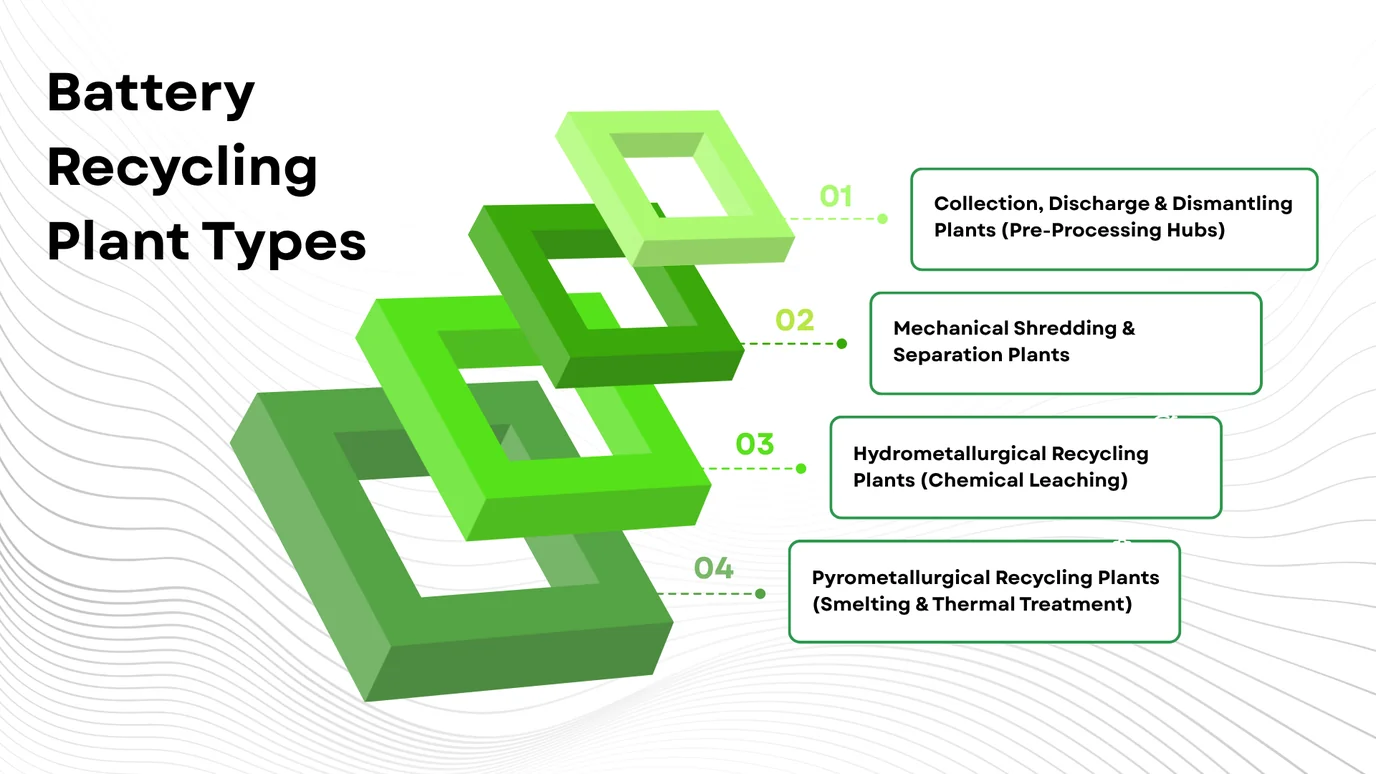
Battery recycling plants fall into four main types. The type depends on the process used, the cost to set up, and where the plant sits in the recycling chain. You can run a small pre-processing hubPre-Processing HubFacility where waste materials are sorted, separated, and prepared for specialized recycling. or a full chemical refinery, depending on your scale and budget.
Recycling Supply Chain Model
Collection & Dismantling (Safe Segregation) ──► Mechanical Processing (Black Mass / Metal Scrap) ──► Pyrometallurgy OR Hydrometallurgy (Smelting / Chemical Refining)
Collection, Discharge & Dismantling Plants (Pre-Processing Hubs)
-
Process Focus: Collection, safety deactivation, automated/manual pack disassembly, and cell sorting.
-
How It Works: You start by safely discharging large battery packs, like those from electric vehicles or UPS systems. This is done with a salt bath or resistor circuits to prevent fire risk. Next, you remove the outer casing and cooling plates, then separate the battery modules or cells for the next step.
-
Primary Output: Neutralised, sorted battery cells, steel/aluminum casings, copper wire harnesses, and plastic casings.
-
Capital & Operational Intensity: Low to Medium CAPEX; labour-intensive.
Mechanical Shredding & Separation Plants
-
Process Focus: You reduce the size of the batteries, then use air and magnets to separate the parts. Screens sort out the rest.
-
How It Works: You shred the discharged cells in two steps, using nitrogen or argon gas to stop fires. Magnets pull out iron and steel. Air and vibrating screens separate copper and aluminium foils from the powder that holds the valuable metals.[10]
-
Primary Output: For lead-acid batteries, you get clean polypropylene chips and lead paste. For lithium-ion batteries, you get black mass (a powder with nickel, cobalt, and lithium) and copper or aluminium foils.
-
Capital & Operational Intensity: These plants cost a medium amount to set up and use a moderate amount of power.
Hydrometallurgical Recycling Plants (Chemical Leaching)
-
Process Focus: You use chemicals to extract metals. This includes acid leaching, solvent extraction, and making the metals settle out as solids.
-
How It Works: You dissolve black mass or lead paste in acids like sulphuric or nitric acid, with reducing agents. Then you use solvents and adjust the pH to pull out each metal one by one.[11]
-
Primary Output: You get high-purity chemicals like lithium carbonate, cobalt sulphate, nickel sulphate, and refined lead salts. These are used to make new batteries.
-
Capital & Operational Intensity: These plants need high capital to set up. You also need advanced systems to treat chemical wastewater.
Pyrometallurgical Recycling Plants (Smelting & Thermal Treatment)
-
Process Focus: You use high heat to reduce, smelt, and separate the metals from the waste slag.
-
How It Works: You feed spent batteries or lead paste into a blast or rotary furnace at over 1200°C. The plastics and liquids burn off as gas. What remains is a liquid metal mix of nickel, cobalt, copper, and lead.[12]
-
Primary Output: You get crude lead, nickel-cobalt alloys, and slag as outputs.
-
Capital & Operational Intensity: These plants need very high capital and use a lot of energy. You also need strong systems to clean the gases before release.
In India, the type of plant you choose depends mainly on the battery chemistry you plan to process.
Lead-Acid Battery (LAB) Plants: Over 90% of lead-acid battery recycling in India uses pyrometallurgy with rotary or blast furnaces. You break the battery casings with hammer mills, separate the plastics in sink-float tanks, and smelt the lead paste in rotary furnaces. This gives you lead ingots that are 99.97% pure.
Lithium-Ion Battery (LIB) Plants: For lithium-ion batteries, most plants use two steps: first mechanical shredding, then hydrometallurgy. Direct smelting is not common because you lose most of the lithium in the slag. Instead, you shred the cells under inert gas to make black mass, then use acid leaching to recover lithium, cobalt, and nickel salts. Recovery rates are usually over 95%.
EV Battery Recycling: What Changes When the Pack Comes Out of a Vehicle
An EV battery recycling line is a lithium-ion line with a heavier front end. The chemistry, the machinery and the licences are the ones described above. What changes is that the feedstock arrives as a vehicle pack rather than as loose cells, and that the seller is usually a manufacturer with a legal obligation to hand it over.
- The pack has to be made safe before it can be processed. Large packs from electric vehicles are discharged in a salt bath or across resistor banks, then stripped of casing and cooling plates so the modules and cells can be sorted. That is the work of a Tier 1 collection and dismantling hub, and it sits ahead of every other step.
- Chemistry decides the economics. NMC and NCA packs from electric cars carry cobalt and nickel and are the valuable ones. LFP dominates Indian electric two- and three-wheelers and its metal value is lower, so an LFP-heavy plant lives on how much lithium it can recover.
- Shredding is done under inert gas. A charged cell that is cut open can burn, which is why the 5 TPD mechanical line costed in section 2 uses a nitrogen-blanketed, explosion-proof dual-shaft shredder. Its output is black mass, not a finished metal.
- The buyer is the cell industry. Black mass refines into precursor cathode active material (pCAM) that goes back into new EV cells. That is why Tier 3 economics rest on hydrometallurgy rather than smelting — direct smelting loses most of the lithium in the slag.
- The feedstock is contracted, not bid for. EV brand owners are named in the Battery Waste Management Rules, 2022 and carry EPR obligations, so end-of-life packs, warranty returns and manufacturing rejects move on take-back agreements. Direct contracts with EV two- and three-wheeler manufacturers are what keep an EV line fed; open auctions do not.
The volume is arriving. Lithium-ion is the fastest-growing segment of India’s battery recycling market at about 27% CAGR, automotive scrap already supplies about 60% of feedstock, and more than 2.3 million annual EV sales are entering their replacement cycles.
4. Battery Recycling Licence in India: CTE, CTO and EPR and more
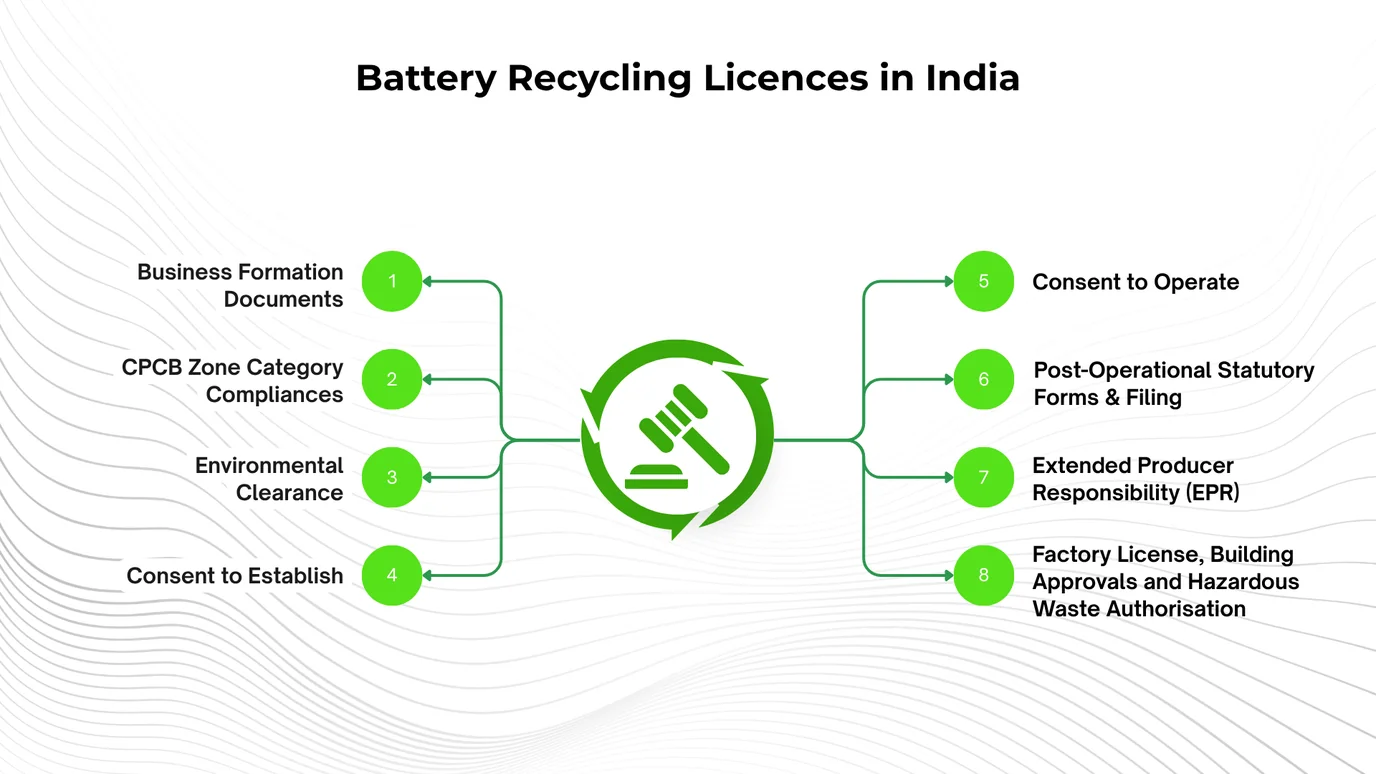
You must follow a strict sequence of regulatory steps to set up a battery recycling plant. Each approval depends on the one before it, so you cannot skip or rearrange the order.
Business Formation documents
Register your company as a Private Limited Company or LLP on the MCA Portal. You will also need the following:
- PAN (Permanent Account Number) – You need a PAN to file income tax returns on profits from selling recovered metals and EPR certificates.
- TAN (Tax Deduction and Collection Account Number) – Once your plant starts making payments, you must deduct tax at source (TDS) when buying battery waste and collect tax at source (TCS) when selling recovered metal. You need a TAN for these transactions. TDS and TCS apply only if your turnover crosses certain thresholds.
- GST (Goods and Services Tax) registration – GST is an indirect tax on goods and services in India. It allows you to claim input tax credit, so the GST you pay on purchases is set off against the GST you collect on sales. This reduces your net cost. The benefit is significant if you invest heavily in machinery like shredders, separators, and classifiers.
- MSME (Udyam) Registration (Optional) – MSME registration classifies your plant as a micro, small, or medium enterprise. Registering on the Udyam portal gives you access to government benefits like lower interest rates on loans, priority sector lending, electricity bill concessions, and eligibility for capital subsidy schemes for recycling plants.
- IEC (Import Export Code) - IEC is a 10-digit code from the Directorate General of Foreign Trade (DGFT). You need it to import or export goods. For a battery recycling plant, you need an IEC if you plan to import machinery like shredders or sorting systems, or export processed black mass and metal salts.
CPCB Zone Category Compliances
You must pick your industrial zone according to the pollution index factor.[22] This number measures how much your plant will pollute. If you choose the wrong zone, you will not get regulatory approval.
The Central Pollution Control Board sets the zoning rules in its Classification of Industrial Areas.
Lithium-Ion Battery Recycling Plant Zones:
- If you use only hydrometallurgical processes, you can set up your plant in the Orange Zone.
- If you use pyrometallurgical processes with cleaner or gaseous fuels, you can also set up in the Orange Zone.
- If you use pyrometallurgical processes with coal or liquid fuels, you must set up in the Red Zone.
- If you use both conventional hydrometallurgical and pyrometallurgical methods, you can only set up in the Red Zone.
Lead Battery Recycling Plant Zones:
- You can only set up a lead battery recycling plant in the Red Zone.[23]
Environmental Clearance
Environmental ClearanceEnvironmental Clearance (EC)Mandatory regulatory approval required for certain industrial projects in India before commencement of operations. comes under the EIA Notification, 2006. As per entry 3(a), battery recycling plants that use hydrometallurgical and pyrometallurgical processes for recovery require clearance from the SEIAA or MoEF&CC. For purely mechanical setups for black mass recovery, EIA environmental clearance is not needed.
Consent to Establish (CTE)
Once you have secured your land, apply for Consent to Establish (CTE)Consent To Establish (CTE)The approval a State Pollution Control Board issues before a plant may be built at a given site, under the Water Act 1974 and the Air Act 1981. from your State Pollution Control Board (SPCB) before you start any construction, order machinery, or begin site work. Getting CTE early lets the board review and approve your site layout, water use, and pollution control plans before you spend on major equipment. It is important to note that once CTE is obtained, plant construction must be completed within 5 years.
Documents Required for CTE Application
- Proof of Land Ownership / Registered Lease: Copy of land deed, allotment letter, or long-term industrial lease agreement (minimum 10–15 years).
- Site & Factory Layout Plan: Detailed drawing showing plant dimensions, machinery layout, raw battery storage area, hazardous waste storage shed, drainage lines, and designated greenbelt space.
- Detailed Project Report (DPR): Complete technical report covering raw material capacities, process flow diagram, water requirement balance sheet, power load breakdown, and total capital investment.
- Process Flow ChartProcess Flow ChartA step-by-step diagram showing how a process works using standardized symbols and arrows. and Material Balance – This is a schematic tracking of the process flow your plant will use, with details on inputs, outputs, and losses at each stage.
- Pollution Control System Proposals: Engineering designs for air pollution control devices (baghouse filters, wet scrubbers) and liquid effluent treatment (Zero Liquid Discharge / ETP plans).
- Business Incorporation & ID Proofs: Company Certificate of Incorporation (CIN), GST, PAN card, and authorized signatory board resolution.
Consent to Operate (CTO)
After you get your CTE and finish construction, machinery installation, and pollution control setup, apply for Consent to Operate (CTO)Consent To Operate (CTO)The approval a State Pollution Control Board issues before a built plant may begin operating, under the Water Act 1974 and the Air Act 1981. It is renewed periodically. from your State Pollution Control Board (SPCB) 60 to 90 days before you plan to start production. CTO is your final permit under the Water and Air Acts. Running the plant or even trial production without a valid CTO is illegal and can result in the plant being sealed or power cut by state authorities.
- Consent to Operate (CTO) (SPCB)
- Hazardous and Other Wastes Authorization (SPCB)
- Factory License (Directorate of Factories & Boilers / Chief Inspector of Factories)
- Fire Safety NOC ( State / District Fire & Rescue Services Department)
- CPCB Battery Recycler EPR Registration (CPCB)
- High-Tension (HT) Industrial Power Load Sanction (DISCOM)
- Groundwater Extraction NOC (SIDC)
Documents Required for CTO Application
- Copy of Previously Issued CTE: Valid Consent to Establish (CTE) order issued by the State Pollution Control Board.
- CTE Compliance Report: Point-by-point compliance report demonstrating that all conditions stipulated in the original CTE order have been fulfilled.
- As-Built Factory & Machinery Layout: Final architectural and machine layout drawing highlighting installed pollution control units (baghouses, wet scrubbers, ETP).
- Completion & Machinery Commissioning Proof: Invoices for installed recycling machinery and performance completion certificates from equipment suppliers.
- Effluent Treatment & Emission Analysis Reports: Water, trade effluent, and stack emission test reports from an NABL-accredited or SPCB-approved laboratory.
- Hazardous Waste Management Plan: Application under Form 1 detailing secure battery storage, electrolyte handling, and tie-ups with certified TSDF operators.
- Water & Electricity Connection Proof:HT industrial power sanction letter, electricity bill, and water allocation agreement or CGWA NOC.
- Fire Safety NOC & Factory Registration Copy: Approved Fire NOCFire NOCMandatory fire safety approval required before a waste-to-value facility can legally operate. from the state fire department and Factory License copy issued by the Directorate of Factories.
You must apply to renew your CTO on the SPCB portal at least 120 days before it expires. Include your environmental compliance records to avoid any legal gaps in your operations.
Post-Operational Statutory Forms & Filing Flow
- Maintain Daily Plant Records (Form 3 Register): Keep a daily logbook at the plant. Record all incoming spent batteries, daily processing quantities, stored black mass or recovered metals, and hazardous waste sludge.
- Track Hazardous Residue Dispatches (Form 10 ManifestForm 10 ManifestRegulatory tracking document required for all hazardous waste transport in India.): For every truck that sends toxic waste or electrolyte sludge to a certified TSDF operator, use the 7-copy manifest system. This is required for legal chain-of-custody tracking.
- Submit SPCB Hazardous Waste Annual Returns (Form 4): Combine your daily Form 3 records and submit your annual environmental compliance report to the State Pollution Control Board before 30 June each year.
- Upload Operational Data on CPCB EPR Portal: Log into the CPCB portal to report how much scrap you collected, your recovered metal yields, and to generate digital EPR creditsEPR CreditsTradable certificates that represent compliance with producer responsibility obligations for end-of-life product management. for trading.
Extended Producer Responsibility (EPR)
Under the Battery Waste Management (BWM) Rules notified by the Ministry of Environment, Forest and Climate Change (MoEFCC), Extended Producer Responsibility (EPR) is an environmental policy mandate based on the "polluter pays" principle. It makes entities introducing batteries into the Indian market legally responsible for the entire life cycle of those batteries, from manufacturing to collection, recycling, and material recovery. Managed centrally via the CPCB online portal.
EPR creates a digital credit system that tracks battery sales, enforces minimum recovery targets, and supports a circular economy.
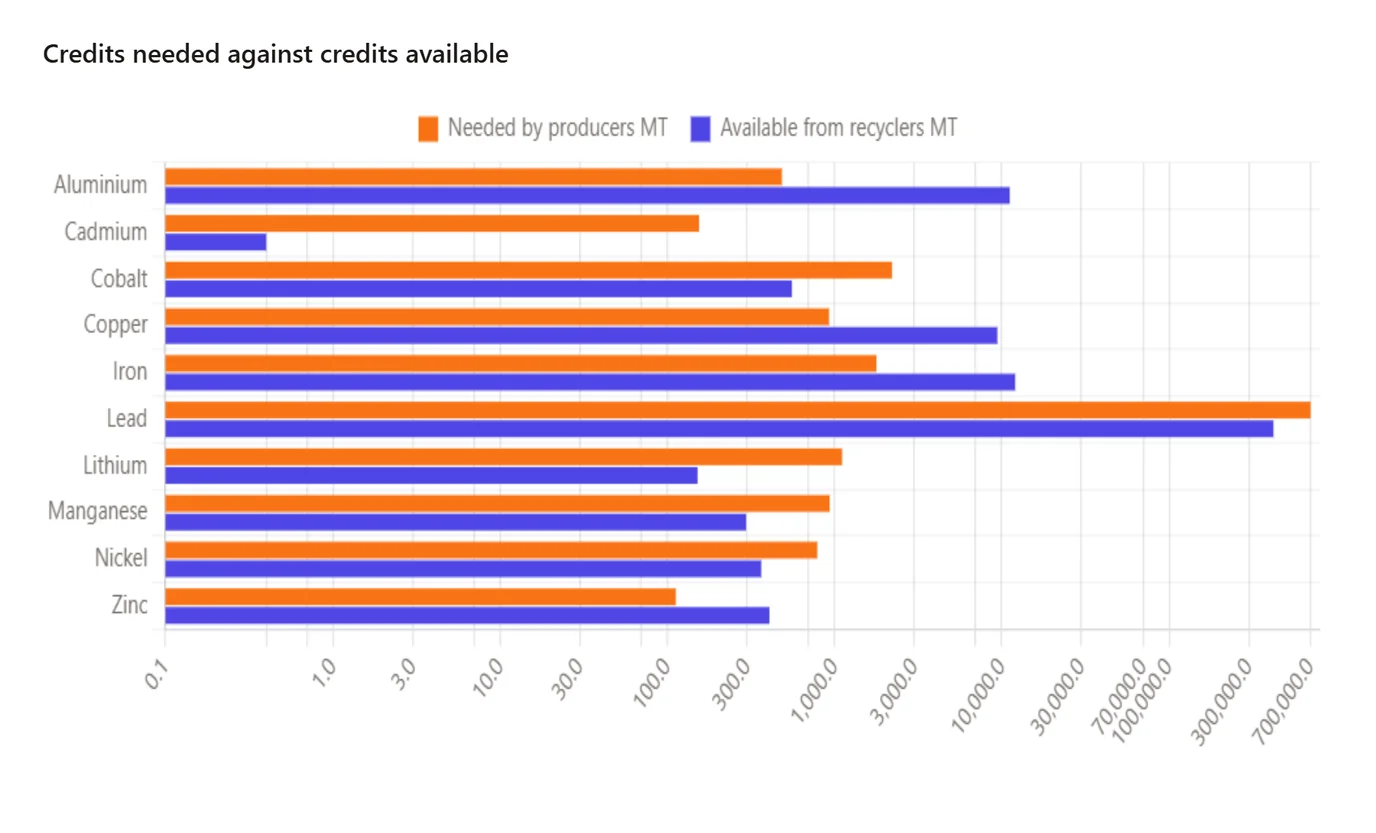
The system sets up a dual market. Producers buy compliance credits, and formal recyclers earn extra revenue by issuing those credits.[7]
EPR Compliance Matrix: Producer vs. Recycler
| Compliance Parameter | Producer / Importer Perspective | Recycler Perspective |
|---|---|---|
| Core Responsibility | Mandatory collection and recycling of spent batteries based on historical sales targets. | Guaranteeing minimum 90% lead recovery yield through environmentally sound technology. |
| Monetization and Financial Flow | Buys digital EPR certificates to satisfy annual statutory recycling deficits. | Generates and sells digital EPR credits on CPCB portal, creating a high-margin secondary income. |
| Material Mandate | Must integrate mandatory minimum percentage of domestically recycled materials in new batteries. | Supplies pure secondary lead ingots (99.97%) or recovering metals (Li, Co, Ni, Cu) back to OEMs under closed-loop contracts. |
| Portal Reporting and Audit | Files annual/quarterly returns on sales, collection volumes, and certificate retirements. | Submits real-time weighbridge data, energy logs, and mass balance reports for CPCB verification. |
Key Takeaway for Business Owners
- For battery producers, EPR turns waste management from a voluntary CSR activity into a legal and financial obligation. If you miss your targets, you face heavy Environmental Compensation (EC) penalties.
- For recycling entrepreneurs, EPR gives you a steady supply of raw material through OEM buyback contracts. It can also increase your gross profit margins by 15% to 25% through certificate trading.
Approval Bodies & Indicative Timelines
The table below summarizes the key regulatory approvals, licenses, issuing authorities, and processing timelines required to set up and operate a Battery recycling facility in India:
| Approval Body | Licence / Certificate | Indicative Timeline* | Legal Framework Baseline |
|---|---|---|---|
| SPCB / PCC | Consent to Establish (CTE) | ~60 Days | Air Act 1981 / Water Act 1974 |
| SPCB / PCC | Consent to Operate (CTO) | ~90 Days | Air Act 1981 / Water Act 1974 |
| SPCB / PCC | Hazardous Waste Authorisation | ~120 Days | HOWM Rules 2016 |
| Directorate of Factories | Factory Licence | 30 to 60 Days | Factories Act 1948 |
| State Fire Services | Final Fire Safety NOC | 15 to 30 Days | NBC 2016 / State Fire Acts |
| CPCB (Central) | EPR Portal Recycler Registration | 30 Working Days | Battery Waste Management Rules, 2022 |
Indicative approval timelines and governing bodies for a battery recycling plant; Hazardous Waste Authorisation and the CTO are the longest lead items.
5. How to Start a Battery Recycling Business: Step by Step
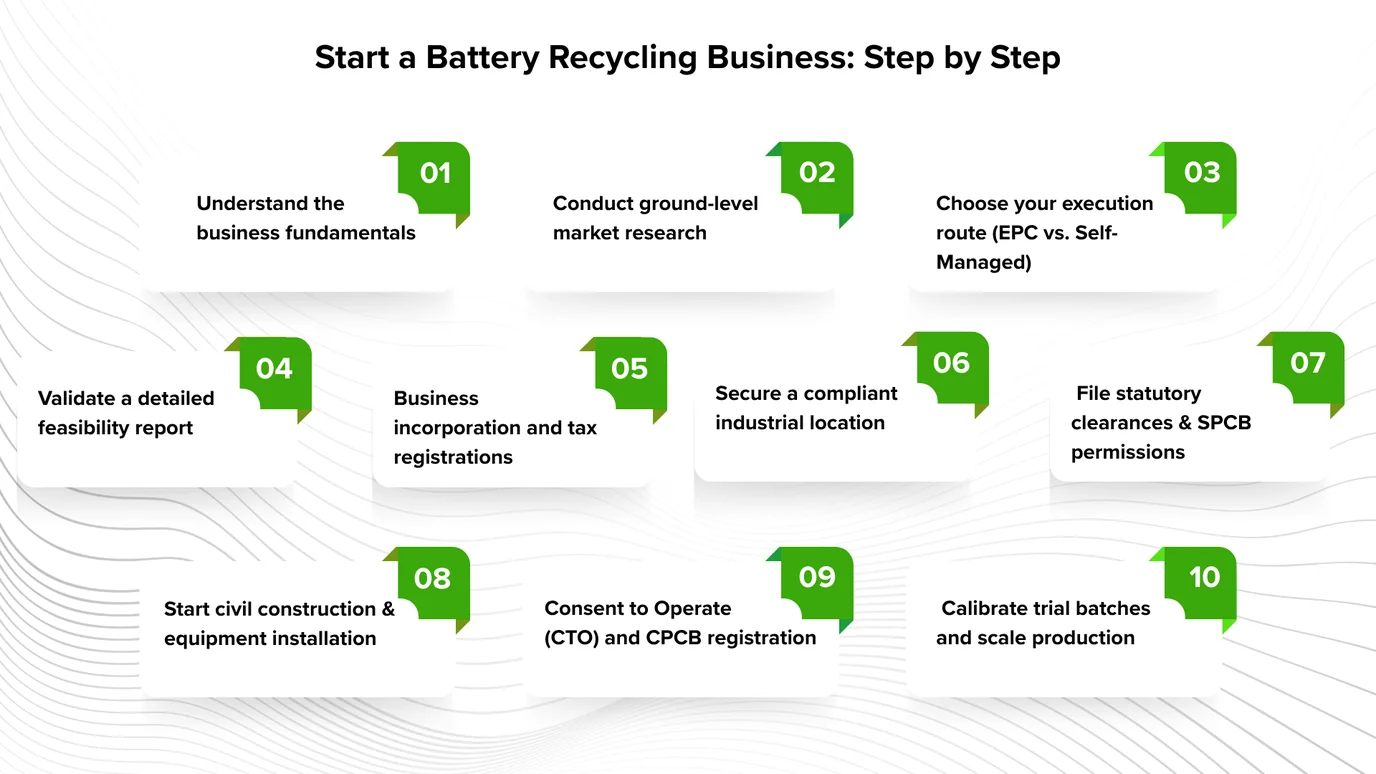
Step 1: Understand the business fundamentals
Before you spend any money, make sure you understand how the battery recycling business works from start to finish. This includes how you will get scrap batteries, the basics of smelting or leaching, how you will sell the recovered metal, and how digital EPR (Extended Producer Responsibility) credits work on the CPCB (Central Pollution Control Board) platform. If you need more detail, Adhara-Viveka has resources on battery waste recycling.
Step 2: Conduct ground-level market research
Talk to local scrap dealers, equipment suppliers, battery traders, and regulatory consultants in your area. Prices for spent batteries, machinery, and compliance paperwork change quickly. Get written quotes before you build your budget. Do not rely on rough estimates.
Step 3: Choose your execution route (EPC vs. Self-Managed)
Decide if you will hire an EPC (Engineering, Procurement, and ConstructionEngineering, Procurement, and Construction (EPC)A turnkey contracting arrangement where one contractor handles design, procurement, and construction of industrial facilities.) contractor for a full setup, or if you will buy equipment and manage the project yourself with help from consultants. An EPC can speed up the process and gives you one point of contact. Managing it yourself usually costs less, but you will need to handle more details.
Step 4: Validate a detailed feasibility report
Get a Detailed Project Report (DPR). This is your main financial plan, not just a formality. Check the DPR’s assumptions about capital costs (CAPEX) using what you learned from your own research before you show it to banks or investors.
Step 5: Business incorporation and tax registrations
Once you know the project works on paper, set up your business. Register as a Private Limited company or LLP. Get your GST number, apply for an MSME or Udyam registration, and get an Import-Export Code (IEC) if you plan to trade scrap or metal outside India.
Step 6: Secure a compliant industrial location
Buy or lease industrial land only in approved industrial zones like MIDC, GIDC, or RIICO that allow Red or Orange Category operationsOrange Category OperationsIndustries with moderate pollution potential requiring specific environmental clearances and ongoing regulatory compliance.. Make sure the site has access for heavy trucks, enough electrical power (200 to 500 kW or more), industrial water supply (15 to 50 KLD), and enough space for a 33% greenbelt around the boundary, as required.
Step 7: File statutory clearances & SPCB permissions
Submit your Consent to Establish (CTE) application to the State Pollution Control Board prior to breaking ground on civil works. Concurrently apply for Hazardous Waste Authorization (HWA) under Schedule IV, secure a Fire Department NOC, and obtain factory layout approvals from the local Department of Factories and Boilers.
Step 8: Start civil construction & equipment installation
Build enclosed sheds with acid-resistant floors and bunds to contain spills. Install your main processing equipment, such as shredders, sorters, furnaces, or leaching tanks. Set up a Zero Liquid Discharge (ZLD) plant, air pollution control systems with a 30-metre stack, and online emission monitoring (OCEMSOnline Continuous Emission Monitoring System (OCEMS)Real-time monitoring system that tracks industrial air emissions and transmits compliance data to regulatory authorities.).
Step 9: Secure Consent to Operate (CTO) and CPCB registration
After the State Pollution Control Board (SPCB) inspects your site and checks your pollution control systems, you will get your Consent to Operate (CTO). Upload your CTO and factory approvals to the CPCB portal to register as an authorised recycler. This lets you issue and trade digital EPR certificates.
Step 10: Calibrate trial batches and scale production
Run trial batches, both cold and hot, to adjust your process settings like furnace temperature, baghouse pressure, and scrubber pH. Once your emissions and discharges meet legal limits, start buying scrap at scale, increase production of ingots or black mass, and begin selling EPR credits on the CPCB exchange.
6. Battery Recycling Machinery and Equipment List
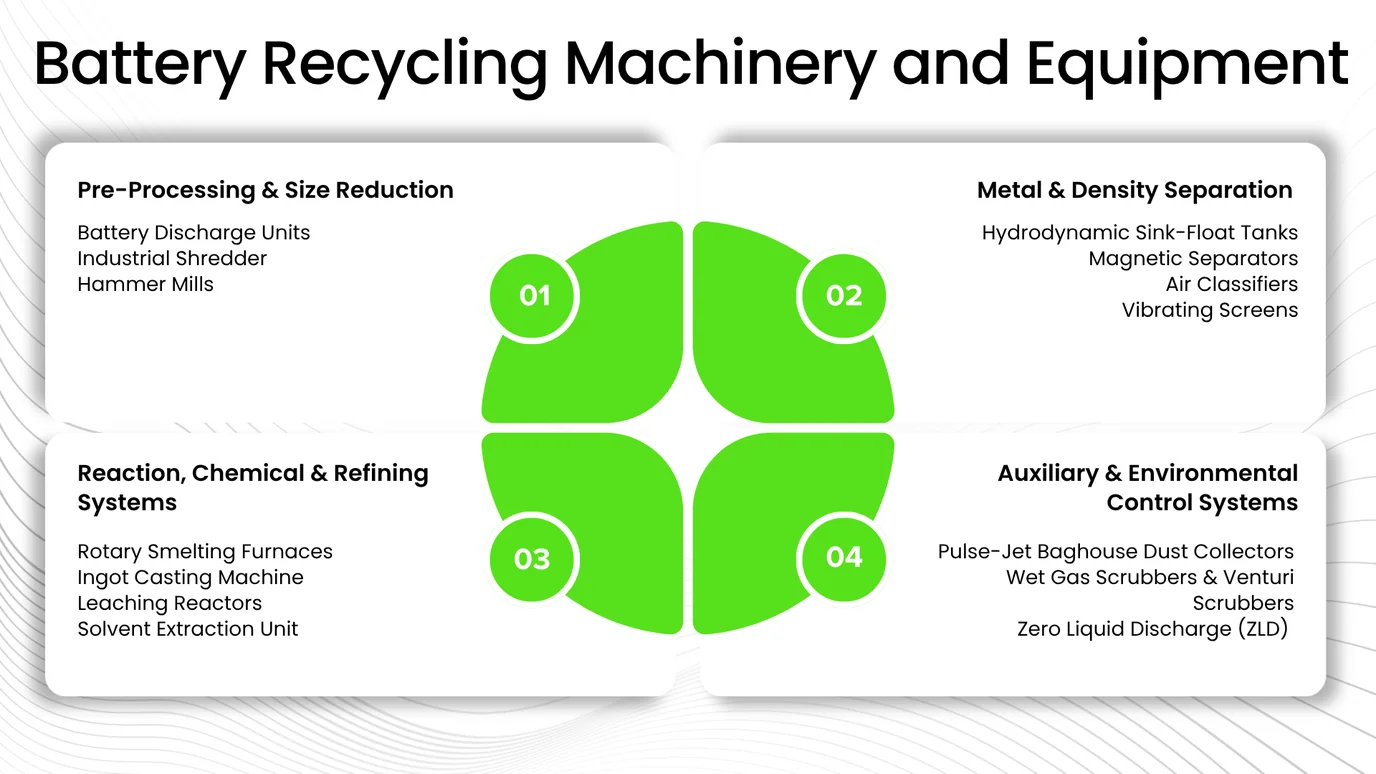
A battery recycling plant uses several types of machinery, each for a specific step. You can group the equipment into four main stages: pre-processing, physical separation, refining, and environmental controls.
The main process steps are: Pre-processing (discharge baths, shredders, mills), Metal and density separation (sink-float tanks, Z-shape separators), Reaction and refining (smelting furnaces, hydrometallurgical reactors), and Pollution control (baghouse filters, zero liquid discharge systems, scrubbers).
Pre-Processing & Size Reduction Equipment
-
Battery Discharge Units: Deep immersion tanks use saltwater or electrical loads to drain any leftover charge from batteries. This step prevents thermal explosions during crushing.
-
Industrial Shredder: Industrial shredders are heavy, low-speed crushers that run under nitrogen. They break battery packs into coarse, even pieces.
-
Hammer Mills: Hammer mills are high-speed machines that crush shredded battery parts. They release the active powder (called Black Mass) from lithium-ion batteries or loosen lead paste from metal grids in lead-acid batteries.
Metal & Density Separation Machinery
-
Hydrodynamic Sink-Float Tanks: Sink-float tanks are water channels where light plastic chips float and heavy metal parts sink. This separates polypropylene (PP) casings from lead grids and paste.
-
Magnetic Separators: Magnetic separators use strong magnets above conveyor belts to pull out steel and iron parts as the material moves through.
-
Air Classifiers: Pneumatic air-flow systems that isolate light separator films and plastic dust from heavier metallic particles.
-
Vibrating Screens: Vibrating screens use layers of mesh to separate fine Black Mass powder from larger pieces of copper and aluminium foil.
Reaction, Chemical & Refining Systems
- Rotary Smelting Furnaces (Pyrometallurgy): Rotary smelting furnaces run at 1000 to 1200°C. They melt lead paste and scrap metal to produce purified lead ingots.
-
Ingot Casting Machine: Ingot casting machines pour, cool, and solidify molten metal into standard ingots for sale.
-
Leaching Reactors (Hydrometallurgical): Leaching reactors are sealed, acid-resistant tanks. They use acids to dissolve Black Mass powder and release metal ions into solution.[16]
-
Solvent Extraction Unit: Solvent extraction units use chemical columns to separate lithium, nickel, cobalt, and manganese salts by adjusting the pH.
- Crystallization Reactor: Crystallisation reactors turn purified metal solutions into solid, battery-grade salts such as lithium carbonate and cobalt sulphate.
Auxiliary & Environmental Control Systems
-
Pulse-Jet Baghouse Dust CollectorsPulse-Jet Baghouse Dust CollectorIndustrial dust collector that uses compressed air pulses to clean fabric filter bags and remove particulate matter from recycling processes.: Baghouse dust collectors use fabric filters to trap fine lead dust and particles from shredding and furnace exhaust.[17]
-
Wet Gas Scrubbers & Venturi Scrubbers: Wet gas scrubbers spray alkaline solutions to absorb sulphur dioxide (SO2) and other harmful vapours before the gas is released.
-
Zero Liquid Discharge (ZLD) Effluent Plant: Zero liquid discharge (ZLD) plants use filtration, reverse osmosis, and evaporation to treat acidic wastewater so it can be reused completely within the plant.
Machine Selection Best Practices
When purchasing battery recycling equipment, you must look beyond the initial purchase price and evaluate machines based on throughput efficiency, structural safety, and verified recovery yields. Buyers should mandate guaranteed output performance metrics from suppliers—specifically requesting an 85% to 95% recovery yield for Black Mass powder in Lithium-Ion lines and 95% pure metal recovery in Lead-Acid breaking and smelting lines.
Machines that process batteries must have built-in safety controls. Lithium-ion shredders need a constant nitrogen blanket or oxygen monitoring to prevent fires. Lead-acid crushers should use acid-resistant alloys or thick polypropylene linings to handle sulphuric acid. Ask for a clear list of blade replacement costs and check that spare parts are available locally. This helps you avoid expensive shutdowns.
When you buy recycling machinery, focus on real-world performance and safety features, not just what the catalogue says. Ask the supplier for a live Factory Acceptance Test (FAT) or visit a working client site. Check that the recovery yield is above 95% and that the equipment can be expanded easily, for example by upgrading from a 1 ton per hour shredder to a larger line as your feedstock increases.
You should prioritise vendors who offer full lifecycle support, modular equipment, and built-in compliance with environmental rules, not just individual machines. Choose suppliers with experience in turnkey projects so that all parts of the plant work together and meet CPCB emission and ZLD standards from the start. Make sure your contract includes on-site installation, operator training, and a 1 to 2 year warranty on major parts like gearboxes and drive motors. This protects your investment.
7. Battery Recycling Plant Location, Layout and Infrastructure
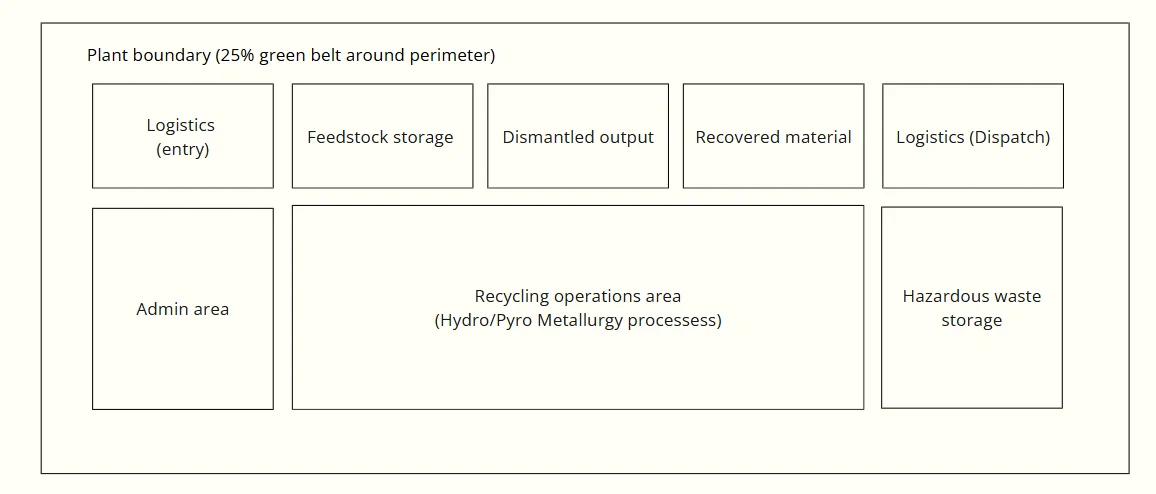
Your site choice decides if you get State Pollution Control Board (SPCB) clearance and avoid major logistics problems. If you process hazardous heavy metals, battery acids, or flammable lithium solvents, your plant is classified as Red Category under Central Pollution Control Board (CPCB) rules. This triggers strict buffer zone rules for your site.
Key Siting Criteria & Regulatory Buffer Requirements
To get Consent to Establish (CTE), you must choose land inside a designated industrial estate like MIDC, GIDC, RIICO, or UPSIDA, or in a non-agricultural industrial zone.[13]
- Designated Industrial Zones: Set up your facility inside an authorised state industrial park or an area with an approved industrial master plan.
- Greenbelt Compliance: Set aside 10 to 33 percent of your land for a greenbelt buffer, as required by CPCB rules.
- Residential & Institutional Buffer: Pick a site at least 500 metres to 1 kilometre from any notified residential area, school, hospital, or urban settlement.[15]
- Ecological & Water Body Buffer: Keep at least 500 metres between your site and any major water source like a river, lake, or canal, and any forest boundary or protected ecological area.
- Logistics Corridor Siting: Choose a site close to a national or state highway. This makes it easier to move heavy lead scrap, black mass, and refined chemical products.
Demand-Supply Strategy
When you choose a plant location, check the gap between where battery waste is generated and where registered processing capacity exists.
-
Target High-Generation OEM Clusters: If you locate your plant near major automotive and battery assembly hubs like Maharashtra, Tamil Nadu, or the NCR region, you cut logistics costs and can tie up directly with OEMs for manufacturing scrap and EPR take-back contracts.
-
Capitalize on the Regional Capacity Gap: While states like Uttar Pradesh and Rajasthan host dense lead smelting capacity, regions in Southern and Eastern India face a deficit in local, CPCB-authorized Li-ion recycling facilities, creating lower local competition for raw scrap.
-
Adopt a Hub-and-Spoke Model: If you set up decentralised mechanical shredding spokes near dense urban collection hubs, you can concentrate raw scrap locally and move high-density black mass efficiently to a central chemical refinery.
Core Infrastructure Requirements
A compliant battery recycling plant needs specialised civil engineering and dedicated environmental protection utilities.
| Infrastructure Module | Engineering Specifications | Critical Operational Role |
|---|---|---|
| Acid-Impervious Flooring | Acid-resistant epoxy flooring with bunded containment walls and concrete spill troughs. | Prevents sulfuric acid and electrolyte leaks from seeping into soil or groundwater. |
| Power Load Connection | 200 kW to 500 kW+ 3-phase commercial grid line (plus backup industrial DG sets). | Drives mechanical shredders, air classifiers, pumps, and pyrometallurgical furnace induction setups. |
| Effluent Treatment Plant (ETP / ZLD) | Closed-loop Zero Liquid Discharge (ZLD) setup featuring neutralization tanks, RO units, and evaporators[14]. | Treats acidic wastewater, chemical leachates, and floor washing runoff for 100% water reuse. |
| Air Pollution Control System (APCS) | Multi-stage baghouse filters, venturi scrubbers, and alkaline wet scrubbers tied to designated stacks. | Captures lead dust, acid fumes, and volatile organic compounds (SO2/VOCs) to meet CPCB stack norms. |
Utility Breakdown
- Processing/Operations Zone - Use about 30 percent of your land for battery discharge, dismantling, shredding, black mass separation, and hydrometallurgical or pyrometallurgical recovery lines. This is your core production area.
- Hazardous Waste Storage Zone - Set aside 10 percent for storage sheds for non-recoverable hazardous residue waiting for TSDF (Treatment, Storage, and Disposal Facility) dispatch.
- Effluent Treatment Zone (ETP) - Use 10 percent of your land for a wastewater treatment system. This is needed to meet the Zero Liquid Discharge requirement before any water leaves your site.
- Warehousing Zone - Set aside 10 percent for inbound storage of collected scrap or used batteries, and outbound storage for recovered material waiting to be sent to buyers.
- Administrative & Utility Zone - Use 10 percent for your office building, security or entry gate, weighbridge for tracking inbound and outbound tonnage, and parking.
- Movement spaces - Keep 5 percent of your land for future expansion.
The people who usually explain this business to you — vendors, brokers, commission agents — earn money when you say yes. We do not. We sell the understanding, not the project.
8. Where to Source Battery Feedstock
You cannot run a battery recycling plant profitably unless you can get a steady supply of good-quality feedstock. One place to start is the list of companies selling battery waste on MyWasteSolution. The type of feedstock you get will vary by chemistry, contamination, yield, and how you source it.
Feedstock Classification by Battery Chemistry
Each battery chemistry needs its own processing setup. Mixing them reduces metal recovery and increases the risk of fire or thermal incidents.
1. Lead-Acid Battery (LAB) Feedstock
-
Flooded Lead-Acid (FLA): These are large vehicle batteries with liquid sulphuric acid, metallic lead plates, and lead oxide paste.
-
Valve-Regulated Lead-Acid (VRLA / AGM / Gel): These are sealed batteries from telecom and home UPS systems. The acid is immobilised, so you get high purity and predictable scrap yields.
2. Lithium-Ion Battery (LIB) Feedstock
-
NMC (Nickel Manganese Cobalt) & NCA: These batteries are used in electric cars and high-end electronics. They are valuable because you can recover cobalt and nickel from them.
-
LFP (Lithium Iron Phosphate): This chemistry is common in Indian electric two-wheelers, three-wheelers, and energy storage. The metal value is lower, so profitability depends on how much lithium you can recover.
-
LCO (Lithium Cobalt Oxide): You find these in older smartphones, laptops, and power banks. They have high cobalt content.
3. Off-Spec Manufacturing Scrap & Production Rejects
- Anode/cathode trimmings, rejected coated foils, and non-conforming battery cells sourced directly from gigafactories and cell assembly lines.
Feedstock Sourcing Channels
You can source feedstock in four main ways:
| Channel | Feedstock Category | Key Procurement Strategy | Commercial Drivers |
|---|---|---|---|
| Direct B2B Take-Back Agreements | EV OEMs, Telecom, and Battery Manufacturers | Long-term contracts to manage manufacturing rejects, warranty returns, and end-of-life EV packs. | OEMs fulfill CPCB EPR mandates; recyclers gain traceable, high-volume feedstock. |
| Aggregator Networks and Kabadiwalas | Unorganized Retail Scrap | Aggregating spent consumer batteries, auto batteries, and solar UPS units via local scrap yards. | Spot-market pricing based on daily metal indexes (e.g., LME lead rates). |
| Bulk Institutional Auctions | Indian Railways, State Transport (STUs), Discoms | Bidding on high-volume government tender auctions for spent substation and traction batteries. | Predictable, bulk volume streams with standardized battery dimensions. |
Feedstock Strategy & Storage Mandates
Never mix lead-acid and lithium-ion batteries in the same processing line. If a lithium-ion cell goes into a lead smelter or hammer mill, it can explode or catch fire. If you want to process both types, you need separate receiving areas, pre-treatment setups, and crushing or smelting lines.
To avoid downtime, keep 15 to 30 days of feedstock on site. The CPCB allows you to store spent batteries for up to 90 days, but you must follow their storage rules.
You need different storage setups for each type. Lead-acid batteries need acid-proof floors, bunded walls, and acid fume collection. Lithium-ion batteries need dry, climate-controlled storage with thermal sensors, spark-proof tools, and automatic fire suppression to manage fire risk.
9. Battery Recycling Business Plan
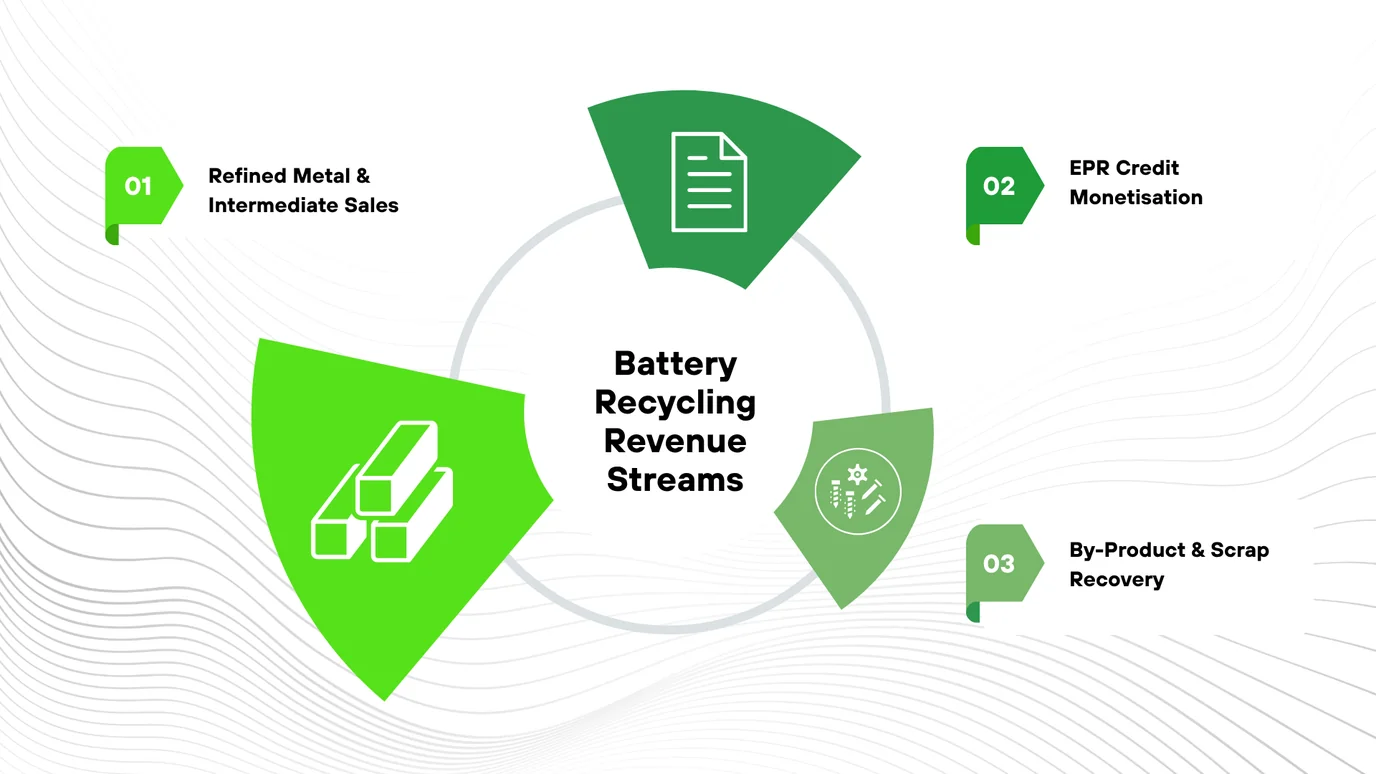
A battery recycling business earns money in two main ways. First, it turns hazardous battery waste into valuable raw materials. Second, it generates revenue by meeting legal recycling obligations under the CPCB Extended Producer Responsibility (EPR) rules.
Revenue Streams
-
Refined Metal & Intermediate Sales: You can earn revenue by selling 99.97% pure lead ingots from lead-acid battery (LAB) plants, or by selling Black Mass powder and battery-grade salts like Li2CO3, CoSO4, and NiSO4. Your main buyers are battery manufacturers, alloy makers, and chemical refiners.
-
EPR Credit Monetisation: You can also sell digital EPR certificates on the central CPCB portal. Battery importers, OEMs, and brand owners buy these certificates to meet their legal recycling targets.
-
By-Product & Scrap Recovery: You can generate extra cash by selling separated copper foils, aluminium casings, and polypropylene (PP) plastic granules to local plastic and metal recyclers.
Business Models
Battery recycling plants use different business models depending on their budget, technical skills, processing methods, and target customers. Choosing the right model, or a mix of models, affects how well you manage feedstock risk and keep your cash flow steady.
1. Tolling & Contract Recycling Model (Fee-for-Service): In this model, you do not buy or own the battery waste. Instead, companies like EV OEMs, battery cell makers, or telecom firms pay you a fee to process their used batteries. You shred the batteries, recover the metals or Black Mass, and return the processed material to the client.
2. Merchant Recycling / Direct Scrap Purchase Model: In this model, you buy used batteries from scrap dealers, auctions, or telecom operators. You process the batteries and sell the recovered materials, like pure lead ingots, Black Mass, or copper and aluminium, on the open market.
3. EPR Compliance & Credit Monetisation Model: Under CPCB's Battery Waste Management Rules, battery producers, importers, and EV brand owners face mandatory statutory recycling obligations. Authorised recyclers process battery waste, log the verified yield on the central CPCB web portal, and generate digital Extended Producer Responsibility (EPR) certificates, which are then sold directly to obligated entities.
4. Hub-and-Spoke (Decentralised Pre-Processing) Model: This model uses several small collection and shredding centres near cities with many EVs. You crush batteries at these local hubs to make Black Mass or lead paste, then send this concentrated material to a central plant for chemical processing or smelting.
5. Closed-Loop "Battery-to-Battery" (B2B Circular Partnership): In this model, you partner directly with a cell manufacturer or precursor producer. You take their manufacturing scrap, recover battery-grade salts like Li2CO3, CoSO4, and NiSO4, and supply these straight back for use in making new cathodes.
Financial Metrics & Investment Returns
| Financial Indicator | Simple Explanation |
|---|---|
| Revenue Projections | The total annual gross income earned by the facility across all sales streams. Includes selling secondary metals (refined lead ingots, copper, aluminum, or Black Mass) and trading digital CPCB EPR credits. |
| Profit and Loss (P&L) Statement | The final accounting statement showing how much net income remains after deducting all expenses. Subtracts raw scrap costs, power, fuel, chemicals, labor, and taxes from total revenue. |
| Return on Investment (ROI) | How much overall profit the plant generates each year compared to the initial project cost. It measures how hard your invested capital is working. |
| Payback Period | The exact time required to recover 100% of your starting investment. Shows how quickly your project reaches zero risk and starts generating net profit. |
| Breakeven Capacity | The minimum plant utilization needed to cover fixed overheads. The point where total operational revenue equals running costs and the business stops bleeding cash. |
| EBITDA Margin | The pure operating profit percentage of the business. Shows core machinery and operational efficiency before accounting for taxes, interest, and bank loan payments[21]. |
Sensitivity Factors
Feedstock Spread Sensitivity: Your business only works if you keep a positive margin between what you pay for battery scrap and what you get for your outputs. Scrap prices often follow the LME lead price or Black Mass value.
Metal Extraction Yields: If your Black Mass recovery or metal extraction drops by 5%, your EBITDA can fall by 10% to 15%. This shows why you need reliable shredders and efficient hydrometallurgical equipment.
EPR Credit Price Stabilisation: EPR certificate trading can add 10% to 20% to your net margin. This extra income helps protect your business when global metal prices fall.
10. Risks and Challenges in Battery Recycling
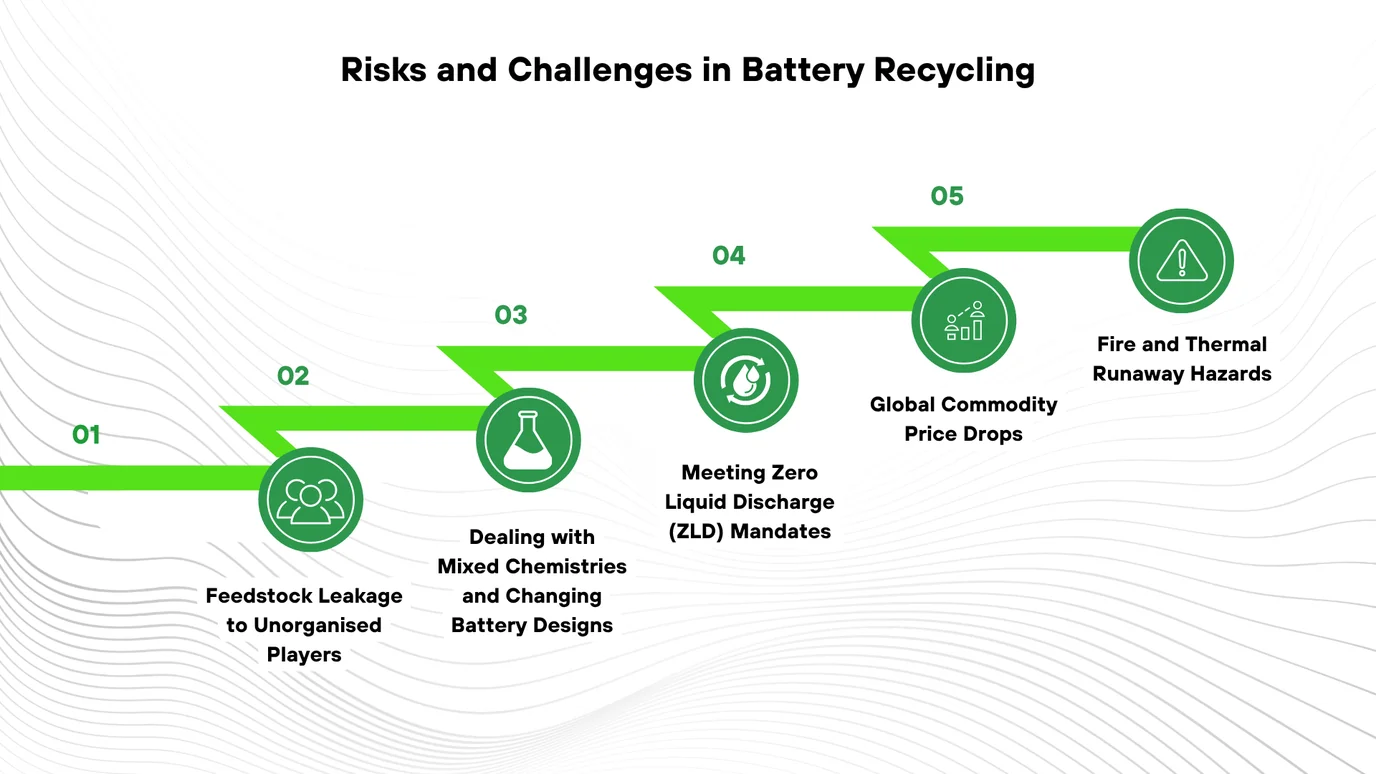
Running a commercial battery recycling plant in India brings specific operational risks. Here are the main challenges you will face, and the practical steps you can take to manage them.
Feedstock Leakage to Unorganised Players
In India, a large share of spent batteries, especially lead-acid, goes to informal collectors and illegal backyard smelters. These operators avoid taxes and pollution control costs, so they can pay more for scrap. This often leaves formal plants short on feedstock and running below capacity.[22]
- Mitigation: To secure feedstock, avoid open auction bidding. Instead, sign direct, long-term take-back agreements with EV two-wheeler and three-wheeler manufacturers, corporate UPS users, telecom companies, and battery importers who need CPCB EPR credit offsets.
Dealing with Mixed Chemistries and Changing Battery Designs
Batteries come in all shapes, sizes, and chemical mixes. A line built strictly for one chemistry. A line designed only for LFP batteries will not process NMC cells efficiently. Manual pack dismantling also slows down operations. Duty dual-shaft shredders and pneumatic air density separators can process mixed input feeds, and use batch-based chemical leaching setups that can adjust acid concentrations depending on the cathode chemistry.[23]
Fire and Thermal Runaway Hazards
Spent lithium batteries often hold residual electrical charge, called stranded energy. This can cause short circuits, fires, or toxic gas release during storage or crushing.[24]
- Mitigation: Discharge all incoming batteries fully before crushing. Use deep saltwater immersion tanks or electrical resistor discharge units. Run shredding and crushing lines under an inert gas blanket, such as nitrogen, to remove oxygen and prevent fires.
Meeting Zero Liquid Discharge (ZLD) Mandates
Pollution control boards set strict limits on toxic wastewater. Acidic effluent from battery washing, lead de-sulfurisation, or hydrometallurgical leaching contains heavy metals and sulphates. You cannot legally discharge this water outside your plant.
- Mitigation: Set up a closed-loop water recycling system from the start. Use a Multi-Effect Evaporator (MEE)Multi-Effect Evaporator (MEE)Industrial evaporation system using multiple heat recovery stages to concentrate liquid waste streams with high energy efficiency. with Reverse Osmosis (RO) units and automated gas scrubbers to neutralise acidic wash water. This lets you recycle all water back into your plant.
Protecting Margins Against Global Commodity Price Drops
Raw scrap prices change with international metal exchanges such as the London Metal Exchange (LME). If you buy spent batteries at a high price and metal rates fall before you sell your output, your margins will shrink.
- Mitigation: Use a dynamic pricing formula for buying raw scrap that links directly to real-time LME rates. Also, include digital CPCB EPR credits in your revenue plan. EPR certificate trading can provide a second income stream when global metal prices fall.[25]
Costs, regulations, location analysis and vendor comparison for battery recycling — researched from source, not estimated. Free to browse.
11. Is Battery Recycling Business Worth Starting?
Battery recycling in India can work as a business, but only if you run it as a proper manufacturing operation. Treating it as simple waste handling does not deliver reliable results.[26]
What Drives the Business Case
A Policy-Backed Strategic Safety Net: The Battery Waste Management Rules (BWMR) and Extended Producer Responsibility (EPR) require manufacturers and importers to meet strict recycling targets. This creates a steady supply of used batteries for recyclers. You can also earn extra revenue by selling EPR certificates through the CPCB portal.
High Economic Returns: Established lead-acid battery recycling plants in India usually report EBITDA margins between 18% and 24%, and annual returns on investment (ROI) from 25% to 45%. For lithium-ion batteries, early plants using hydrometallurgical processes can earn high margins by recovering metals like lithium, cobalt, and nickel. This is driven by growing demand from electric vehicles and grid storage.
Urban Mining & National Resource Security: India imports most of its raw battery metals. Recycling spent batteries into secondary metal ingots and high-purity Black Mass (the concentrated mix of valuable metals from processed batteries) reduces this dependence. It also gives recyclers more control over prices when selling to Indian battery manufacturers.[27]
The Operational Reality: What It Takes to Win
Profitability is possible, but not guaranteed. The main difference between a working plant and one that fails is how you handle three key areas:
- Secured Supply Channels: Successful plants avoid open auctions and instead secure direct supply contracts with electric vehicle manufacturers, fleet operators, and telecom companies.
- CPCB Environmental Compliance: You need Zero Liquid Discharge (ZLD) systems and multi-stage air pollution scrubbers to keep your State Pollution Control Board (SPCB) Consent to Operate (CTO) license.[28]
- Flexible Technology: Plants with modular shredders and flexible leaching circuits can handle changes in battery types and scrap quality.
If you can secure a steady supply, meet all compliance requirements, and keep recovery rates high, battery recycling is a proven manufacturing business in India.
Weighing this against another stream? The same guide exists for starting an e-waste recycling business — similar approvals, a lower entry cost, and a different set of buyers for what it recovers. The same is true of a plastic recycling business, where the EPR credit system works the same way.
12. Battery Recycling Market Size and Industry Outlook in India (2026)
India's battery recycling industry is undergoing a structural transformation in 2026, transitioning rapidly from an unorganized scrap trade into a highly regulated, tech-driven circular economy market. Driven by surging EV sales, expanding telecom infrastructure, and strict government recovery targets, the domestic demand for organized recycling capacity has reached an all-time high.
As of 2026, the Indian market value for battery recycling stands at approximately USD 616 Million, with projections indicating it will cross USD 1.49 Billion by 2032[4] at a robust CAGR of 15.85%.
Market Segmentation & Projections (2026 vs. 2032)
| Market Segment | 2026 Status and Market Share | Key Growth Drivers |
|---|---|---|
| Lead-Acid Batteries (LAB) | Dominant (~46.8% Market Share)[5] | Telecom UPS, commercial vehicle fleets, inverter systems, mature scrap supply chain. |
| Lithium-Ion Batteries (LIB) | Fastest Growing (~27% CAGR) | Electric 2W/3W retirements, smartphone replacement cycles, grid energy storage. |
| Automotive Feedstock | Largest Feedstock Source (~60%) | Over 2.3 million annual EV sales entering replacement cycles. |
Market Growth Drivers
-
Strict EPR Mandates: The Extended Producer Responsibility (EPR) framework under the Battery Waste Management Rules enforces a mandatory 90% material recovery target for recyclers by FY 2026–27.[6]
-
Critical Mineral Security: India relies heavily on imports for Lithium, Cobalt, and Nickel. Domestic recycling is now recognized as a strategic "urban mining" asset to reduce import dependency.
-
Formalization of Informal Recycling: Central Pollution Control Board (CPCB) compliance rules are diverting spent batteries away from unorganized smelters toward certified zero-emission facilities.
Recycling Capacity & Market Gap
India generates over 1.2 Million Tonnes (12 Lakh Tonnes) of spent battery waste annually across automotive, industrial, consumer electronics, and renewable sectors.
- Lead-Acid Battery (LAB) Waste: ~1,050,000 to 1,100,000 Tonnes/Year
- Lithium-Ion Battery (LIB) Waste: ~90,000 to 120,000 Tonnes/Year
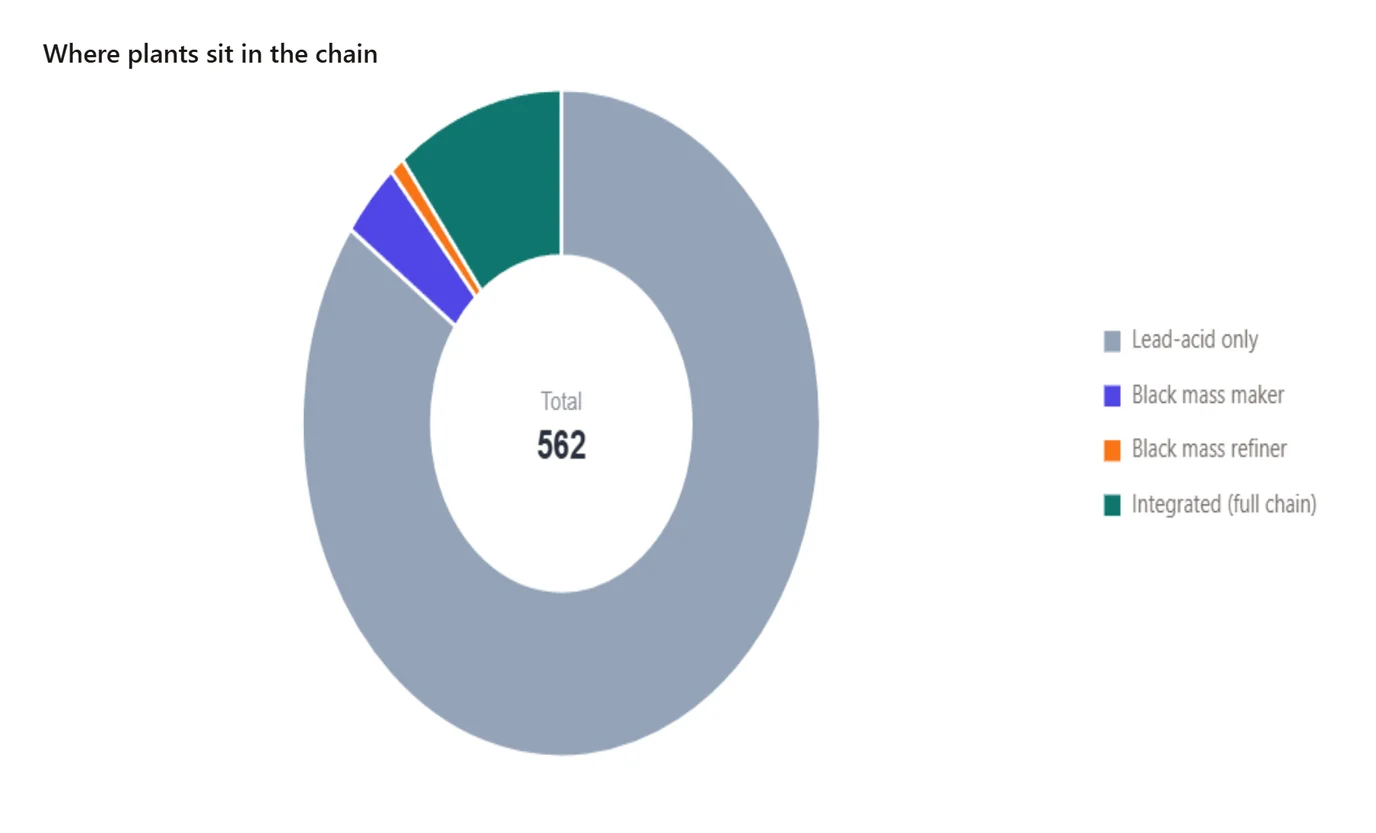
562 plants hold 6,070,444 MT/yr of licensed capacity.
-
By licence: 477 plants (84.9%) can only do lead-acid, and 85 plants (15.1%) hold at least one non-lead-acid licence (R2, R3 or R4).
-
Only 24 plants (4.3% of the industry) have ever proven they can process lithium-type batteries.
-
Of the 85 plants licensed for lithium-type work, 71.8% have produced no evidence of it — 28 earned nothing at all, 13 recovered only casing metals, and 18 did lead-acid work instead.
Geography & siting
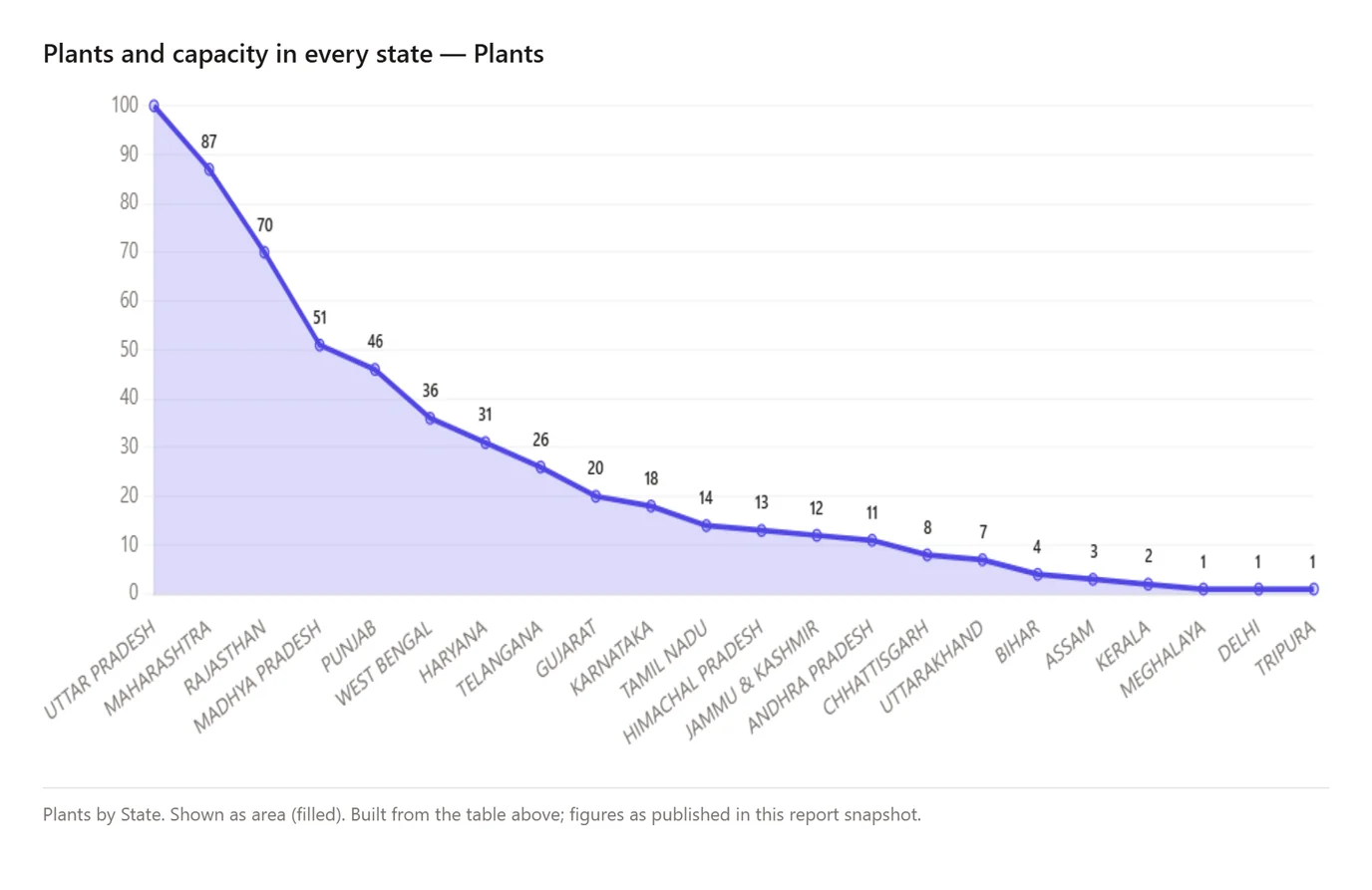
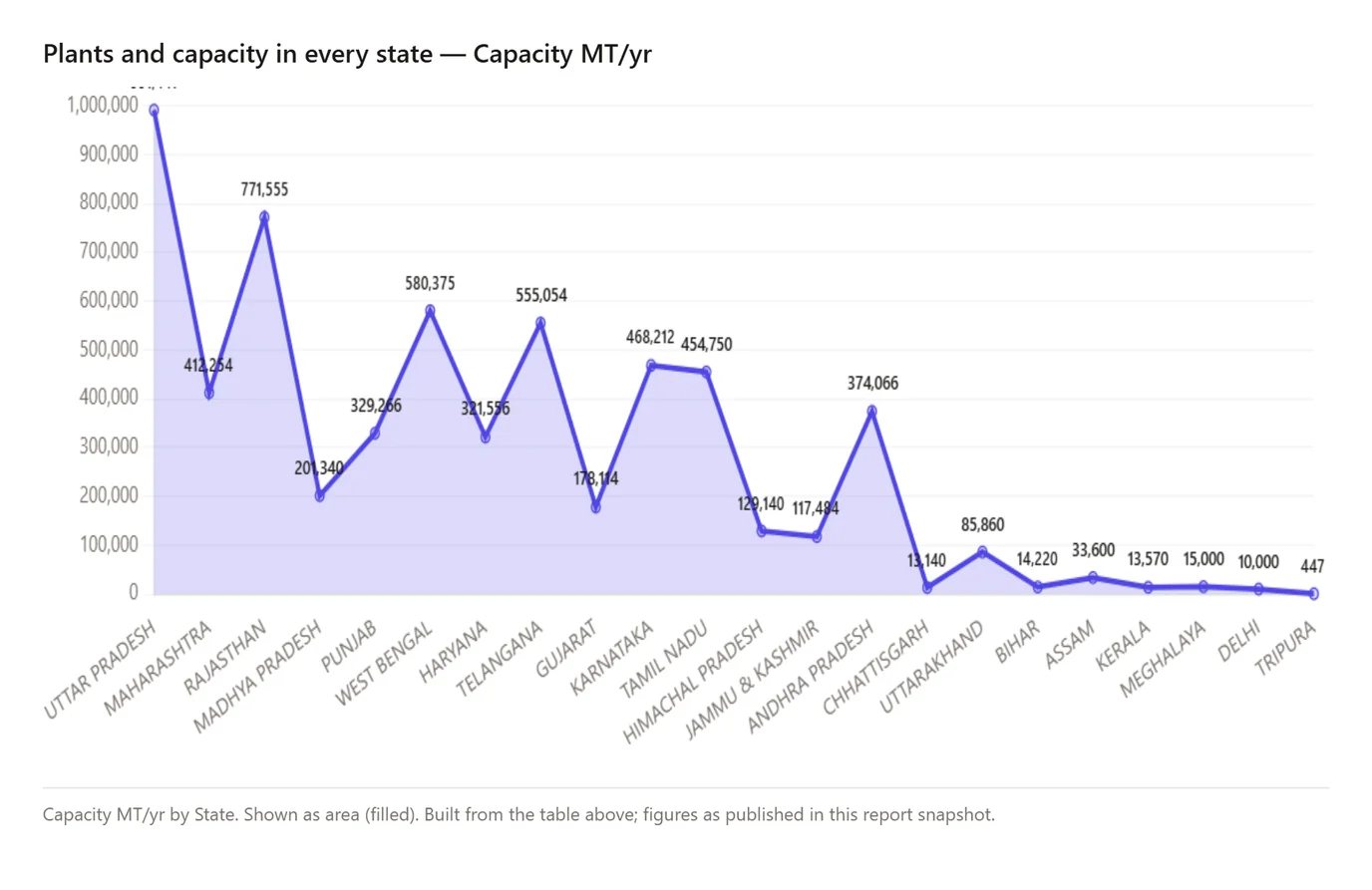
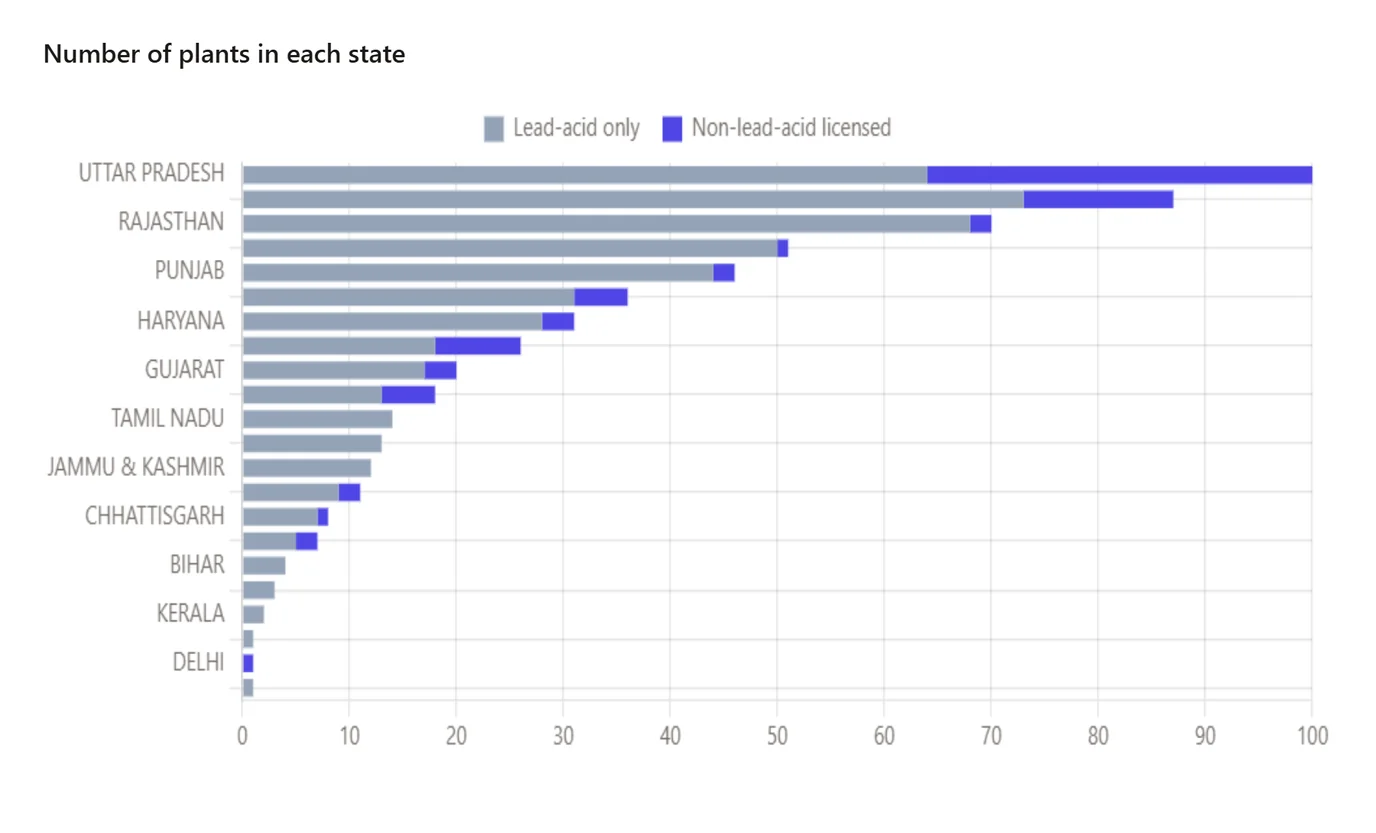
With mandatory CPCB recovery targets pushing producers to secure EPR credits while authorized recyclers remain in short supply, India faces a massive demand-supply gap in official recycling capacity. This deficit creates a high-margin opportunity for new, compliant plants to generate immediate revenue by processing raw feedstock and selling tradable EPR certificates directly to battery manufacturers and OEMs.
13. Key Regulatory Policies, Subsidies & Framework
Battery recycling in India is now tightly regulated. You must comply with rules set by the Central Pollution Control Board (CPCB), register on their online portal, and meet Extended Producer Responsibility (EPR) requirements. If you do not comply, the penalties are significant.
Primary Regulatory Policies & Rules
The Ministry of Environment, Forest and Climate Change (MoEFCC) replaced the 2001 rules with the 2022 Battery Waste Management Rules. These cover four types of batteries: Electric Vehicle (EV), Portable, Automotive, and Industrial.[7]
- Mandatory EPR Targets & Material Recovery:
Lead-acid battery recyclers must recover at least 90% of materials. Lithium-ion battery recyclers have lower targets at first, but these increase over time.
- Centralized CPCB EPR Credit Portal:
You must register on the CPCB online portal if you produce, import, refurbish, or recycle batteries. As a recycler, you generate EPR certificates for the materials you recover. You sell these certificates to battery producers, who need them to meet their legal targets.
These rules set out how you must store, handle, transport, and move heavy metal scrap, acid sludge, and other toxic waste from battery processing.
Government Subsidies & Financial Incentives
Central and state governments offer subsidies to support battery recycling and critical mineral recovery in India.
National Critical Mineral Mission (NCMM) Recycling Incentive:
The National Critical Mineral Mission (NCMM) offers ₹1,500 Crore in incentives for extracting critical minerals from battery scrap and other secondary sources.[8]
-
You can get a 20% subsidy on equipment, machinery, and utilities if your plant does full mineral extraction, not just basic shredding.
-
There are also production-linked incentives based on your extra sales above a set baseline.
-
Small companies and startups can get up to ₹25 Crore in total support. Large companies can get up to ₹50 Crore.
State Industrial Development Policies:
States like Uttar Pradesh, Gujarat, Tamil Nadu, and Rajasthan offer extra incentives for battery recycling plants.
-
You can get 25% to 50% off land prices in certain industrial zones.
-
Some states reimburse 100% of State GST (SGST) for five to ten years.
-
You may also get electricity duty waivers and power tariff discounts of ₹1 to ₹2 per unit.
Environmental Compensation (EC) & Penalties
If you do not comply with the CPCB Environmental Compensation guidelines, you face heavy financial penalties. You will not get a warning notice first.[9]
| Violation Type | Liable Entity | Penalty / Consequence |
|---|---|---|
| Operating Without CPCB/SPCB Registration | Recyclers / Smelters | Immediate shutdown order, plant sealing, and heavy EC levies. |
| Incorrect Reporting / Fraudulent EPR Credits | Recyclers | Cancellation of EPR portal registration, financial penalty, and legal prosecution under Section 15 of EPA. |
| Improper Hazardous Residue Disposal | Processing Facility | Daily environmental compensation fees until full remediation is verified. |
FAQs: Battery Recycling Business in India: Cost, Licences, Profit and How to Start (2026)
Can I legally import used battery scrap from other countries to keep my plant running?
No, you cannot import used lead-acid or lithium battery waste for recycling. The Hazardous Waste Management Rules restrict this to stop dumping from other countries. You will need to source your feedstock from within India. Most plants get supply from domestic scrap dealers, corporate auctions, telecom battery replacements, or EPR take-back agreements with local EV manufacturers.
How long does the complete setup and licensing process take before commercial production?
You should plan for 12 to 18 months from start to production. Getting land in an approved industrial park usually takes 2 to 3 months. The State Pollution Control Board (SPCB) Consent to Establish (CTE) takes another 3 to 4 months. Civil work and machinery setup need 5 to 6 months. The final steps—Consent to Operate (CTO), Hazardous Waste Authorisation, and CPCB EPR portal registration—take 2 to 3 months more.
How do CPCB EPR credits actually generate cash for my business?
Every ton of battery waste you recycle generates a digital EPR certificate on the CPCB portal. Battery makers and EV brands are legally required to buy these certificates to meet their recycling targets. This gives you a second source of income besides selling recovered metals. The price is set by demand from these obligated companies, not just the market for metals.
What happens if global metal prices (LME) crash after I buy raw scrap at peak rates?
Margin compression from LME metal price drops is a real risk in merchant recycling. Successful operators mitigate this by implementing dynamic raw scrap purchasing formulas tied directly to weekly LME indexes rather than fixed rates. Additionally, digital CPCB EPR certificate trading acts as a strategic financial cushion, providing fixed, policy-driven cash flow that keeps the facility profitable even during international metal market dips.
Should I focus on Lead-Acid or Lithium-Ion recycling for my first facility?
Lead-Acid recycling offers immediate cash flow and lower technical risk because 70% to 85% of domestic lead demand relies on secondary recycled ingots, ensuring an established domestic market. Lithium-ion recycling offers higher growth and long-term valuation upside driven by India’s EV transition, but demands higher capital, complex hydrometallurgical processing, and advanced fire safety systems. Many new promoters start with lead-acid or mechanical lithium shredding (Black Mass) to generate immediate revenue before expanding into advanced lithium refining. ** **
How is EV battery recycling different from recycling other lithium-ion batteries?
The chemistry, the machinery and the licences are the same. Three things change. An EV battery arrives as a vehicle pack, so it has to be discharged in a salt bath or across resistor banks and torn down to modules before anything else can happen. The chemistry decides the economics — NMC and NCA packs from cars carry cobalt and nickel, while the LFP packs common in Indian two- and three-wheelers pay only on lithium recovery. And the feedstock is contracted rather than bought at auction, because EV brand owners carry EPR obligations under the Battery Waste Management Rules, 2022 and move their packs on take-back agreements.
What does an EV battery recycling plant cost in India?
An EV pack line is a lithium-ion line, so the same three tiers apply. A 2 TPD collection and dismantling hub — the stage that discharges packs and strips them to modules — runs ₹1.05 crore to ₹1.70 crore. A 5 TPD mechanical plant with a nitrogen-blanketed shredder, producing black mass, runs ₹9.40 crore to ₹13 crore. A 10 TPD integrated refinery that also leaches the black mass back to metal salts starts at ₹25.5 crore. Section 2 breaks each tier down line by line, including land, utilities and pollution control.
Is a battery scrap business the same as a battery recycling business?
No, and the difference decides what you can earn. A battery scrap business buys and moves spent batteries — from scrap dealers, aggregator networks and institutional auctions — and sells them on. A battery recycling business processes them, and that is the one that registers on the CPCB EPR portal, generates EPR certificates for the material it recovers and sells those certificates to producers who need them. Section 9 calls the buy-and-process route the merchant recycling model; buying scrap is the first half of it, not a business of its own.
Is there a battery recycling franchise in India, or do I have to build my own plant?
You do not have to build a refinery to start. The two low-capital ways in are both in this guide. A Tier 1 collection and dismantling hub — discharging packs, tearing them down, sorting cells and selling the output to larger recyclers — costs ₹1.05 crore to ₹1.70 crore at 2 TPD. The tolling model asks for less still: EV makers, cell manufacturers and telecom firms pay you a fee to process their batteries and you never buy the material. If someone offers you a franchise, judge it the way you would any vendor — ask for their CPCB recycler registration, their Consent to Operate and their recovery yields, because the licences named in section 4 sit with whoever actually processes the waste.
Sahil Sanwal founded MyWasteSolution, the marketplace where India’s recyclers, waste companies and plant-setup consultants find each other. He writes about what it actually takes to build and run a recycling business here — the costs, the approvals and the economics operators deal with rather than the version in a brochure.
References
- STC Engineering. Lead Acid Battery Recycling Process & Plant Specifications https://stcitaly.com/sites/default/files/library/2021-07/Lead%20Acid%20Battery%20Recycling.pdf
- National Center for Biotechnology Information (NCBI). Efficient Recycling Processes for Lithium-Ion Batteries: Pyrometallurgy, Hydrometallurgy, and Direct Recycling https://pmc.ncbi.nlm.nih.gov/articles/PMC11818314/
- MDPI Materials. Combined Hydro-Mechanical and Pyrometallurgical Recycling Approach for Lithium-Ion Batteries https://www.mdpi.com/2313-0105/9/1/15
- MarkNtel Advisors. India Battery Recycling Services Market Study: Outlook 2026-2032 https://www.marknteladvisors.com/research-library/india-battery-recycling-services-market-study.html
- IMARC Group. India Battery Recycling Market Size, Share, Trends & Forecast 2026-2034 https://www.imarcgroup.com/india-battery-recycling-market
- Central Pollution Control Board (CPCB). Battery Waste Management Rules & EPR Implementation Guidelines https://cpcb.nic.in/
- Central Pollution Control Board (CPCB). Battery Waste Management Rules & EPR Implementation Portal https://eprbattery.cpcb.gov.in/
- Press Information Bureau (PIB), Government of India. Cabinet Approves ₹1,500 Crore Incentive Scheme to Promote Critical Mineral Recycling https://www.pib.gov.in/PressReleasePage.aspx?PRID=2163454
- Central Pollution Control Board (CPCB). Environmental Compensation guidelines (PDF) https://cpcb.gov.in/openpdffile.php?id=TGF0ZXN0RmlsZS80MjFfMTcyNjAzMjEyMF9tZWRpYXBob3RvNjc5NS5wZGY
- International Journal of Innovations in Science, Engineering And Management (IJISEM). Lithium-Ion Battery Components and Its Recycling Methods – A Review https://ijisem.com/journal/index.php/ijisem/article/download/408/377
- Pall Corporation. Recycling of Lithium-Ion Batteries: Hydrometallurgy Process https://www.pall.com/content/dam/pall/chemicals-polymers/literature-library/non-gated/application-notes/lithium-battery-recycling.pdf
- MDPI / ResearchGate. A Novel Pyrometallurgical Recycling Process for Lithium-Ion Batteries https://www.researchgate.net/publication/348497230_A_Novel_Pyrometallurgical_Recycling_Process_for_Lithium-Ion_Batteries_and_Its_Application_to_the_Recycling_of_LCO_and_LFP
- IMARC Group. Lithium-ion Battery Recycling Plant Setup in India: Cost, ROI & Best Siting Locations https://www.imarcgroup.com/insight/lithium-ion-battery-recycling-plant-setup-india
- Gujarat Pollution Control Board (GPCB) & CPCB. Siting Criteria and Guidelines for Storage & Processing of Hazardous Industrial Chemicals https://www.simpliance.in/download/file/dXBsb2Fkcy8xMzA3MjAyMl9FSFNfMDRfMjAyMi0wNy0xM18wNzE5MzcuNzUxMzE4LnBkZg==
- Central Pollution Control Board (CPCB). Locational Criteria and Infrastructure Guidelines for Hazardous Waste Facilities https://odocmms.nic.in/OCMMS/SPCB_DOCUMENTS/CRITERIA%20FOR%20HAZARDOUS%20WASTE%20LANDFILLS.pdf
- Wang, X., et al. (2019). Hydrometallurgical recovery of lead from spent lead-acid battery paste via leaching and electrowinning in chloride solution. Hydrometallurgy / ResearchGate https://www.researchgate.net/publication/335235491_Hydrometallurgical_recovery_of_lead_from_spent_lead-acid_battery_paste_via_leaching_and_electrowinning_in_chloride_solution
- Tian, X., et al. (2016). Environmental impact assessment of recycling spent lead-acid battery by using pyrometallurgical process. Journal of Cleaner Production, 133, 857–868
- ResearchGate. Cost Modelling and Key Drivers in Lithium-Ion Battery Recycling https://www.researchgate.net/publication/394635932_Cost_modelling_and_key_drivers_in_lithium-ion_battery_recycling
- IMARC Group. Lead Acid Battery Recycling Plant Cost, Setup & Detailed DPR https://www.imarcgroup.com/lead-acid-battery-recycling-plant-project-report
- NITI Aayog (2022). Advanced Chemistry Cell Battery Reuse and Recycling Market in India. Government of India Report https://www.niti.gov.in/sites/default/files/2022-07/ACC-battery-reuse-and-recycling-market-in-India_Niti-Aayog_UK.pdf
- Green Li-ion & ResearchGate. Economic Modelling, EBITDA Margins & ROI Factors in Battery Recycling Operations https://www.greenli-ion.com/post/economic-advantages-of-investing-in-battery-recycling
- CEEW Study on Lead Acid Battery Recycling in India. Addressing Feedstock Diversion to Informal Smelters and Capacity Utilization https://www.ceew.in/publications/lead-acid-battery-recycling-india
- ResearchGate / MDPI Technical Review. High-Volume Battery Recycling: Technical Review of Challenges and Future Directions https://www.mdpi.com/2313-0105/11/3/94
- IIT Bombay GESH Knowledge Hub. Battery Recycling, Reuse and Repurpose: Ecosystem, Safety Risks, and Material Recovery https://gesh.iitb.ac.in/site/knowledge-hub-documents/d1ec6ac1-a4dc-11f0-9098-bc2411738d23.pdf
- PMC Academic Review. Current Challenges in Efficient Lithium-Ion Batteries' Recycling: Technological, Economic, and Policy Perspectives https://pmc.ncbi.nlm.nih.gov/articles/PMC9749077/
- RMI (Rocky Mountain Institute) Report. Charting a Circular Battery Future in India: Market Opportunities & Techno-Economic Potential https://rmi.org/resources/charting-a-circular-battery-future-in-india/
- DIYguru / NITI Aayog Industry Review. Battery Recycling India: Market Scale, EPR Frameworks & Capacity Gap Analysis https://diyguru.org/battery-recycling-india/
- P&S Intelligence Market Forecast. India Battery Recycling Market Outlook: Value Drivers and Growth Projections https://www.psmarketresearch.com/market-analysis/india-battery-recycling-market-report