A BioCNG plant turns organic waste such as press mud, cattle dung, paddy straw, food waste and municipal waste into vehicle fuel. Anaerobic digestion makes raw biogas with about 55–60% methane; PSA or membrane systems upgrade it to biomethane above 90%; compressed to 200 to 250 bar, it becomes BioCNG, which replaces fossil CNG without any change to the engine. The leftover digestate is sold as Fermented Organic Manure (FOM) and Liquid FOM.
A commercial plant costs about ₹9 Cr – ₹13 Cr for a wet-CSTR plant on press mud, cattle manure or distillery waste (Model A), and ₹12 Cr – ₹17 Cr for a dry, agro-residue plant on paddy straw or Napier grass (Model B), excluding land. Model A costs about 40% less to run. BioCNG sells at ₹45 to ₹90 per kg, plants report an operating margin of 30% to 40%, and payback takes 4.0 to 5.5 years.
You will need company incorporation, PAN, TAN and GST, Consent to Establish and Consent to Operate from your State Pollution Control Board, a two-stage PESO approval to compress and store gas, and registration on the GOBARdhan portal. Plants on agricultural residue, animal waste, press mud or MSW fall in the Blue category with a 7-year CTO; plants on industrial or process waste are Red, with a 5-year CTO. CTE takes 45 to 90 days and CTO 45 to 60 days.
1. What Does a BioCNG Plant Business Actually Do?
India generates large amounts of agricultural stubble, animal manure, food waste, and press mud every day. Most of this is either dumped or burned, which causes pollution. A circular economyCircular EconomyAn economic model focused on minimizing waste and maximizing resource use by keeping materials in use for as long as possible. approach treats this material as feedstock for biogas production. The biogas can then be upgraded to BioCNG, a fuel that replaces fossil CNG.[1]
Costs, regulations, location analysis and vendor comparison for compressed biogas — researched from source, not estimated. Free to browse.
Understanding Raw Biogas vs. Biomethane vs. BioCNG
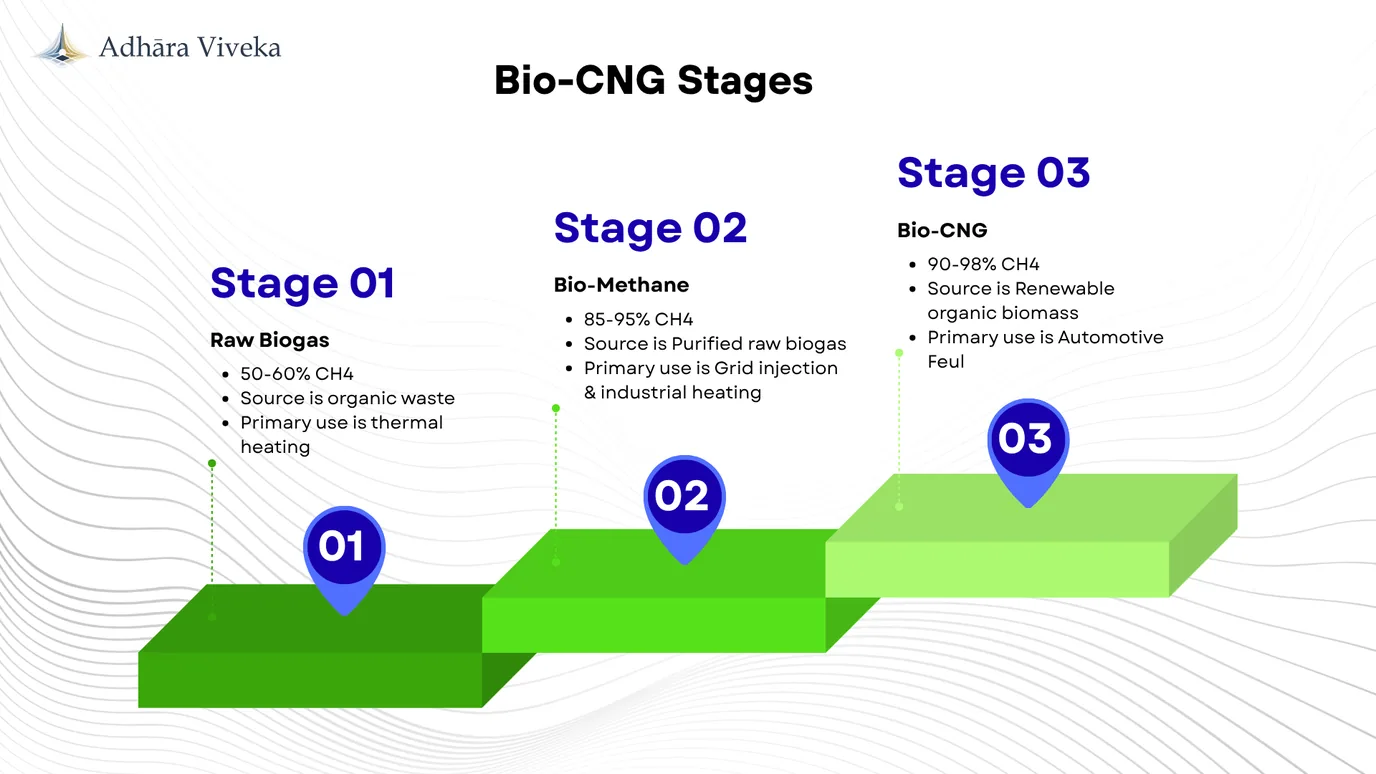
Before you invest in a BioCNG plant, you need to know how waste is converted into fuel-grade gas. The process runs in three main stages.
- Raw biogas: The first stage is anaerobic digestionAnaerobic DigestionBiochemical process where microorganisms break down organic matter in oxygen-free conditions to produce biogas and digestate., which means breaking down organic waste without oxygen. This produces raw biogas, a gas mixture with about 55–60% methane (CH4), 35–40% carbon dioxide (CO2), moisture, and small amounts of hydrogen sulphide (H2S), which is corrosive. You can burn this raw biogas in boilers or generators, but it is not suitable for commercial vehicles.
- Biomethane: In the second stage, you use purification systems like Pressure Swing Adsorption (PSA)Pressure Swing Adsorption (PSA)A separation technique where gases adhere to solid materials at high pressure and release at low pressure, achieving high purity. or membrane technology to remove CO2 and moisture. This increases the methane content to above 90%, usually between 92% and 98%.[2]
- BioCNG: In the final stage, you compress the purified biomethane to high pressure, usually 200 to 250 bar. It is then stored in cascade cylinders or filled directly into vehicles. BioCNG matches fossil CNG in energy value, performance, and chemical composition.
BioCNG as a Vehicle Fuel: How It Compares to Fossil CNG
You can use BioCNG in place of fossil CNG for vehicles. Both meet the same standards for methane purity and pressure, so you do not need to change the engine or the filling system. This makes BioCNG a practical renewable option for transport.
| Parameter | Raw Biogas | Fossil CNG | BioCNG (CBG) |
|---|---|---|---|
| Methane Concentration (CH4) | 50% – 60% | 85% – 95% | 90% – 98% |
| Origin / Source | Organic Waste Decomposition | Underground Fossil Deposits | Renewable Organic Biomass |
| Pressure State | Ambient / Low Pressure | High Pressure (~200 bar) | High Pressure (200–250 bar) |
| Primary Use Case | Thermal Heating / Power Gensets | Transport / City Gas Grid | Automotive Fuel / Gas Grid Injection |
BioCNG Plant Mechanism from a Business Angle
A BioCNG plant turns organic waste into high-purity fuel using a three-step process.
- Feedstock sourcing: You can often get feedstock like press mud, paddy straw, cattle dung, or municipal waste at little or no cost. Sometimes you are even paid a tipping fee to take it. This keeps your raw material costs low.
- Anaerobic Digestion: You feed the organic waste into digesters, usually Continuous Stirred-Tank Reactors (CSTRs)Continuously Stirred Tank Reactor (CSTR)A bioreactor design where feedstock continuously enters while thoroughly mixed digestate exits, maintaining uniform conditions.. Microbes break down the waste and produce raw biogas.
- Gas Upgrading and Compression: The raw biogas is cleaned to remove impurities like CO2, H2S, and moisture. This raises the methane content above 90%. The gas is then compressed for storage and transport.
A BioCNG plant earns money from two main sources of revenue, from both the feedstock you take in and the products you sell.
- BioCNG: You sell most of your gas to Oil Marketing Companies like IOCL, HPCL, and BPCL under long-term offtake agreements. You can also sell to industrial users and city gas distributors.
- Bio-fertilisers: The leftover digestate is processed into Fermented Organic Manure (FOM) and Liquid FOMLiquid FOMLiquid nutrient-rich co-product from anaerobic digestion in CBG plants, used as a local organic fertilizer.. You can sell these to farmers and the agriculture sector.
Links you might be interested in
2. BioCNG Plant Cost in India: Full Breakdown
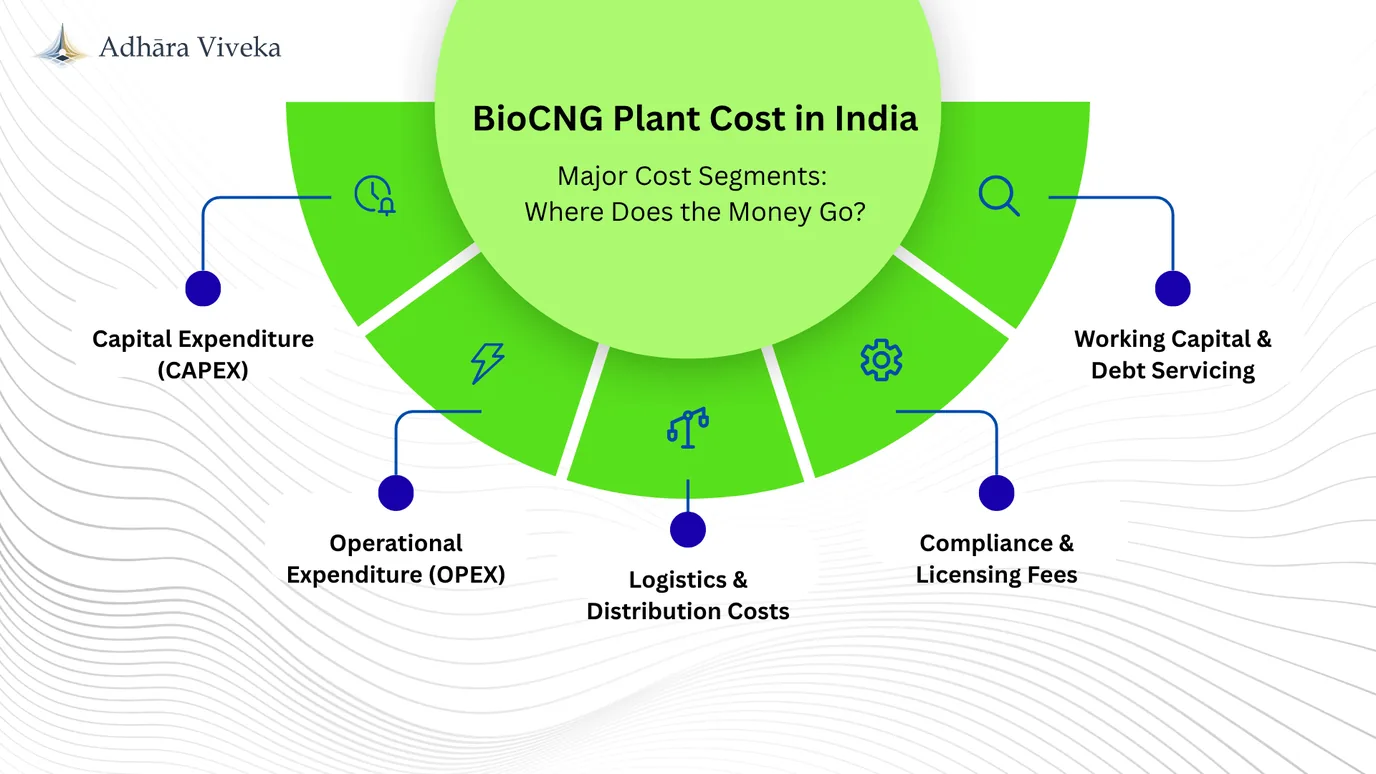
If you are planning a commercial BioCNG plant in India, the main cost is not just the machinery. The real spend includes operating costs, logistics, and the price of meeting compliance rules. You need to understand these costs early. This is how you avoid overruns and plan for a plant that works.
Major Cost Segments: Where Does the Money Go?
You should break down the costs into five main categories to get a realistic picture.
- Capital Expenditure (CAPEX): This covers what you spend upfront on land, building the plant (including digesters, platforms, and storage lagoons), and buying machinery like pre-treatment units, CSTR digesters, upgrading systems, compressors, and cascade storage.
- Operational Expenditure (OPEX): These are your regular running costs. Most of this goes to buying raw biomass, paying for water, electricity, and chemicals, maintaining the plant, and wages.
- Logistics and Distribution Costs: You need to pay to bring raw biomass to your plant and to send compressed gas out to buyers. Both add up quickly.
- Compliance and Licensing Fees: Statutory upfront and annual fees for State Pollution Control Board (SPCB) consents, PESOPESOIndian regulatory body governing safety standards for explosives, petroleum, and hazardous materials handling. (Explosives) approvals, regular safety audits, and end-product quality approvals.
- Working Capital and Debt ServicingDebt ServicingThe periodic cash payments required to cover interest and principal repayment on outstanding debt.: Operational cash reserves to manage daily operations, inventory buffer funds, and bank loan interest payments during the initial phase before reaching full commercial capacity.
Core Factors Influencing the Overall Cost Structure
| Driving Factor | Operational Impact |
|---|---|
| Feedstock Selection and Pre-treatment | Complex feedstocks increase equipment CAPEX (eg: agri and municipal wastes requires pretreatment) and power OPEX by 25%–35%. Whereas press mud or cattle dung requires simple slurry mixing.[3] |
| Upgrading Technology Choice | Membrane systems and Pressure Swing Adsorption (PSA) have higher initial CAPEX but lower parasitic power draw. For Water Scrubbing, the upfront is cheaper but its water intensive.[4] |
| Plant Capacity and Scalability | With larger capacity and higher daily volumes of CBG (Like 15 tons per day instead of 5) spreads out fixed costs and lowers the per-kg production cost significantly |
| Logistical Radius | If your procurement and supply chain radius exceeds 25-30km it directly increases your OPEX with high cost of transport fuel. |
| Digestate Processing Scale | Converting digestate into value-added Granulated Fermented Organic Manure (FOM) involves adding drying, granulating, and bagging machinery which directly increases your secondary CAPEX but creates a secondary revenue stream. |
CAPEX Factors for BioCNG Plants
When you look at CAPEX for a commercial CBG plant, do not just focus on plant capacity. The cost depends just as much on the type of feedstock, the machinery needed to treat it, and the construction required.[5]
Most commercial BioCNG plants in India fit into one of two types.
- Model A (Wet-CSTR or Spent WashSpent WashIndustrial wastewater byproduct from distilleries and food processing operations with high organic content and environmental management challenges. and Slurry) is built for high-moisture feedstocks like press mud, cattle manure, and distillery waste.
- Model B (Dry or Agro-Residue) is for high-ligninLigninA complex polymer that provides structural support to plant cell walls, making them rigid and difficult to decompose, low-moisture agricultural waste like paddy straw and Napier grass. This type needs heavy shredding and thermo-chemical pre-treatmentThermo-Chemical Pre-TreatmentHeat and chemical-based preparation of waste feedstock to improve conversion efficiency..
| Category | Model A (₹ Lakhs) | Model B (₹ Lakhs) | % allocation | Technical Specifications |
|---|---|---|---|---|
| Civil Construction and Land Prep | ₹220 – ₹280 | ₹280 – ₹350 | 15% – 20% | Foundations for digesters (heavy RCC), steel sheds, concrete storage bays, control room. |
| Feedstock Pre-Treatment Unit | ₹60 – ₹90 | ₹140 – ₹220 | 10% – 15% | Heavy-duty bale shredders, de-stringers, pulpers, grit separators, and hydro-mixers. |
| Anaerobic Digester Tanks (CSTR) | ₹300 – ₹380 | ₹380 – ₹480 | 20% – 30% | CSTR tanks with top-entry agitators, heating jackets, double membrane domes. |
| Biogas Upgrading System | ₹120 – ₹160 | ₹120 – ₹160 | 10% – 15% | H2S biological scrubber + Membrane / Pressure Swing Adsorption (PSA) unit (>96% CH4). |
| High-Pressure Gas Compression | ₹90 – ₹120 | ₹90 – ₹120 | 10% – 15% | 3-stage or 4-stage reciprocating compressor (rated for 250 bar outlet pressure). |
| Gas Storage Cascades and Bottling | ₹50 – ₹80 | ₹50 – ₹80 | 8% – 10% | 10–12 mobile cylinder cascades (500–600 kg gas capacity each) + filling panel. |
| Digestate Processing (FOM System) | ₹60 – ₹90 | ₹80 – ₹110 | 8% – 10% | Solid-liquid decanter centrifuge, rotary dryer, and organic manure granule/bagging unit. |
| Electricals, Utility and Automation | ₹50 – ₹70 | ₹60 – ₹80 | 8% – 10% | 33kV/11kV transformer substation, DG backup set, SCADA control panel, and piping network. |
| Statutory Approvals and Soft Costs | ₹30 – ₹50 | ₹30 – ₹50 | 3% – 5% | PESO licenses, SPCB CTE/CTO fees, Detailed Project Report (DPR) preparation, grid sync studies. |
| ESTIMATED TOTAL CAPEX | ₹9 Cr – ₹13 Cr | ₹12 Cr – ₹17 Cr | (Excludes raw land purchase cost) |
OPEX Factors for BioCNG Plants
| Operational Cost Head | Model A | Model B | Cost Drivers |
|---|---|---|---|
| Feedstock Procurement and Logistics | Low to Medium | High | Model A: Sourced via long-term contracts from sugar mills or gaushalas with minimal processing. Model B: Requires seasonal buying, baling, aggregation, and year-round warehousing/storage. |
| Electricity and Utility Power | Low to Medium | High | Model A: Standard power draw for CSTR agitators and slurry pumps. Model B: High power load for heavy-duty shredders, de-stringers, and chemical pre-treatment. |
| Consumables, Chemicals and Media | Medium | High | Model A: Standard biological H2S scrub nutrients and anti-foaming agents. Model B: Specialized enzyme inoculants/additives required to break down tough plant lignin. |
| Plant Maintenance and Machinery Wear | Low to Medium | High | Model A: Low abrasive wear; regular pump seal and compressor maintenance. Model B: Heavy wear-and-tear on shredder blades, hammers, agitator impellers, and feeding screws. |
| Plant Manpower and Technical Staff | Low to Medium | Medium to High | Model A: Automated slurry feeding requires standard shift operators and a lab tech. Model B: Labor-heavy material handling for bale unstacking, shredder feeding, and yard management. |
| Digestate and Effluent Handling | Low | Medium to High | Model A: Direct liquid slurry distribution or decanter centrifuge separation. Model B: High volume of solid digestate requiring drying, granulating, and bagging infrastructure. |
Key Takeaway: Model A costs about 40% less to run than Model B. This is because press mud and cattle dung break down more easily and do not need much pre-treatment. Model B needs more power to shred straw and more working capital to store feedstock between seasons.
Disclaimer: The CAPEX and OPEX numbers above come from industry averages, project reports, and data from working plants in India. Use them as a guide only. Your actual costs will depend on your location, feedstock supply, seasonal price swings, local power rates, and which technology vendor you choose. You should do a site-specific Techno-Economic Feasibility Study and prepare a detailed project report before you commit money or order equipment.
No testimonials, no client logos. The knowledge base is free and live — judge the depth yourself.
3. Which BioCNG Plant to Build: ₹9 Crore to ₹17 Crore
A BioCNG plant turns organic waste into methane using bacteria. The process runs in four main steps, each handled by a different group of microbes.
- Hydrolysis – First, bacteria break down complex waste into simpler organic molecules. This step is called hydrolysis.
- Acidogenesis – Next, other bacteria convert these molecules into volatile fatty acidsVolatile Fatty AcidsVolatile Fatty Acids — organic compounds produced during anaerobic digestion that indicate process imbalance when elevated. (VFAs) and alcohols. This is the acidogenesis stage.
- Acetogenesis – Then, acetogenic bacteriaAcetogenic BacteriaMicroorganisms that convert larger organic compounds into acetic acid and hydrogen, serving as an intermediary step in anaerobic digestion. digest the VFAs to produce acetic acid, hydrogen, and carbon dioxide. This step is called acetogenesis.
- Methanogenesis – Finally, specialised microbes consume these compounds and release raw biogas. This gas is about 60% methane and 40% carbon dioxide. This stage is called methanogenesis.
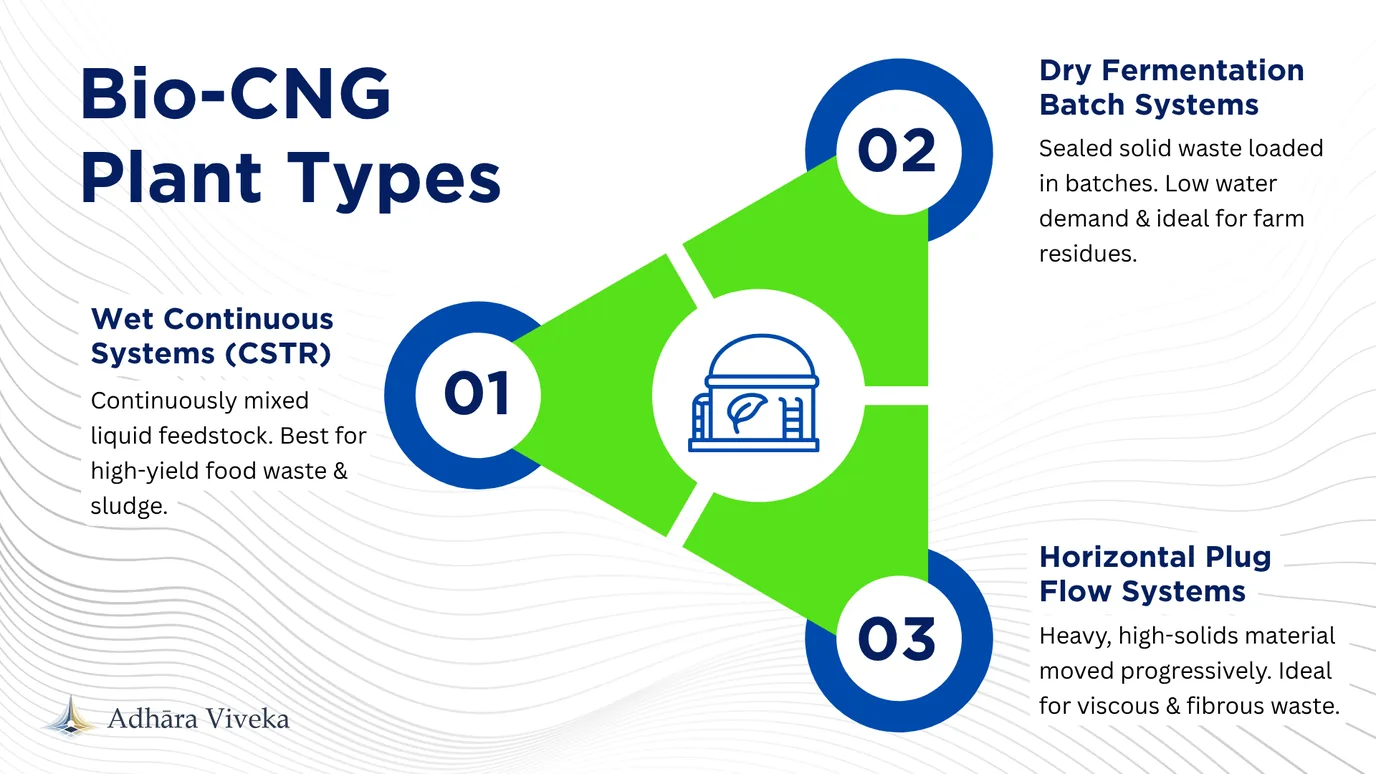
To handle different types of waste, commercial developers in India rely on three primary plant setups:
Wet Continuous Systems (CSTR)
About 80% to 85% of commercial plants in India use wet continuous reactors. You make a slurry by blending waste such as sugarcane press mud, cattle manure, or liquid spent wash with water. You then pump this slurry into large insulated tanks fitted with motor-driven mixers. The mixing keeps the microbes working and prevents heavy material from settling at the bottom.
Dry Fermentation Batch Systems
If your feedstock is dry agricultural waste such as paddy straw, Napier grass, or city garbage, adding water to make a slurry raises your operating cost. Dry fermentation systems avoid this cost. You pack the solid waste into sealed concrete tunnels using front loaders. Instead of stirring, you spray recycled liquid over the waste to break it down. This method uses very little fresh water, but it does require heavy mechanical shredding and thermo-chemical pre-treatment.
Horizontal Plug Flow Systems
Horizontal plug flow systemsPlug-Flow DigesterA digester design where feedstock moves through as a continuous plug with minimal mixing, ideal for high-solids content. work best for semi-solid waste, such as thick dairy manure mixed with chopped crop bedding. You push the heavy paste in from one end of a long channel. As you add new material, the waste moves slowly toward the outlet as a solid plug. This setup needs little mechanical stirring and uses less water than a wet continuous reactor.
Key Operational Parameters
| Operating Parameter | Wet Continuous (CSTR) | Dry Fermentation (Batch) | Horizontal Plug Flow |
|---|---|---|---|
| Total Solids (TS %) | 8% – 12% (Pumpable slurry) | 25% – 35% (Solid, stackable biomass) | 11% – 25% (Thick, paste-like slurry) |
| Hydraulic Retention Time (HRT) | 20 – 30 Days | 28 – 42 Days | 15 – 30 Days |
| Operating Temperature | 35°C – 40°C (Mesophilic) | 50°C – 55°C (Thermophilic) | 35°C – 40°C (Mesophilic) |
| Raw Methane Yield (CH4 %) | 55% – 65% | 50% – 60% | 55% – 62% |
Plug flow systems process waste in 15 to 30 days. The waste moves forward in a single direction, so there is no back-mixing. Wet continuous stirred-tank reactors (CSTRs)Wet Continuous Stirred-Tank Reactor (CSTR)Industrial reactor type used for continuous biogas production through anaerobic digestion of organic feedstocks. can reach methane yields of up to 65 percent. The mixing keeps bacteria in contact with the feedstock, which improves gas production. Dry fermentation uses feedstock with about 35 percent total solids (TS)Total Solids (TS)The percentage of solid matter in a slurry or mixture, expressed as a dry weight percentage. For wet anaerobic digestion, typically maintained at 8–15% TS.. It uses less water, since it relies on recycled liquid to support bacterial growth.
The people who usually explain this business to you — vendors, brokers, commission agents — earn money when you say yes. We do not. We sell the understanding, not the project.
4. BioCNG Plant Licence in India: CTE, CTO and PESO
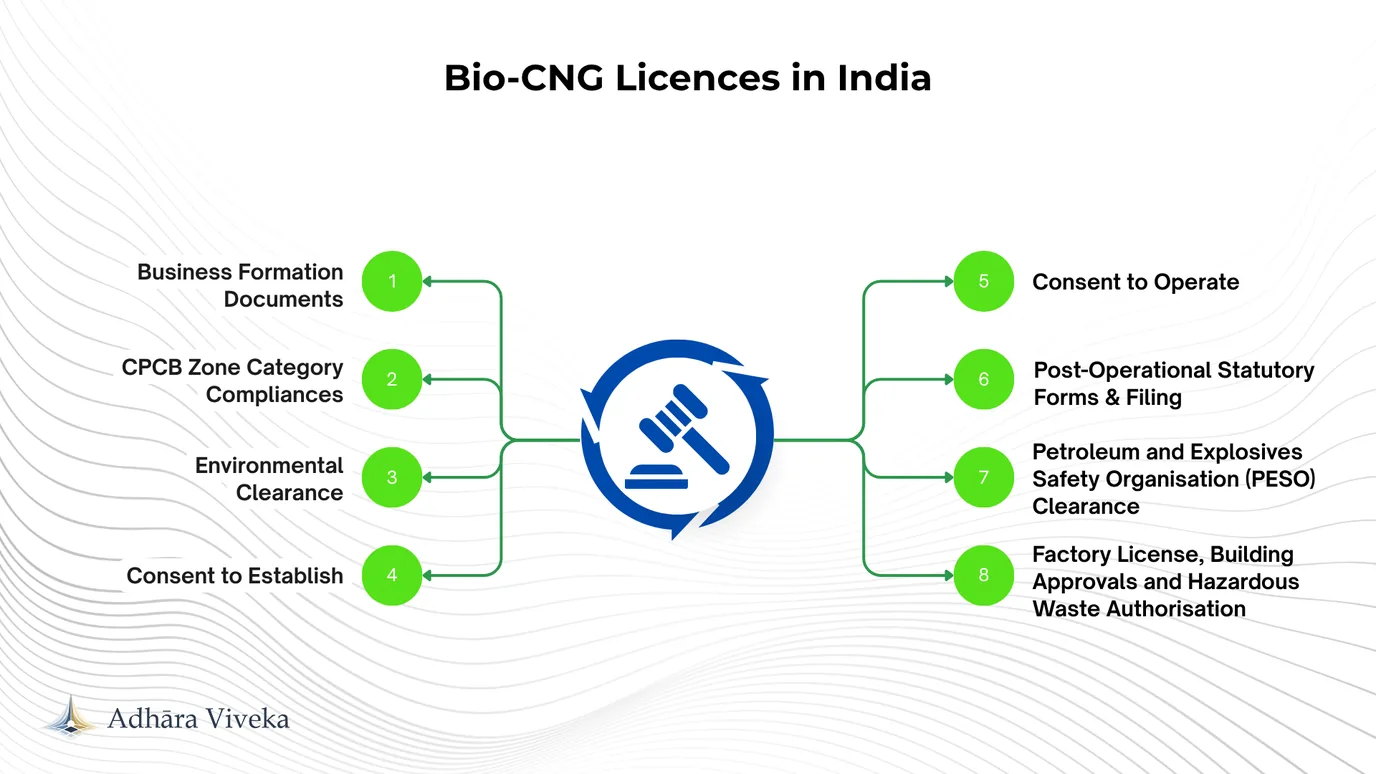
Before you do anything else, you need to set up your BioCNG plant as a legal entity and get the standard tax registrations.
Entity Registration and Tax Filings
- Certificate of Incorporation (CoI): Register your plant as a Private Limited CompanyPrivate Limited CompanyA business entity with limited shareholder liability, restricted share transfer, and a maximum of 200 shareholders, commonly used in India's waste management and recycling sectors. (Pvt Ltd) or a Limited Liability Partnership (LLP)LLPA business structure providing limited liability protection to partners while maintaining operational flexibility. using the Ministry of Corporate Affairs (MCA) SPICe+ portalSPICe+ PortalIntegrated government portal that consolidates company registration and statutory compliance in India..
(Choose Pvt Ltd if you plan to raise bank loans, apply for government bioenergy schemes, or bring in investors. Banks and schemes usually require this structure.) - Corporate PAN and TAN: You get both numbers automatically when you file for incorporation through SPICe+.
- You need a PAN (Permanent Account Number) to open a bank account, sign gas sale agreements with Oil Marketing Companies (OMCs), buy land, and file income tax returns.
- You need a TAN (Tax Deduction and Collection Account Number) to handle TDS on biomass purchases, equipment invoices, and contractor payments.
- GST Registration: You must register for GST to sell commercial gas or organic fertilisers. The law puts Compressed Biogas (CBG) and Fermented Organic Manure (FOM) under specific HSN codesHarmonized System of NomenclatureInternational standard system for assigning numerical codes to classify traded products and commodities across borders..
- BioCNG or CBG (HSN 2711) attracts 5% GST.
- Fermented Organic Manure / Liquid FOM (HSN 3101) attracts 5% GST, or 0% if you sell it unbranded in bulk.
Business-Specific Corporate Registrations
- Udyam / MSME Registration: You can register online for free with the Ministry of MSME. This certificate is essential if you want priority sector loans from banks, lower bank guarantee requirements, or access to subsidies under central bioenergy schemes.
- Import Export CodeImport Export CodeA mandatory 10-digit registration code required by Indian customs for all import and export activities. (IEC): You need an Import Export Code (IEC) from the Directorate General of Foreign TradeDirectorate General of Foreign TradeIndian government agency responsible for regulating imports, exports, and trade policy implementation. if you plan to import specialised machinery like high-pressure membrane upgrade units or high-bar compressors, or if you want to export granulated organic fertilisers.
- Shop and Establishment Act Registration: You must get this registration from your local municipal corporation or state labour department for your main office.
- EPFO and ESICESICStatutory body managing India's Employees' State Insurance Scheme for worker social security benefits. Registrations: You need to register with EPFOEPFOStatutory body that manages mandatory employee provident funds, pensions, and insurance for formal sector workers in India. and ESIC if your plant has more than 10 to 20 employees.
Zoning Compliance and Pollution Index (PI) Evaluation
From 2025, the government classifies Bio-CNG plants by feedstock type and environmental impact. This decides how much regulatory oversight your plant faces and how long your consent to operate lasts.[6]
BLUE Category
If you use municipal solid waste (MSW), agricultural residue, animal waste, or press mud as feedstock, your plant falls in the Blue Category. Here, the Pollution Index (PI)Pollution IndexA numerical score that measures the degree of environmental contamination from multiple pollutants. and how much wastewater you generate set your compliance requirements.
- Plants generating wastewater of 50 KLD or more with PI 82.5 (CTO validity 7 years).
- Plants generating wastewater less than 50 KLD with PI 79 (7-year validity).
- Plants that do not discharge any wastewater and produce by-products such as Fermented Organic Manure (FOM)/Liquid Fermented Organic Manure (LFOM)LFOMLiquid Fermented Organic Manure — the liquid form of digestate with enhanced nutrient availability for plant uptake./enriched manure and/or Briquettes/pellets using fuel have a PI of 60 (7-year CTO).
WHITE Category
White Category applies if your plant does not discharge any wastewater and uses electricity to make by-products like Fermented Organic Manure (FOM), Liquid Fermented Organic Manure (LFOM), enriched manure, or briquettes and pellets. You can use MSW, agro residue, energy cropsEnergy CropsCrops specifically grown for energy production rather than food, including fast-growing grasses, trees, and algae, grass, weeds, animal waste, or press mud as feedstock, but not industrial or process waste. These plants have a low PI of 20.0 and do not need a Consent to Operate.
RED Category
Red Category covers plants that use industrial or process waste as feedstock. These have a PI of 82.5. The amount of wastewater does not affect the category. You can handle any volume, but your Consent to Operate is valid for only 5 years because of the higher risk.
(Note: The Blue Category was introduced as a special classification for environmentally beneficial, renewable, and clean technology projects. Previously, industrial activities were strictly grouped into Red, Orange, Green, and White categories based on their Pollution Index (PI) score. However, sustainable initiatives like Bio-CNG (Compressed Bio-Gas / CBG) and waste-to-resource plants faced unnecessary administrative delays because they were evaluated using standard industrial pollution criteria rather than their overall environmental net benefit.)
Environmental Clearances (CTE, CTO and PESO)
After you confirm your zone category, you need to get environmental clearances from the State Pollution Control Board (SPCB). The law requires two separate approvals for a BioCNG plant: Consent to Establish (CTE) and Consent to Operate (CTO), under the Water Act (1974) and Air Act (1981).[7]
1. Consent to Establish (CTE)
You must get CTE before you start any civil work or install heavy equipment. This clearance confirms your site, layout, and design meet environmental siting rules. To apply, you need to submit the following documents.
- Detailed Project Report (DPR): State your plant's processing capacity, daily feedstock, mass and energy balance, total capital investment, and expected revenue streams.
- Plant Layout and Siting Map: Show that your site meets SPCB buffer zoneBuffer ZoneRegulated separation distance around a facility to protect surrounding areas from industrial impacts. rules. You usually need to keep 100 to 500 metres from highways, rivers, residential areas, and hospitals.
- Water Balance and Effluent Treatment Plan: Explain how much water you will use each day and show that you will not discharge untreated liquid. Your application should state how you will convert slurry into Liquid Fermented Organic Manure (LFOM) or treat it in an onsite Effluent Treatment Plant (ETP)Effluent Treatment Plant (ETP)A system that treats industrial wastewater to remove pollutants and meet discharge standards..
- Air Pollution and Odor Control Strategy: Give details of closed unloading bays and wet scrubbersWet ScrubbersAir pollution control devices that use liquid to capture particulate matter and gaseous pollutants from exhaust streams. to control odour. Include the planned heights for flare stacksFlare StackDevice that safely burns excess waste gases in industrial waste-to-value operations. and DG set exhaust chimneysDG Set Exhaust ChimneyVertical exhaust duct system for Diesel Generator sets that ensures compliant emission dispersion in waste-to-value facilities..
- Land Documents: Provide your registered land deed or long-term lease, and proof of Non-Agricultural (NA) land conversionNon-Agricultural (NA) Land ConversionThe regulatory process of obtaining government approval to change agricultural land classification for non-farm uses like industrial facilities. permission.
CTE is usually valid for 5 years. The consent fee depends on your plant's total capital investment, and ranges from ₹25,000 to ₹1.5 lakh depending on the state. If you need more time to finish construction, you must apply for an extension before your CTE expires.
2. Consent to Operate (CTO)
You can apply for CTO after you finish construction, but before you start loading feedstock or purifying gas. SPCB officials will inspect your site to check that you have built the plant as per the approved CTE drawings. To get CTO, you need the following approvals.
- CTE Compliance Report: Give a point-by-point response showing you have met every condition in your original CTE letter.
- Chartered Accountant (CA) Certificate: Get a certificate from a Chartered Accountant (CA) stating your final gross fixed asset cost, including land, building, and machinery.
- Plant Layout and Machinery Plan: Submit a final site map that marks process buildings, ETP or LFOM lagoons, hazardous waste storage, and greenbelt areas.
- Environmental Sample Analysis Reports: Provide lab test results for treated water, groundwater, ambient air qualityAmbient Air QualityThe quality of air in the open environment as experienced by people, plants and animals in a given area; measured against NAAQS limits., and DG set stack emissions.
- Proof of Installed Machinery: Submit invoices and commissioning reports for shredders, scrubbers, enclosed flare systems, compressors, and groundwater monitoring wells.
- Fire and Safety Clearance Copy: Submit your provisional Fire NOC and preliminary PESO layout approval.
- Board Resolution: Provide a board resolution that authorises your plant manager or Director to sign and file the CTO application.
CTO is valid for 7 years (blue category) or 5 years (red category). You must apply for renewal at least 60 days before expiry, and include your annual environmental audit reports.
3. Petroleum and Explosives Safety Organisation (PESO) Clearance Framework
If you handle high-pressure biomethane (compressed to 200 to 250 bar), your plant falls under the Petroleum and Explosives Safety Organisation (PESO). PESO uses a strict two-stage approval process.[8]
Stage A: Layout and Site Drawing Approval (Pre-Construction)
You must submit your site drawings to PESO for design validation before you build gas compression units, filling bays, or cascade storage racks.
- Safety Buffer Distance Verification: You usually need to keep 15 to 30 metres of clear space between high-pressure compressors, storage cascades, dispensing points, boundary walls, and electric substations. The exact distance depends on your storage volume.
- Hazardous Area Classification Drawings: Identify Zone 0, Zone 1, and Zone 2 hazardous areas. Make sure all electrical motors, junction boxes, and lighting fixtures in these zones are certified as Flameproof or Explosion-Proof (Ex-d)Flameproof or Explosion-Proof (Ex-d)Explosion-proof equipment that safely contains and cools internal explosions in hazardous industrial environments..
- Disposer and Flare System Placement: Place emergency relief vents and cold flare stacks at a safe distance from gas collection bags and digester domes.
Stage B: Final PESO License to Fill and Store (Pre-Commissioning)
After you finish building your plant, a PESO inspector will check the physical installation.
- Hydrostatic Pressure TestHydrostatic Pressure TestNon-destructive test using pressurized water to verify pressure vessel and pipeline integrity. Certificates: Provide test records for all high-pressure gas pipelines, storage cylinders, and cascade manifolds.
- Safety Relief Valve (SRV) Calibration: Submit verification certificates for pressure relief valves that will open automatically if system pressure goes above design limits.
- Gas Cascade Inspection: Arrange for inspection of the static or mobile cascade frames, cylinder mounts, and multi-port valve manifolds.
Statutory Clearances: Approval Timelines
| Stage | Approval | Target Window |
|---|---|---|
| Stage 1 | Entity Incorporation | 15 - 30 Days |
| Stage 2 | CTE (Pollution Board) | 45 - 90 Days |
| PESO Stage A (Layout) | 30 - 60 Days | |
| Stage 3 | Fire Safety NOC | 30 - 45 Days |
| Stage 4 | CTO (Pollution Board) | 45 - 60 Days |
| PESO Stage B (License) | 30 - 60 Days |
Policy Portals and Quality Standards
You must register on central government portals before you can access incentives, sign long-term offtake agreements, or legally sell your products. The main portals are listed below.
1. GOBARdhan Unified PortalGOBARdhan Unified PortalGovernment portal for registering and tracking biogas and bio-waste projects across India. Registration – This portal is the single-window hub for all commercial CBG and biogas plants in India. Register online once you have land and basic business documents such as the Certificate of Incorporation (CoI), PAN, and GST. You will get a unique GOBARdhan Registration Number. You need this number to apply for central financial assistance, priority sector loans, or state subsidies.[9]
2. SATAT SchemeSATAT schemeSustainable Alternative Towards Affordable Transportation — a government initiative to promote bio-compressed natural gas production and supply in India. Integration – This scheme sets up a formal process for long-term gas sales to Oil Marketing Companies like IOCL, BPCL, HPCL, and GAIL. To take part, submit an Expression of InterestExpression of InterestA preliminary document indicating interest in a procurement opportunity or project, used to pre-qualify participants. (EOI) on the OMC's e-tendering portal. You will need your Detailed Project Report (DPR), CTE approval, proof of feedstock supply, and financial viability reports. If selected, you will get a Letter of InterestLetter of InterestA non-binding preliminary document that outlines intent and key terms before formal negotiations begin. (LOI) that makes you an official CBG project developer. You can then sign a 10- to 15-year Commercial Offtake AgreementCommercial Offtake AgreementLong-term purchase contract that secures a buyer for future production, reducing market risk for producers. with the OMC to sell your CBG at fixed statutory prices.[10]
3. Fertilizer Control Order (FCO) Compliance – The Fertilizer Control Order (FCO) sets the rules for making, testing, and selling all fertilisers in India. You need a Fertilizer Manufacturing License from your State Department of Agriculture. You must also test each batch every quarter at a NABLNABLAn autonomous body that certifies the technical competence and quality management of testing and calibration laboratories in India.-accredited lab. You cannot sell your digestate as commercial organic fertilizer unless it meets all FCO Schedule-I standardsFCO Schedule-I StandardsIndian regulatory standards governing fertilizer quality, nutrient levels, and contaminant limits for market compliance..[11]
| Parameter | Fermented Organic Manure (FOM) | Liquid FOM (LFOM) |
|---|---|---|
| Moisture Content | Maximum 30% to 40% by weight | Liquid slurry form |
| Organic Carbon | Minimum 12.0% | Minimum 4.0% |
| Total NPK (N + P2O5 + K2O) | Minimum 1.2% to 3.0% (combined) | Minimum 0.6% (combined) |
| C:N Ratio | Below 20:1 | Below 15:1 |
| pH Value | 6.5 to 8.0 | 6.5 to 8.5 |
| Heavy Metals (Pb, Cd, As, Cr) | Below strict PPM limits defined in FCO | Below strict PPM limits defined in FCO |
4. IS Standards Certification – You must get quality and safety certification from the Bureau of Indian Standards (BIS) for both your purified gas and your storage equipment. The main BIS standards for BioCNG plants are:
- IS 16087:2016IS 16087:2016Indian Standard specification that defines quality and safety requirements for Bio-CNG fuel composition and properties. (Biomethane Specification): Defines the exact gas composition required before CBG can be injected into city gas networks or filled into vehicular cascades:[12]
- Methane (CH4): Minimum 90.0% by volume.
- Carbon Dioxide (CO2) + Nitrogen (N2): Maximum 10.0% combined.
- Hydrogen Sulfide (H2S): Maximum 20.0 mg/m3 (approx. 15 ppm).
- Moisture / Water Vapor: Zero free moisture (dew point constraintsDew Point ConstraintsOperational limits that prevent water vapor from condensing in gas systems.).
- IS 15490: These standards cover high-pressure seamless steel cylinders and cascade frames for transporting compressed biomethane at 200 to 250 bar.
- IS 7285: These are the technical specifications for making gas cylinders and safety pressure release devices.
5. How to Start a BioCNG Business: Step by Step
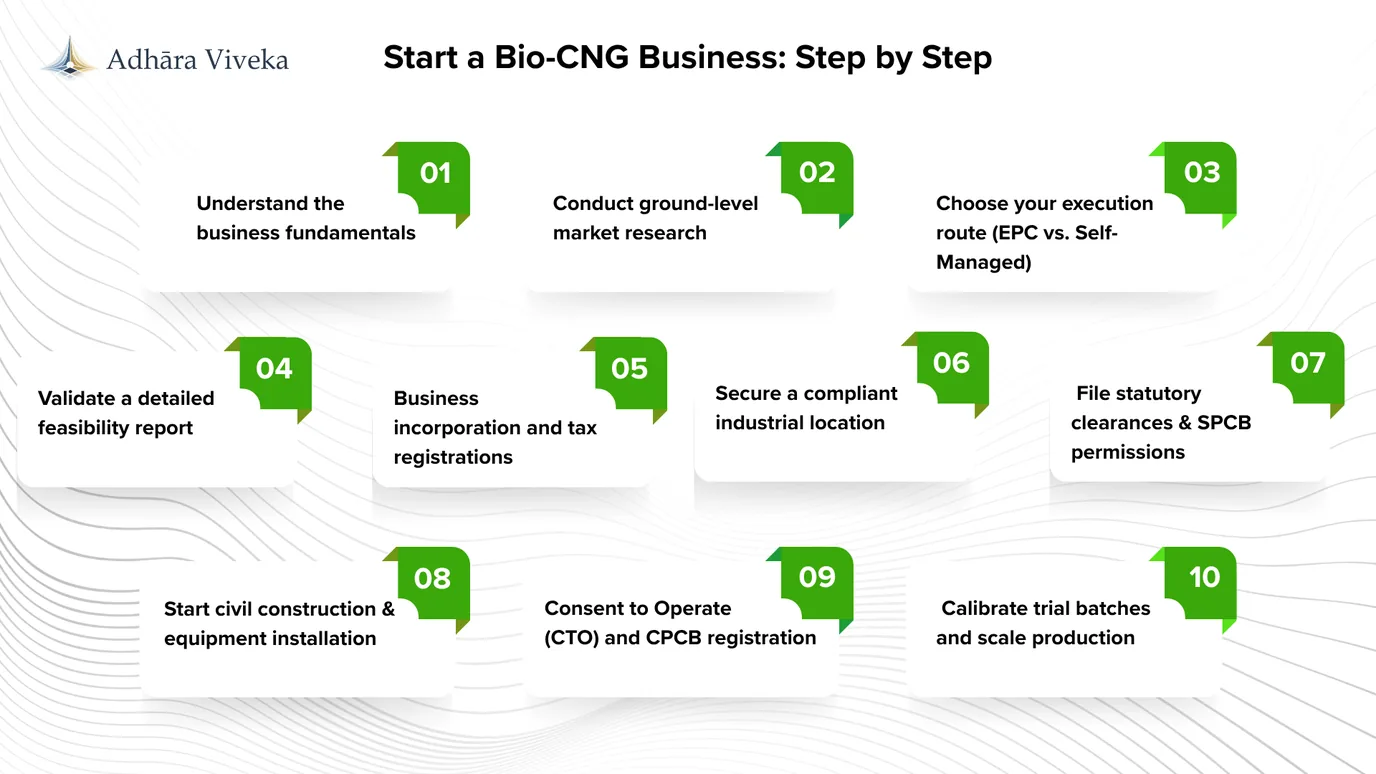
You need a clear, step-by-step plan to take a BioCNG plant from idea to commercial gas production. Each stage has specific requirements and risks.
1. Understand the BioCNG Business model
Understand how a BioCNG plant works, including the main process steps and how it earns revenue. Research current BioCNG plants in India to see what capacities and configurations are common. Use public sources for this data.
2. Conduct Ground Research
Check how much feedstock you can get each day within 50 km of your site. Typical sources are press mud, cattle dung, paddy straw, or food waste from farmers, municipalities, and industries. Collect samples from each source and send them to a NABL-accredited lab. Test for total solids (TS%), volatile solids (VS%), and theoretical methane yield. Do this before you decide on equipment size.
3. Talk to Experts
Visit 2 or 3 BioCNG plants that use your main feedstock. Focus on how they handle process and maintenance issues, gas purification, and storage. Before you start any legal steps, speak to a technical expert or consultant. Get their input on your process and calculations to check if your plan is realistic.
4. Register your Business as a legal Entity
Register your business as a private limited company through the MCA SPICe+ portal. This gives you the required licences: corporate PAN, TAN, and Certificate of Incorporation (CoI) for tax purposes. Apply for GST registration under HSN 2711 for compressed biogas (CBG) and HSN 3101 for fertiliser output (FOM). Register as an MSME under Udyam to qualify for Priority Sector LendingPriority Sector LendingRBI mandate requiring banks to lend a minimum portion of credit to priority sectors including MSMEs and agriculture. (PSL).
5. Secure Non-Agricultural (NA) Land
Secure non-agricultural land by buying it or signing a registered lease for at least 15 to 25 years. Check that the site meets State Pollution Control Board (SPCB) and Petroleum and Explosives Safety Organisation (PESO) buffer distance rules. These are usually 100 to 500 metres from homes and water bodies. Make sure there is a wide road for moving gas cylinders by truck.
6. Prepare a Bankable Detailed Project Report (DPR)
Prepare a Detailed Project Report (DPR) with clear breakdowns of capital and operating costs (CAPEX and OPEX), mass and energy balances, debt-equity ratiosDebt-Equity RatioA financial metric showing the balance between a company's debt and equity financing., and cash flow projectionsCash Flow ProjectionFinancial forecast of anticipated cash inflows and outflows over a future period. for 10 years. You need this DPR to apply for central government schemes through the GOBARdhan portal, to get offtake agreements (letters of intentLetter of Intent (LOI)A non-binding preliminary document outlining initial understanding and key terms between parties before a formal contract., LOI), and to qualify for SATAT scheme subsidies.
7. Pre-Construction Statutory Approvals (CTE and PESO)
Apply for pre-construction approvals from the State Pollution Control Board (SPCB) and Petroleum and Explosives Safety Organisation (PESO). Submit your plant layout, water balance diagrams, hazardous area classification drawings (Zone 0, 1, 2), and safety buffer plans through the SPCB online portal.
8. Execute Civil Works
Start civil works by building digester foundations, receiving pits, digestate drying bedsDrying BedsEngineered systems for removing moisture from sludge using natural drainage and evaporation., and high-pressure storage tanks. Set up electrical substations and diesel generator (DG)Diesel Generator (DG) SetsA self-contained backup power unit pairing a diesel engine with an alternator, used during grid outages; subject to CPCB noise and emission norms. backup, high-pressure gas piping, safety flare stacks, and fire hydrant systems.
9. Install your Machinery
Order and install machinery such as digester tanks, membrane or pressure swing adsorption (PSA) purification units, high-pressure compressors, and decanter centrifuges. Sign contracts with technology vendors only after you get Consent to Establish (CTE) clearance. Use your offtake letter (LOI) from oil marketing companies (OMC) and GOBARdhan registration to apply for machinery loans under Reserve Bank of India (RBI) Priority Sector Lending (PSL) rules.
10. Secure Operational Consents (CTO and Final PESO License)
After the State Pollution Control Board (SPCB) inspects your site and gives post-construction clearance, load feedstock slurry into the digesters. Allow the microbial reaction to start. Test the gas for purity. You need at least 90% methane (CH4) as per IS 16087 standards before you begin commercial gas filling.
6. BioCNG Plant Machinery and Equipment List
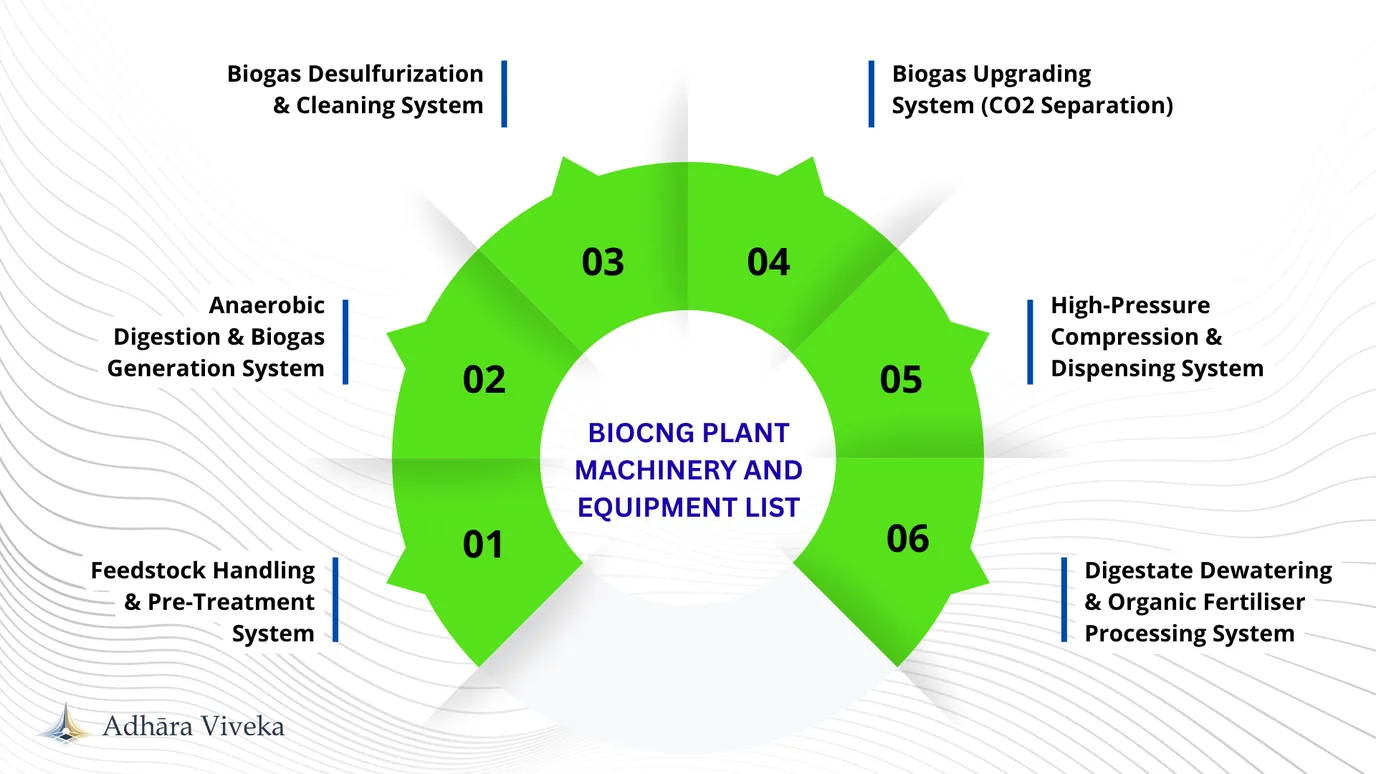
The plant uses machinery and engineering systems to turn raw organic waste into compressed fuel and organic fertiliser.
Feedstock Handling and Pre-Treatment System
These machines break down, mix, and clean the incoming feedstock so bacteria can digest it more easily.
- Heavy-Duty Shredder: Chops fibrous agro-residues to a uniform 10–20 mm size. This increases the surface area for microbes to work on.
- Stone Separator: Mixing units blend dry biomass with water to form a slurry. They also remove heavy contaminants like stones, sand, and metal, which protects pumps from abrasion.
- Feed Submersible Mixer: Keeps the total solids (TS%) concentration of the slurry uniform before it enters the main digesters. Uses continuous mixing with propeller agitators.
Anaerobic Digestion and Biogas Generation System
This is where the biological reaction happens. Bacteria convert organic matter into raw biogas in oxygen-free conditions at 37°C to 55°C.[13]
- CSTR Digester Tanks: Bolted steel tanks lined with fused glass coatingsFused Glass CoatingsA coating technique that fuses glass material onto surfaces using high-temperature thermal treatment.. These resist corrosion from chemical slurries and volatile fatty acids.
- Submersible Jet Agitators: Mechanical mixers prevent scum from forming on top of the slurry. They also keep heavy solids suspended so there are no dead zones.
- Dual-Membrane Biogas Holder Roofs: Flexible, UV-resistant gasholdersGas HolderFlexible storage vessels with two layers of membrane material that expand and contract to buffer fluctuations in biogas production while preventing gas escape. sit on top of the digesters. They keep the internal gas pressure steady and store extra raw biogas.
Biogas Desulfurization and Cleaning System
Raw biogas from the digesters contains hydrogen sulphide (H2S) and moisture. Both must be removed to protect compressors from corrosion.
- H2S Scrubber Tower: Vertical packed towers use micro-aerophilic bacteria to reduce H2S from 1,500–5,000 ppm to below 100 ppm by biological oxidation.[14]
- Chemical filtration tank: Secondary dry-bed absorbers with iron oxide media remove trace H2S to meet IS 16087 standards, below 20 mg per cubic metre.
- Refrigerated Gas ChillerRefrigerated Gas ChillerEquipment that cools gas streams using refrigeration cycles to condense moisture and impurities.: Cools the gas stream to 4°C. This condenses and removes water vapour.
Biogas Upgrading System (CO2 Separation)
This unit separates carbon dioxide (CO2) from methane (CH4). It raises gas purity from about 60% to over 90% methane, which meets automotive fuel standards.[15]
- Multi-Stage Polymeric Membrane Separation UnitMulti-Stage Polymeric Membrane Separation UnitMulti-stage membrane separation system used to purify biogas by selectively removing carbon dioxide.: Polymer bundle filters let CO2 molecules pass through fibre walls but keep methane at high pressure. This achieves over 98% methane recovery without using chemicals.
- Vacuum Pressure Swing Adsorption (VPSA/PSA) System: Multi-column vessels with carbon molecular sieves strip CO2 under pressure. The columns are regenerated under vacuum.
High-Pressure Compression and Dispensing System
Once biomethane meets fuel purity standards, it is compressed to transport pressure for distribution.
- Oil-Free Reciprocating CBG Compressor: Multi-stage booster compressors pressurise purified biomethane from atmospheric pressure up to 200–250 bar, with no oil carryover.
- Mobile / Static Storage Cascades: High-pressure seamless steel cylinder frames (IS 15490 compliant) store and transport compressed gas by truck to OMC retail outlets or industrial buyers.
- Automated Emergency Gas Flare: High-temperature enclosed flare stacks with automatic spark ignition burn off excess gas during emergency shutdowns.
Digestate Dewatering and Organic Fertiliser Processing System
These machines process the heavy organic slurry left after digestion into solid and liquid bio-fertilisers.
- Screw Press Separator: High-speed centrifugal separators spin the digestate to separate it into a dry solid cake (15–25% moisture) and a liquid filtrate.
- Rotary Drum Dryer: Thermal drying units and pan granulators process solid organic manure (FOM) into packaged fertiliser granules.
7. BioCNG Plant Location, Layout and Infrastructure
You need to choose a site that meets legal requirements and gives you reliable access to utilities. This is essential if you want your BioCNG plant to run without interruptions.[16]
Core Site Selection Factors
- Use non-agricultural (NA) or industrial land with enough soil strength to support heavy digester tanks, receiving pits, and concrete storage pads.
- Keep your plant within 15 to 25 km of your feedstock source. If you transport feedstock more than 30 km, your operating costs will rise sharply.
- Site your plant within 10 to 15 km of city gas distribution (CGD)City Gas DistributionCity Gas Distribution — a piped gas network infrastructure that delivers gas directly to homes and businesses. points, OMC retail pumps, or industrial zones. This makes gas offtake easier and reduces the need for mobile cascade trucks.
- You need direct access to a wide road. This is necessary for daily feedstock deliveries and for moving gas out by heavy cascade trucks.
Safety buffers must comply with state SPCB and CPCB environmental guidelines:[17]
| Distance | Buffer Areas |
|---|---|
| 500 m to 1,000 m | Human habitations, schools, and hospitals to prevent odor complaints |
| 100 m to 200 m | Riverbeds, lakes, and drinking water sources to avoid contamination. |
| 15 m to 30 m | Internal buffer zone around compressor sheds and storage cascades under PESO rules. |
Essential Utility Requirements
You need a continuous power supply to run agitators and pumps. Install a DG set with full plant capacity to cover grid failures. Secure a reliable water supply for dilution and process flow. Plan for 3 to 4 litres of fresh water per kg of dry biomass. Get this through a Central Ground Water Authority (CGWA) NOC or a municipal connection. Use a closed-loop filtrate recovery systemClosed-Loop Filtrate Recovery SystemIndustrial system for treating and reusing wastewater in manufacturing and recycling operations. to cut down fresh water use. Set up a fire water storage reservoir with pumps around compressor sheds for safety. Choose a site on high ground with natural drainage above flood levels to avoid surface runoff.[18]
(Note: As per Blue Category norms, no process wastewater can be discharged outside the plant boundary)
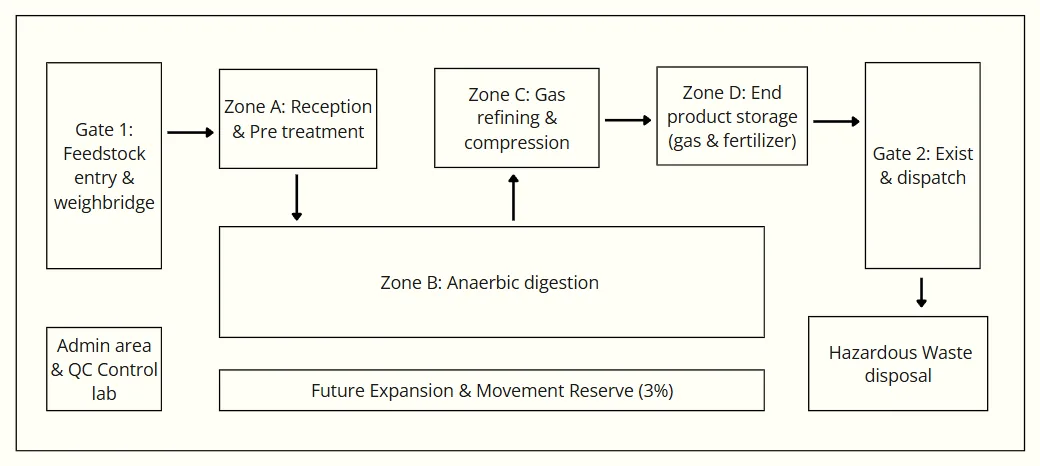
Plant Infrastructure Distribution
- Storage and Logistics (40%): You need hoppers, pre-sorting yards, and enough space to store 3 to 4 months of paddy straw or press mud for seasonality.
- Digestion and Processing (30%): This includes CSTR tanks (digesters), purification skidsPurification SkidsModular equipment units that purify raw biogas into high-methane compressed biogas for fuel applications., and enrichment unitsEnrichment UnitsEquipment that purifies raw biogas to CBG specifications by removing impurities and increasing methane concentration..
- Fertiliser Management (20%): You will need slurry tanksSlurry TanksStorage vessels for slurry feedstocks and digestate in waste processing and biogas production., drying beds, and a packaging unit for solid and liquid fertiliser (FOM/LFOM).
- Safety and Utilities (10%): Plan for gas cascade filling stations, PESO buffer zonesPESO Buffer ZonesRegulatory exclusion zones around hazardous material facilities mandated by PESO for public and environmental safety., administrative buildings, and space for future expansion.
8. Where to Source BioCNG Feedstock
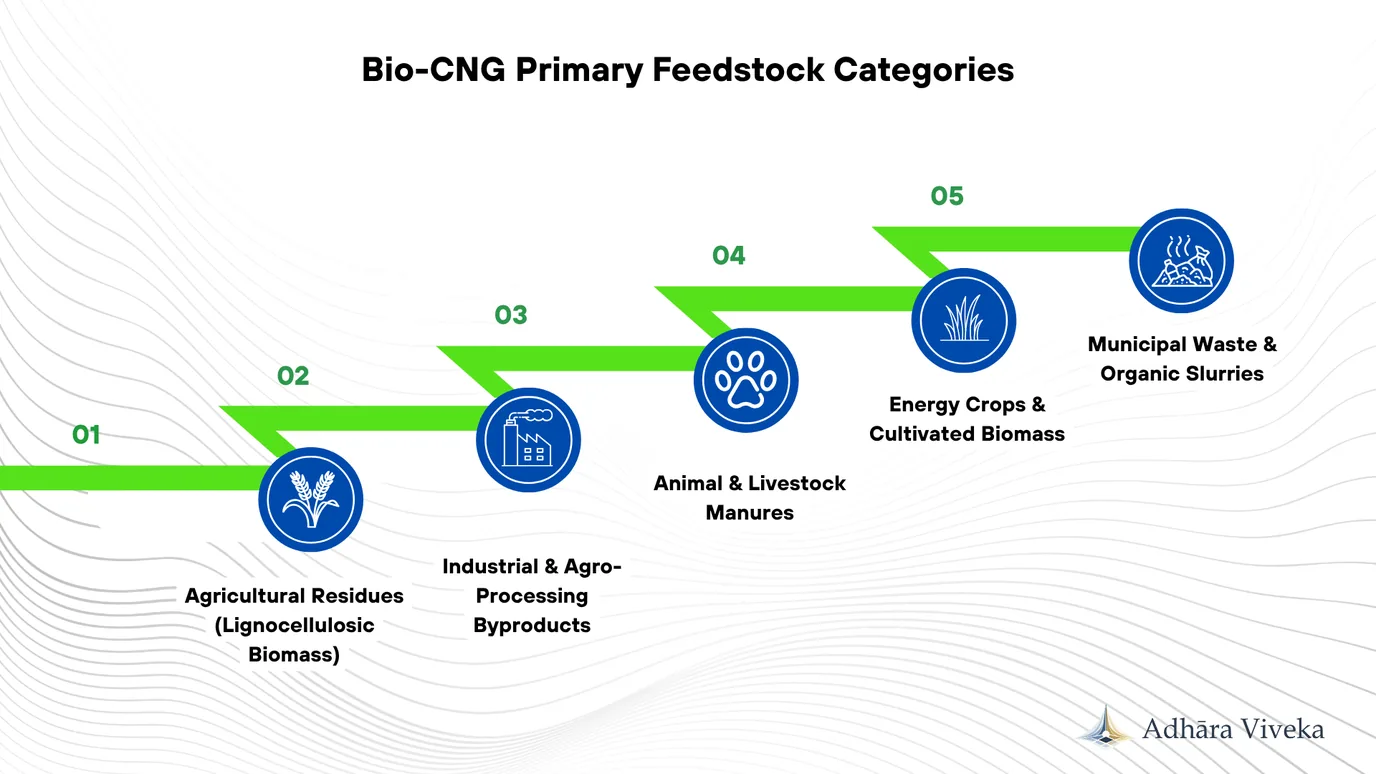
You need a stable, continuous feedstock supply if you want your plant to run reliably and stay commercially viable over the long term.
Primary Feedstock Categories
- Agricultural Residues (Lignocellulosic BiomassLignocellulosic BiomassPlant biomass containing cellulose, hemicellulose, and lignin; used as feedstock in biogas and biofuel production.): Paddy straw, wheat straw, maize stalks, cotton stalks, and sugarcane bagasse are all high-volume residues. They produce good yields of dry-matter biogas, but you will need to pretreat them by mechanical shredding to break down the tough lignin bonds. Supply peaks after harvest: October to December for Kharif crops, and April to June for Rabi crops.[19]
- Industrial and Agro-Processing Byproducts: Press mud from sugar mills, spent wash from distilleries, starch slurry from tapioca processing, fruit and vegetable processing waste, and spent grain are common byproducts. Press mud is popular because it contains no lignin, digests quickly, and gives high methane yields. However, it is only available during the sugar crushing season, from November to April.
- Animal and Livestock Manures: Cattle dung from dairy farms, poultry litter, and piggery waste are all used as feedstock. Cattle dung is especially useful because it is rich in methanogenic bacteria and acts as a natural starter for co-digestion. You can get it year-round, though collection drops slightly during the monsoon.
- Energy Crops and Cultivated Biomass: Hybrid Napier grass, sorghum, and duckweed are grown specifically as energy crops. They offer uniform total solids (TS%) and consistent biochemical methane potentialBiochemical Methane PotentialLaboratory measure of maximum methane yield from organic feedstock under controlled anaerobic conditions. (BMP). You can harvest them several times a year.
- Municipal Waste and Organic Slurries: Segregated municipal solid waste (MSW) organic fractions, vegetable mandi waste, and sewage treatment plant (STP)Sewage Treatment PlantSewage Treatment Plant — facility that treats sewage/domestic wastewater (separate from industrial effluent). biosludgeBiosludgeSolid residue from wastewater treatment or anaerobic digestion, containing nutrients and organic matter with potential for soil amendment or further processing. are all available in cities. Urban MSW is generated in high volumes throughout the year, with peaks during fruit seasons.
Procurement and Sourcing Channels
- Sign a long-term contract, usually for 5 to 10 years, directly with local sugar mills to secure raw press mud at fixed seasonal prices.
- You can partner with regional biomass aggregators. They collect paddy and wheat straw directly from farmer fields after harvest and supply it to you.
- Set up a network with large dairy cooperatives and Gaushalas to collect cow dung. Build direct links with livestock farmers to source other manures.
- Sign contracts with your local municipalities and Agricultural Produce Market CommitteesAgricultural Produce Market CommitteeState-regulated agricultural market committee that manages physical mandis and oversees trade of notified farm commodities. (APMC) to arrange daily bulk pickups of fruit, vegetable, and food waste.
- You can also use digital B2B feedstock trading platforms like BioTradX. These platforms let you source seasonal biomass in bulk by submitting requests for quotes (RFQs).
Feedstock Selection Criteria
If you want to maximise methane output, start by checking your feedstock against key physical, chemical, and biological criteria.[20]
| Feedstock Type | Gas Yield Potential | Digestion Speed | Carbon-Nitrogen Balance | Supply Seasonality | Storage and Handling |
|---|---|---|---|---|---|
| Press Mud (Sugar Mill Waste) | Very High | Fast | Balanced | Seasonal (6–8 months during crushing) | Easy to store in covered yards; rots slowly. |
| Cattle Dung | Low to Medium | Medium | High Nitrogen (Needs carbon mix) | Available daily, year-round | Easy to handle; best used fresh as a slurry. |
| Paddy / Wheat Straw | High | Slow | High Carbon (Needs nitrogen mix) | Seasonal (1–2 month harvest windows) | Requires baling and dry storage space; zero rotting.[21] |
| Food and Mandi Waste | High | Very Fast | High Nitrogen / Acidic | Available daily, year-round | Must be processed within 24–48 hours; degrades fast. |
| Poultry Litter | Very High | Medium | Very High Nitrogen (Risk of tank overload) | Available daily, year-round | High odor; must be mixed carefully with low-nitrogen waste. |
(Note: Carbon and nitrogen balance means keeping the right mix of high-carbon waste, such as straw, and high-nitrogen waste, such as manure. This balance keeps the bacteria active and stops the tank from becoming acidic.)
Gas Recovery by Feedstock Type
The table below gives you the typical raw biogas output, purified BioCNG recovery, and solid fertilizer yield for each metric ton of fresh feedstock.
| Feedstock Type | Moisture Content (%) | Dry Matter (TS %) | Purified BioCNG Yield (kg/MT) |
|---|---|---|---|
| Press Mud | 70% – 75% | 25% – 30% | 35 – 45 kg |
| Cattle Dung | 80% – 85% | 15% – 20% | 10 – 15 kg |
| Paddy Straw | 10% – 15% | 85% – 90% | 70 – 85 kg |
| Food / Mandi Waste | 80% – 88% | 12% – 20% | 25 – 35 kg |
| Poultry Litter | 20% – 30% | 70% – 80% | 40 – 50 kg |
(Note: High gas potential means a feedstock breaks down quickly and fully. But when you measure yield per metric ton of raw feedstock, moisture content is the key factor. One ton of paddy straw has nearly three times as much dry organic matter as one ton of wet pressmud. This is why paddy straw gives you 70 to 85 kg BioCNG per ton, while pressmud gives you 35 to 45 kg per ton, both measured on a wet weight basis.)
9. BioCNG Business Plan
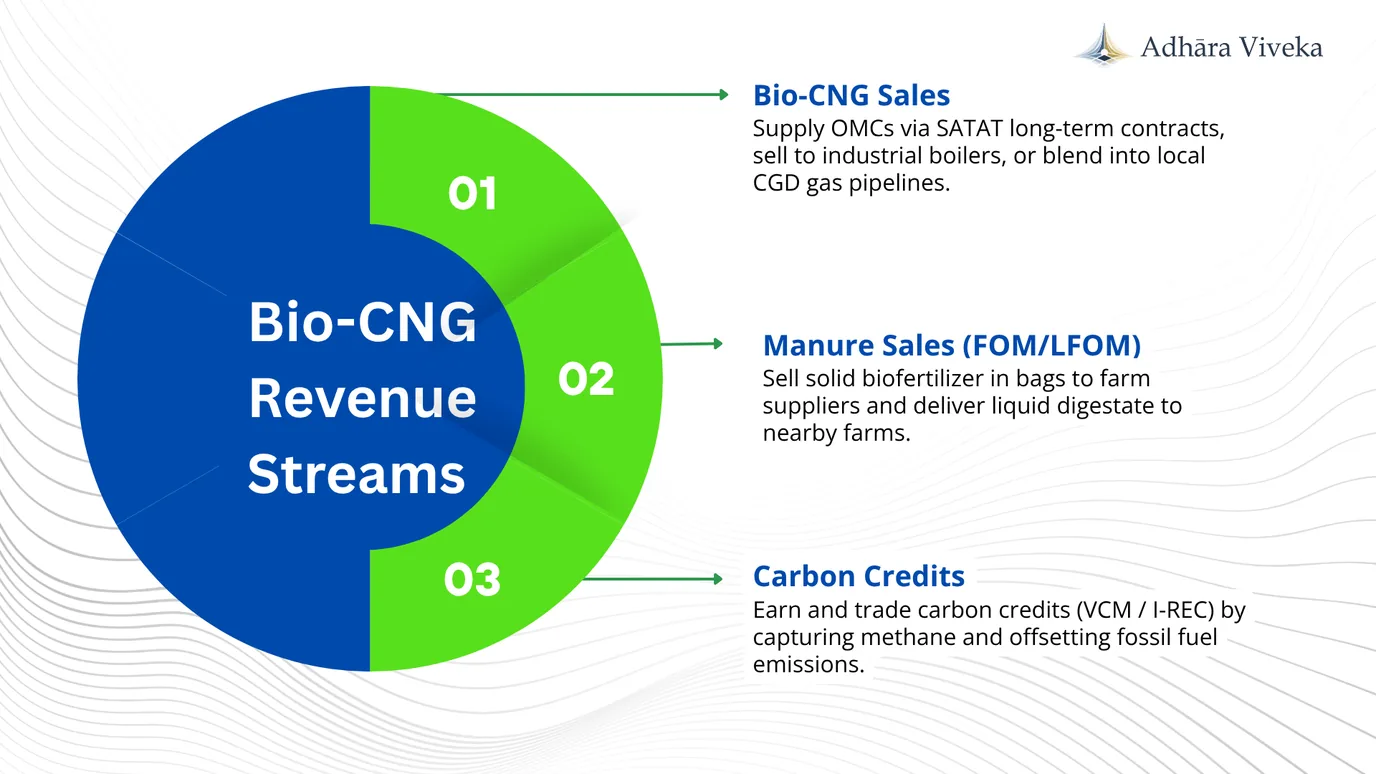
A BioCNG plant earns money from four main sources: the gas you produce, solid and liquid biofertilisers, government subsidies, and carbon creditsCarbon CreditsTradable certificates representing emissions reductions or avoidance, often earned through waste-to-energy projects..
BioCNG Revenue Streams
1. Compressed Biogas (CBG / BioCNG) Sales: You can sell BioCNG directly to Oil Marketing Companies (IOCL, BPCL, HPCL, GAIL) under a SATAT OMC Offtake Agreement at the set procurement price. You can also supply local factories, commercial kitchens, or industrial boilers using mobile cascades at market natural gas rates. If you sign with a City Gas Distribution (CGD) network to blend CBG into CNG or PNG lines, you get a long-term, stable buyer.[5]
2. Fermented Organic Manure (FOM) Sales: You can pack and sell solid biofertiliser in bags to local farm suppliers, tea estates, or nurseries, as long as you meet Fertilizer Control Order (FCO) rules. You can also sell liquid digestate (LFOM), which is high in nutrients, to nearby farmers for irrigation.
3. Central Subsidy Support: You get a subsidy of ₹1,500 per metric ton for every ton of FOM or LFOM you sell to certified fertiliser companies. This is paid under the GOBARdhan and Market Development Assistance (MDA) schemes.
4. Carbon Credits and Green Certificates: When you capture methane and use it to replace fossil fuels, your plant earns carbon credits. You can sell these credits on international markets such as VCM or I-REC to companies that need to offset their emissions. This gives you an extra source of income.
BioCNG Plant Financial Metrics
You should judge your BioCNG plant on four main financial measures. These show how profitable the plant is and how long it takes to recover your investment.
1. Revenue Drivers (Daily Cash Generation) – BioCNG sales make up 65% to 75% of your daily cash inflow. Selling digestate lets you earn from all the waste you process.
- You can sell BioCNG at ₹45 to ₹90 per kg, depending on whether you supply OMCs or local industry. Organic manures sell for ₹2.0 to ₹3.5 per kg, plus an extra ₹1.50 per kg from the GOBARdhan MDA subsidy.
2. Operating Margin (EBITDAEBITDA MarginOperating profit margin calculated before interest, taxes, depreciation, and amortization charges.) – Your net profit margin is 30% to 40% after daily running costs. Most of your expenses, about 60% to 70% of revenue, go to feedstock transport and electricity for compressors.
- If you increase production, fixed costs such as staff and land leases do not rise. This can push your profit margin closer to 40%.
3. Payback Period – You can recover your initial capital in 4.0 to 5.5 years. If you source feedstock within 15 km and claim all fertiliser subsidies, you can shorten this payback period.
4. Return on InvestmentReturn on InvestmentA percentage-based measure of profit or loss relative to the amount invested. (ROI and Equity IRR) – Annual return on investment is 18% to 24%, with an equity internal rate of return of 16% to 22%. Government gas offtake guarantees and priority sector lending make your revenue less exposed to market downturns than standard manufacturing.
10. Risks and Challenges in BioCNG Business
Compressed Biogas (BioCNG) plants have policy support, but you will still face operational, regulatory, and financial risks. If you do not manage these, your project can lose money or face long shutdowns.
Feedstock Shortage and Price Volatility
Feedstock supply is seasonal. When harvests end, you may not get enough raw material, and prices can spike without warning.
- You can reduce this risk by signing 5 to 10-year supply contracts with sugar mills or local aggregators. Set up your plant to process more than one feedstock, so you can switch between pressmud, dung, and straw as needed.[22]
Digester Acidosis ("Tank Souring")
If you change waste types suddenly or overfeed the digester, acid levels can rise too fast. This kills the methane-producing bacteria and stops gas production.
- Keep the Carbon-to-Nitrogen ratio between 20:1 and 30:1 by mixing different wastes. Check pH every day. Keep fast-acting chemical buffers like lime or caustic soda on site to correct problems quickly.
High Moisture Content and Low Gas Yields
If you buy wet feedstock like pressmud or mandi waste, you pay for water, not just solids. This lowers your gas yield per tonne.
- Pay for feedstock based on dry matter percentageDry Matter (DM)The solid portion of a material remaining after all water has been removed; used to measure the concentration of solids in digestate and other organic materials. (Total Solids), not wet weight. Blend wet waste with dry residues like paddy straw to improve gas yield.
Heavy Power Dependence and High OPEX
Gas compressors and mixers need power all the time. This increases your operating costs and can cause downtime if the power fails.
- Install rooftop solar PV to cover up to 30% of your daytime power needs. Recycle engine heat where possible. Keep automatic diesel generators ready as backup.
11. Is BioCNG Plant Business Worth Starting?
With India’s massive biomass waste generation and rising fossil fuel prices, BioCNG offers strong environmental benefits and solid financial returns from these wastes. Setting up a BioCNG plant in India is a highly viable and commercially attractive investment, offering a dual-income, circular business model. Your primary revenue comes from selling purified biomethane directly to government Oil Marketing Companies (IOCL, BPCL, HPCL) under long-term offtake guarantees, while a second continuous revenue stream comes from selling fermented organic fertilizer backed by government subsidies.
To achieve an operational profit margin of 30% to 40%, you need a steady, local supply of low-cost feedstock within a 15 km radius and active policy support from the GOBARdhan initiative and Priority Sector Lending. The market is strong because government blending mandates require BioCNG in all Compressed Natural Gas (CNG) and Piped Natural Gas (PNG) marketing entities. Running a profitable commercial BioCNG plant requires careful management of seasonal raw material collection, site approvals, gas transport logistics, and overall risk management. A well-designed BioCNG facility delivers full capital payback in under 5 years and a steady 18% to 24% annual return on investment, making it one of India's most sustainable, future-proof green energy ventures today.
12. BioCNG Market Size and Industry Outlook in India (2026)
India's BioCNG sector is growing fast, mainly because there is a large supply of agricultural waste and a strong demand for cleaner energy. The market is currently worth about USD 0.42 billion. Projections put it at USD 2.41 billion by 2032, which would mean a compound annual growth rateCAGRCompound Annual Growth Rate — measures the average annual growth rate of an investment or market over a specified period. of 33.56%.[23]
Industry Drivers and Future Growth Vectors
- Mandatory CBG Blending Obligation (CBO): The Ministry of Petroleum and Natural Gas (MoPNG) has mandated a 3% CBG blending requirement into City Gas Distribution (CGD) networks for FY 2026–27, scaling up to 5% by FY 2028–29. This creates an assured, statutory off-take market for plant operators.[24]
- Revised Off-Take Pricing: The government now sets the off-take price for BioCNG at 85% of the average retail CNG price. At current rates, this is about ₹77.4 per kg as a base price. This change makes it easier for projects to get financing and improves expected returns, but you should check the latest price before you rely on it.
- Dominant Application: Vehicle fuel accounts for 62% of BioCNG demand. Most of this comes from commercial transport fleets and municipal buses, which are switching to BioCNG as an alternative to conventional fuels.
Operational Landscape of BioCNG in India
- India currently operates approximately 180 to 200 large-scale commercial BioCNG/CBG plants.
- Over 250 plants are under active construction, with another 780+ registered projects in pre-construction phases on the government’s GOBARdhan portal.
- Over 350 dedicated BioCNG retail dispensing outlets and City Gas Distribution (CGD) injection stations are currently operating nationwide.
- Uttar Pradesh has the largest number of operational and planned BioCNG plants. Most of these use pressmud and distillery spent wash as feedstock. Punjab and Haryana lead in processing large volumes of agricultural residue.
Demand vs. Supply Gap
India uses about 55,000 MMSCMMMSCMA unit equal to one million standard cubic meters of gas, measured at 15°C and 1 atmosphere pressure. of natural gas each year but produces only 29,000 MMSCM domestically. This means more than 46% of demand is met by importing LNGLNGNatural gas converted to liquid state for efficient storage and transport, serving as a competing fossil fuel benchmark in renewable energy markets., which is costly. The estimated BioCNG production potential is 62 million metric tonnes per year, but current supply meets less than 2% of this. This gap means there is likely to be strong demand for new BioCNG projects. The sector is expected to attract over ₹5,000 crore in investment in 2026-27, with government incentives playing a key role.[25]
13. BioCNG Rules and Policy Drivers
Government rules and subsidies decide whether your BioCNG plant can find steady buyers and keep costs down. You need to understand these policies before you start.
- CBG-CGD Synchronisation SchemeCBG-CGD Synchronisation SchemeFramework that allows Compressed Biogas to be injected into the natural gas pipeline network for wider distribution. – City Gas Distribution companies are required to buy and blend a set minimum of compressed biogas (CBG) into their supply. If you can produce CBG, this rule gives you a reliable buyer.[27]
- SATAT Scheme (Off-Take Security) – You can sign a ten-year offtake agreement with government oil companies like IOCL, BPCL, HPCL, or GAIL. This locks in a buyer for your gas for a full decade.[26]
- Market Development Assistance (MDA) – If you sell your plant's organic fertiliser (FOM or LFOM) through certified companies, you can claim a central subsidy of ₹1,500 for every metric ton you sell.
- Central Financial Assistance (CFA / MNRE) – You can apply for an upfront capital subsidy under the Waste-to-Energy programme. The grant is between ₹4 crore and ₹10 crore per plant, based on your production capacity.
- Priority Sector Lending (PSL) – Banks must treat BioCNG project loans as Priority Sector Lending. You can borrow up to 70 to 80 percent of your project cost at concessional interest rates.
- Biomass Aggregation Machinery (BAM) Scheme – You can claim financial support for machinery to collect, bale, and store agricultural residue. The scheme pays 50 percent of the capital cost, up to ₹90 lakhs per set and ₹9 crore per project.
- Development of Pipeline Infrastructure (DPI) Scheme – You can get a subsidy to build pipelines from your BioCNG plant to City Gas Distribution networks. The scheme pays 50 percent of the cost for steel or MDPEMDPEA thermoplastic polymer intermediate between LDPE and HDPE, used in gas distribution, packaging, and recyclable applications. pipelines, up to ₹50 lakhs per kilometre for steel, with a maximum of ₹28.75 crore per project for up to 75 kilometres.
BioCNG plant: FAQs
How do I secure a reliable, long-term feedstock supply without price spikes?
Secure supply contracts for at least five years with sugar mills, farm cooperatives, or food processing units. Fix the price increases in advance to avoid sudden spikes. Build your digester to handle more than one type of feedstock. This lets you switch between pressmud, cattle dung, and crop residues as the local supply and prices change through the year.
Is a pipeline injection connection required, or can I sell via cascades?
You do not need a pipeline connection to start selling. Most new plants use high-pressure mobile cascades instead. These are portable gas cylinders you can deliver by truck. Cascades let you supply gas to local factories, hotels, and City Gas Distribution (CGD) stations within about 20 to 50 kilometres.
What critical approvals are needed before starting site construction?
You need four main approvals before you start building. Get a Consent to Establish (CTE) from your State Pollution Control Board. Apply for PESO clearance if you plan to store compressed gas. Secure groundwater permission from the Central Ground Water Authority (CGWA). Check if you need land conversion approval from the District Collectorate. Apply early through the government’s single-window portal to avoid delays.
How long does it actually take to get capital subsidies like CFA or MDA?
You can apply for Central Financial Assistance (CFA) at the start, but the money is paid out in parts after your plant is built and checked. Market Development Assistance (MDA) for fertiliser is paid regularly, but only after you partner with a certified fertiliser marketing company and record your sales on the government portal.
How do I manage low gas output caused by winter temperature drops?
Methane production drops in winter because the bacteria in the digester slow down below 35 to 38°C. You can keep output steady by installing heating loops inside the digester. Use waste heat from your engine or simple solar water heaters to keep the temperature stable.
Sahil Sanwal founded MyWasteSolution, the marketplace where India’s recyclers, waste companies and plant-setup consultants find each other. He writes about what it actually takes to build and run a recycling business here — the costs, the approvals and the economics operators deal with rather than the version in a brochure.
References
- Petersson, A. and Wellinger, A. Biogas upgrading technologies – developments and innovations. IEA Bioenergy Task 37 https://task37.ieabioenergy.com/wp-content/uploads/sites/32/2022/02/upgrading_rz_low_final.pdf
- Biomethane production by anaerobic digestion of organic waste. ResearchGate https://www.researchgate.net/publication/275168720_Biomethane_production_by_anaerobic_digestion_of_organic_waste
- Oreggioni, G.D. et al. Techno-economic analysis of bio-methane production from agriculture and food industry waste. Energy Procedia https://doi.org/10.1016/j.egypro.2017.07.252
- Scholz, M. et al. Techno-economic Analysis of Hybrid Processes for Biogas Upgrading. Industrial and Engineering Chemistry Research https://doi.org/10.1021/ie402660s
- Patel, et al. Cost benefit and environmental impact assessment of compressed biogas (CBG) production from industrial, agricultural, and community organic waste from India. Biomass Conversion and Biorefinery https://doi.org/10.1007/s13399-022-02780-y
- Central Pollution Control Board. Sectors classified by CPCB: Pollution Index and category (Compressed Biogas / Bio-CNG plants, entries 67.1 to 67.5) https://cpcb.gov.in/uploads/Sectors_Classified_by_CPCB.pdf
- Online Consent Management and Monitoring System (OCMMS), State Pollution Control Boards https://ocmms.nic.in/OCMMS_NEW/
- Petroleum and Explosives Safety Organisation (PESO) https://peso.gov.in/web/
- GOBARdhan Unified Registration Portal https://gobardhan.sbm.gov.in/
- SATAT (Sustainable Alternative Towards Affordable Transportation) portal https://satat.co.in/satat/
- The Fertiliser Association of India. Fertiliser Control Order https://www.faidelhi.org/info/fertiliser-control-order/
- Bureau of Indian Standards. IS 16087:2016, Biomethane specification https://standards.bis.gov.in/website/standard-details?encryptedId=eyJpdiI6Ild1UXFqblc0VCtUUW1TdXoxZ1pOZkE9PSIsInZhbHVlIjoid1d5dkliRGFENk5tTmdOSENINE1zdz09IiwibWFjIjoiM2Q1ZGYxZDc0YTBjY2Q2ZWJkMWM3N2IyMmY5MjNiMGQ4ZTBlMjNlNDRkYjU2MWQyMTAzMDkzOTllODEyOWU4MiIsInRhZyI6IiJ9
- Appels, L. et al. Principles and potential of the anaerobic digestion of waste-activated sludge. Progress in Energy and Combustion Science https://doi.org/10.1016/j.pecs.2008.06.002
- Abatzoglou, N. and Boivin, S. A review of biogas purification processes. Biofuels, Bioproducts and Biorefining https://doi.org/10.1002/bbb.117
- Carranza-Abaid, A. et al. Analysis and selection of optimal solvent-based technologies for biogas upgrading. Fuel https://doi.org/10.1016/j.fuel.2021.121327
- Central Pollution Control Board (CPCB) https://cpcb.gov.in/
- Petroleum and Natural Gas Regulatory Board (PNGRB) https://pngrb.gov.in/eng-web/
- Central Ground Water Authority (CGWA) https://cgwa.mowr.gov.in/
- Compressed Biogas (Bio-CNG) from Agricultural Waste: Pathways to a Sustainable Circular Bioeconomy. Journal of Advances in Biology and Biotechnology https://doi.org/10.9734/jabb/2026/v29i74144
- Abubakar, A.M. Biodigester and Feedstock Type: Characteristic, Selection, and Global Biogas Production. Journal of Engineering Research and Sciences https://doi.org/10.55708/js0103018
- Ngetuny, J. et al. Optimizing Feedstock Selection for Sustainable Small-Scale Biogas Systems Using the Analytic Hierarchy Process. Energies https://doi.org/10.3390/en18071739
- Central Pollution Control Board. Environmental Guidelines for Compressed Biogas (CBG) / Bio-CNG Plants (hosted by Bihar State Pollution Control Board) https://bspcb.bihar.gov.in/Environmental%20Guideline%20For%20CBG.pdf
- MarkNtel Advisors. India Compressed Biogas (CBG) Market Size and Forecast 2032 https://www.marknteladvisors.com/research-library/compressed-biogas-cbg-market-india.html
- IMARC Engineering. How to Set Up a Compressed Biogas (CBG) Plant in India https://www.imarcengineering.com/blog/how-to-set-up-a-compressed-biogas-plant-in-india
- Business Standard. Biogas sector expected to see ₹5,000 cr investment in 2026-27: IBA https://www.business-standard.com/industry/news/biogas-sector-expected-to-see-5-000-cr-investment-in-2026-27-iba-125122100184_1.html
- Indian Oil Corporation. SATAT overview https://iocl.com/pages/satat-overview
- Petroleum and Natural Gas Regulatory Board. Compressed Biogas Integration in India's Gas Economy: Progress and Prospects https://pngrb.gov.in/pdf/CBG/20250826_CBG.pdf