
before you fund it.
- Overview sessions — get a deep understanding of how the business works
- Reports — detailed research and analysis on market, regulations, technical and financial aspects
- Location analysis — find the right location for your plant with deep data analysis across 4,000+ industrial areas
- RFQ tool — compare vendor quotes, find the missing points, and filter the right one for you
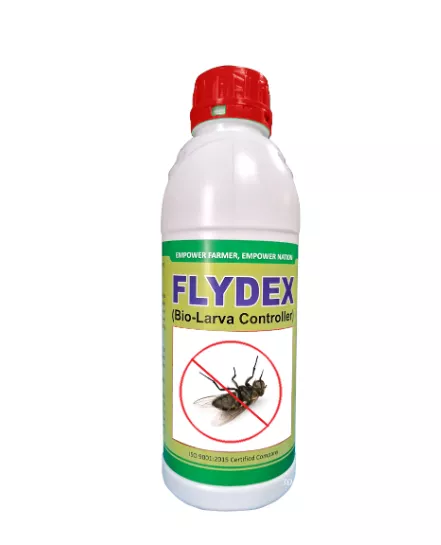
FLYDEX
KK AgrotechBio-Larva Controller
Introduction
One of the largest management problems facing the poultry producer is filth fly control. The shift from many small farm flocks to fewer large poultry operations has greatly increased fly problems by creating concentrated breeding areas and large volumes of manure that cannot be removed frequently. As urbanization and rural non-farm residence increase, poultry producers face increasing pressures to reduce fly population. Manure-breeding flies may cause a public health nuisance, resulting in poor community relations and threats of litigation. A dedicated effort is necessary to achieve an acceptable level of fly control.
Flies pose a health risk for humans and poultry. They are carriers of Salmonella, Pasteurella, Campylobacter and E. Coli which have a negative effect on poultry flocks and farm personnel. The speed of fly reproduction can vary depending on environmental conditions such as warmth, moisture and food sources.
Several kinds of flies are found in and around caged layer/breeder houses in India. The house fly and the little house fly are the most common flies found in poultry farms, sometimes blow flies also live along with them. It’s eco-friendly product.
Fly Life Cycle
a) Four days after emerging from pupal stage, adult females mate and begin to lay eggs, in five to six lots of 100 to 150 eggs. Each female fly can layup to 700 eggs in its lifetime.
b) Female flies congregate and deposit their eggs on warm, moist organic matter which is suitable for the development of larvae. Animal and poultry manure is the best breeding medium for flies. The eggs are white in colour and are about 1.2 mm in length.
c) Eggs hatch into pale-whitish, cylindrical and anteriorly tapering larvae (maggot) in 12 to 24 hours. Maggots pass through three growth stages to complete their development in 4 to 7 days.
d) Mature larvae form a dark reddish-brown puparium from the larval skin and then pupate. The adult fly emerges after a pupation stage of 3 to 4 days.
Poultry Fly Larvae Control
Contains : Entomopathogenic fungi & Bacillus Thuringiensis spp.
CFU count : 2 x 10⁸ CFU/ml (when packed)
Method of Application : FLYDEX is applied as 1 litre per 200 litres of water (@5 to 10 ml / Ltr.) & spread on the litter droppings. The FLYDEX added to the tank in the pressure washing machine & spread on the soil floor. Litter droppings of the birds.
Application : 10 ml / ltr of water once in day continue for 3 days.
After 2 days interval apply 7 ml / ltr of water once in day continue for 2 days.
After every 5 days interval apply 10 ml / ltr of water.
Application Time : Every evening, take direct foliar spry on shit and seating places of flies.
FLYDEX provided long-term control of the larvae, lasting over to production cycle or 15 days.
FLYDEX is spread directly on the accumulated manure. Adult house flies as they emerge from there pupal cases come in the contact with spores of three entomopathogenic fungi present in the FLYDEX, pores released from conidia developed hyphae which penetrate in the body cavity of the flies resulting in death. These three fungi has no detrimental effect on beneficial insects.
FLYDEX significantly reduces the house fly larval densities & adult house fly emergence. It is also control northern fowl mite, chicken mite (roost mite, red chicken mite), biting lice, scaly-mite, depluming mite, fowl tick or bluebug, sticktight or southern chicken flea, bed bug, chigger, turkey gnat (black fly), darkling beetle or lessr mealworm etc.